No Smoke Without Ire: China’s Campuses Struggle to Stub Out Cigarettes
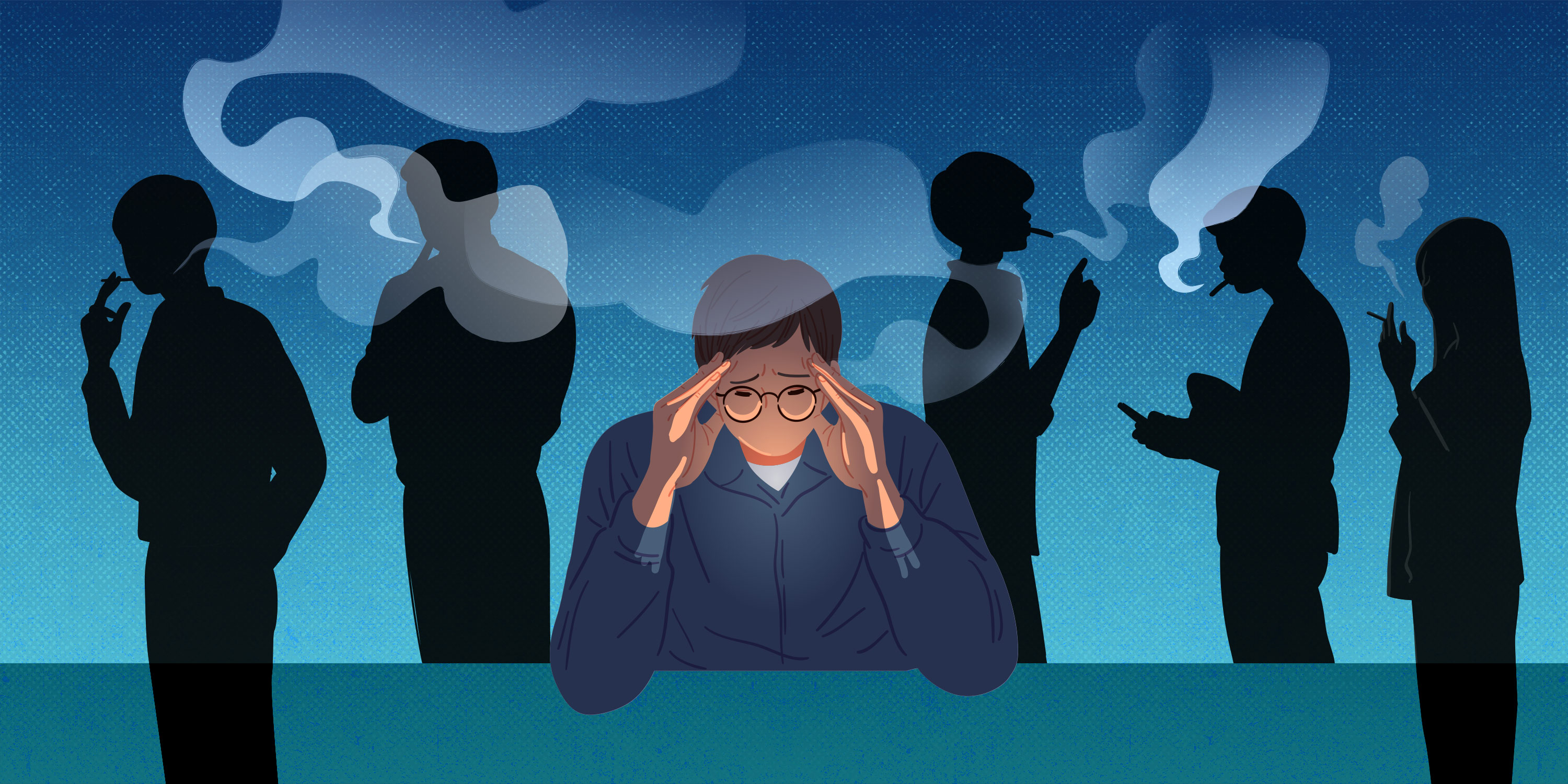
On his first day of graduate school in 2023, Shang Menghao was struck by how many people on campus had cigarettes dangling from their lips. They were smoking in elevators, stairwells, restrooms, and even the showers.
For Shang, who experiences acute physical reactions to secondhand smoke, including breathing difficulty, dizziness, and diarrhea, it was a nightmare.
And things got worse when the 30-year-old began complaining about it — after initially being ignored, he became the target of vicious bullying from fellow students at his Beijing arts academy. He has even clashed with professors and school administrators, potentially affecting future career opportunities.
Shang is not alone. A 2025 survey of university students by the Chinese Center for Disease Control and Prevention found that while just over 7% are smokers, 31% said they are regularly exposed to secondhand smoke in their dormitory.
Despite central government efforts to tackle smoking in shared spaces since 2010, nonsmokers on campuses across China say they continue to hit a brick wall when they call out colleges and universities for gaps in their smoking policies, resulting in conflicts sometimes verging on the criminal.
Burning question
Yang Zeyu, a junior at a university in the central Hunan province, roomed with smokers in his freshman and sophomore years. Both times the roommate was relatively considerate, agreeing to light up only on the outdoor balcony — yet the floor was always covered in cigarette butts and ash, while the smell of smoke still permeated the room and clung to any laundry left out to dry.
“There’s little we can do other than compromise,” Yang says. “We each have to give a little. We can’t have a completely smoke-free room, and my roommate can’t smoke as freely as he wants.”
Finding a balance is a common strategy, while the main alternative appears to be suffering in silence. A survey of students at Shanghai International Studies University in November found that 53% simply choose to “put up with” secondhand smoke. About 30% said they would report the problem to administrators, and just 6% would directly ask a smoker to stub out their cigarette.
Shang is among the minority who does confront classmates about smoking, but “it never worked,” he says, adding that he’s often told in response to “fit in” or “learn the rules of society.”
He recalls a professor once lit up while discussing a thesis proposal in his office — Shang instantly developed a pounding headache, his face flushed red, and he became dazed and confused. He just wanted to leave but felt that would look disrespectful.
He endured the meeting for more than an hour. Afterward, he stepped outside and lingered in the cold for another two hours, hoping to clear his head. Ibuprofen helped with the headache, but his throat remained sore for days.
Conflicts over smoking have even led to tragedy. In 2024, a freshman surnamed Lai at a technical college in Ganzhou, in the eastern Jiangxi province, reportedly drowned himself in a river after a school counselor denied his request to switch to a new dormitory because his roommates smoked and played video games all night.
A court ruled that the college had mishandled both smoking in dorms and Lai’s request to move rooms, and deemed it partially liable for his death. The school was ordered to pay his family 302,946 yuan ($44,920) in compensation.
Lighting the fuse
The Chinese central government introduced the Reference Standards for Smoke-Free Schools in 2010, recommending that campuses place prominent no-smoking signs in key areas and create designated smoking areas in secluded, well-ventilated, outdoor locations. Although not mandatory, the legislation presented tobacco control as a shared responsibility and urged faculty, staff, and students to remind smokers of the rules when they witness violations.
Four years later, the Ministry of Education followed up with a national policy on smoking on campus, instructing universities to impose strict restrictions and ban smoking inside every building. Outdoor smoking areas had to be placed away from gathering places and commonly used walkways, and clearly marked with warnings such as “Smoking is harmful to your health.”
However, Zheng Pinpin, a professor at Fudan University’s School of Public Health, believes that many Chinese universities still lack clear smoke-free policies, making enforcement often a game of cat and mouse. “A school may have a policy but fail to publicize or enforce it, or it may simply not have one at all,” she says.
Zhang Qiang, a student counselor at a vocational college in the eastern Zhejiang province, saw his school steadily retreat from allowing only a few designated smoking areas to letting smokers light up anywhere outdoors. In the winter, many students can still be found smoking inside buildings, with the restroom floors often littered with cigarette butts, he adds.
After trying — and failing — to stop people around him from smoking, Shang began carrying a gas mask everywhere he went, putting it on as soon as someone lit up. He also now wears a protective suit when returning to his dorm after a shower. “If I’m unlucky and run into a lot of smokers, the smoke gets into my clothes, my hair, my skin — and then the shower was for nothing,” he says.
At the arts academy, people sometimes assume the outfit is a performance art piece, even soliciting the occasional “That’s cool!” from passersby. For Shang, it’s his armor against a world of smokers.
Yet the suit does little to protect him from the abuse he receives. After Shang highlighted the issue of smoking on campus, resentful students began blowing smoke in his face, following him and hurling insults, and leaving piles of cigarette butts outside his room.
When he approached the academy’s security office for help, the staff told him to record smokers on his phone as evidence. This only made matters worse, as others then began filming Shang — including one time when he was using the restroom.
Last year, Shang began reporting his concerns to Beijing’s fire safety and health authorities — so far, he’s made 120 complaints, usually with video evidence. In response, he says, health officials will visit the campus to review the surveillance footage and inspect the reported areas, with any students caught smoking in a smoke-free zone facing a 50-yuan fine.
Shang says that it’s not just students who are breaking the rules: the smell of tobacco often drifts from faculty offices, which are also no-smoking zones. Some professors have attempted to justify secondhand smoke, telling him that cigarettes are part of the creative process, that many artists and filmmakers smoke while working, and that conditions are worse on a production set. One suggested that Shang solve the problem by moving off campus.
His complaints have also resulted in a physical altercation with a staff member from a university office, while his advisor declined to write him a recommendation letter for doctoral programs at Chinese universities because Shang “would only run into smokers there, too.”
Yet Shang’s efforts have brought some improvement. The academy has recently introduced tobacco-control regulations and organized awareness campaigns, resulting in more students smoking outside instead of on their dormitory balcony.
No ifs, no butts
In addition to combating secondhand smoke, Shang has also tried to understand the smokers he’s come up against.
He later spoke with the classmate who had filmed him in the restroom, discovering that he was from Lanzhou, capital of the northwestern Gansu province, where smoking on city buses had been commonplace.
Others argued that offering cigarettes and smoking with someone is a way of showing respect, especially to older generations, and a routine part of life in many parts of China.
On campus, smoking is sometimes seen as edgy or an act of rebellion. When Shang moved into his dorm, he noticed that someone had burned a hole through a no-smoking sign with a cigarette.
School counselor Zhang believes smoking serves two main purposes for young people: entertainment and a way to fit in. This is echoed by research from the Chinese Center for Disease Control and Prevention that shows the top three reasons university students take up the habit are stress relief, curiosity, and social connection.
Wang Feifei, an undergraduate student in the northeastern Jilin province who has been smoking for five years, said that academic pressure and struggles with mental health had made it difficult to quit the habit. She understands that some classmates hate the smell, so she slips away to secluded corners outdoors to smoke, waiting for the wind to carry the odor away before returning to her dorm.
If anyone walks past, she immediately stubs out the cigarette. “I feel like I’m sneaking around as if I’ve done something wrong,” she says.
Her university has banned smoking, yet public restrooms often reek of tobacco, and many students light up on their way to and from the dorms. “If you can’t realistically stop everyone from smoking, why not set up ventilated smoking areas on campus like at airports?” she asks.
Ultimately, policies designed to shield people from secondhand smoke will work only if there are clear channels for feedback and reporting, and a specific office is made accountable, according to Zheng from Fudan.
“On one side, you have policy, law, and institutions, and on the other, you have environmental cues that shape social norms and campus culture,” she says, citing the example that public spitting was once commonplace but now frowned upon. “A lot of habits and social attitudes simply shift as society evolves.”
However, until consensus takes hold, friction over smoking will likely persist.
Yu Ying, a university student in Shanghai, takes an exceptionally firm stance against smoking in public and secondhand smoke, arguing that it is “a form of bullying.” She quotes China’s Civil Code as stipulating that no organization or individual may infringe upon another person’s right to health.
When she first started university, she thought she would learn to tolerate smoking. But over time, she began looking for ways to push back, taking on classmates and school administrators.
“I know I’ve offended a lot of people,” Yu says. Her efforts have led to students no longer being able to smoke outside teaching buildings or in restrooms, and she can feel their resentment. Still, she is resolute. She isn’t against cigarettes, but rather smokers forcing others to risk their health by inhaling secondhand smoke.
Yang in Hunan has recently made two friends who smoke. The first time they lit up around him, they paused to ask whether the smell bothered him. When he said that it did, they immediately put out their cigarettes and have not smoked around him since. That small gesture was a stark contrast to his roommates, who had never seemed to consider other people.
Three years into his master’s program, Shang has grown disillusioned and isolated. He says long-term exposure to secondhand smoke has caused lasting damage to his respiratory system, resulting in roughly 100 trips to the hospital for examinations — pulmonology, allergy, ENT, ophthalmology, and gastroenterology.
“It’s not about tobacco control anymore,” Shang says, holding onto his gas mask. “At this point, it’s purely self-preservation.”
(Due to privacy concerns, all names except Zheng Pinpin are pseudonyms.)
Reported by Chen Lei and Wang Shengming.
A version of this article originally appeared in The Paper. It has been translated and edited for brevity and clarity, and is republished here with permission.
Translator: Chen Yue; editors: Wang Juyi and Hao Qibao.
(Header image: Visuals from Imazins/VCG, reedited by Sixth Tone)