The Forgotten Legacy of China’s Greatest Explorer
During the opening decades of the 15th century, a eunuch from China’s imperial court led seven epic voyages across Southeast Asia and the Indian Ocean, pushing westward as far as the Red Sea and the shores of East Africa.
The expeditions were astonishing feats of engineering and navigation. Setting sail decades before Christopher Columbus or Vasco da Gama, Zheng spent years crossing the oceans at the head of a vast fleet of 200 ships. Some of the vessels measured up to 70 meters long — three times the size of Columbus’ ships.
For many, Zheng deserves to rank among history’s greatest explorers. Yet, much about the voyages — and Zheng himself — remains shrouded in mystery. He barely features in the official records left by China’s Ming dynasty (1368–1644), with court historians dismissing his expeditions as impressive, but ruinously expensive. Even the place and date of Zheng’s death are unknown.
The Ming court’s assessment still colors views of Zheng centuries later. Today, the great admiral is well known in China, with generations of schoolchildren learning about his amazing treasure ships that brought giraffes, lions, zebras, and other exotic beasts back from Africa. But the voyages tend to be presented as a historical curiosity that had little lasting impact.
Zou Zhenhuan is on a mission to change that. The 69-year-old — now a distinguished professor at Shanghai’s Fudan University — has spent decades studying Zheng He, and his research has played a significant role in shifting perceptions of the explorer and his legacy. His latest book, “Monsoon Asia and Africa: Cultural Exchange and Zheng He’s Voyages,” is his most comprehensive look at the subject yet.
For Zou, Zheng’s voyages were far more influential than often assumed. Far from a flash in the pan, they opened up a new era of maritime trade between Asia and Africa, as merchants took advantage of the navigational technologies and sea routes pioneered by Zheng. He even believes they helped pave the way for the European Age of Discovery that followed.
In this interview, Zou, who is also a research fellow at the Shanghai Research Institute of Culture and History, explains why Zheng He is often so misunderstood — and why his voyages should be seen as a harbinger of globalization. The text has been edited for brevity and clarity.
Sixth Tone: You have studied Zheng He for more than 20 years. What drew you to this subject in the beginning?
Zou: My interest in Zheng He began in my boyhood. What captivated me most was his extraordinary perseverance — seven voyages spanning more than two decades. Such marvelous experiences are enough to stir the imagination. As the Portuguese poet Luís de Camões wrote in “Os Lusíadas,” the true and marvelous deeds of brave men surpass all fantasy and legend. I was a sickly boy, but I harbored an intense hero complex, and Zheng He’s exploits answered it perfectly.
It was this interest that led me to study Zheng He once I became a historian, and it is this same interest that has sustained my research for so many years.
Sixth Tone: After all these years of research, what kind of person is Zheng He in your mind?
Zou: As my research has deepened, the image of Zheng He in my mind has grown ever richer. Take his religious faith, for example. Many people might assume Zheng He was simply a Muslim. He was indeed born into a Muslim family; his grandfather and father both made the hajj to Mecca. But he was also a devout Buddhist who was accepted as a disciple by an eminent monk, receiving the Dharma name “Fushan,” and supervising the construction of the Great Bao’en Temple in Nanjing. At the same time, Zheng He was also an adherent of Confucianism. Historical records describe him as “endowed with the talent to govern and versed in the teachings of Confucius and Mencius.”
The most famous material testimony to Zheng He’s plural faith is the trilingual stele he erected in the kingdom of Ceylon (present-day Sri Lanka) during his second voyage in 1409. The stele, commonly known as the Galle Trilingual Inscription, is carved in three scripts: the Chinese text praises the Buddha and records a list of offerings; the Tamil text glorifies the Hindu god Shiva; and the Persian text extols Allah. Paying tribute to the deities of three great religions on a single stone tablet is, in my view, the most vivid expression of Zheng He’s cosmopolitan, all-embracing spirit.
Sixth Tone: It seems “plurality” is a keyword when it comes to Zheng He.
Zou: Exactly. Zheng He was a man of all-around talent. To begin with, he possessed exceptional organizational and managerial abilities — commanding a fleet of more than 27,000 men was in itself an enormously complex feat of systems engineering.
He also had the metaphysical learning of a Confucian scholar and was equally adept at practical, technical matters: during the voyages he spread the Chinese calendar, rituals, weights and measures, and architectural techniques to other countries, and with superb diplomatic skill he mediated disputes between Siam and Malacca, and between Annam and Champa.
Plus, he even displayed outstanding military talent: on his very first voyage he defeated Chen Zuyi, a pirate chief who commanded tens of thousands of followers in the Strait of Malacca, wiping out more than 5,000 pirates.
Sixth Tone: When I was reading your book, what impressed me most was Zheng He’s nautical technology — especially his precise understanding and ingenious use of the Indian Ocean monsoons.
Zou: That’s right. The fleet’s seven expeditions were deeply embedded in the monsoon, which is the main reason I titled the book “Monsoon Asia and Africa.”
The regions the fleet traversed — East Asia, Southeast Asia, and the Indian Ocean — are among the areas of the world where the monsoon phenomenon is most pronounced. And in an era without modern propulsion, the monsoon was the “engine” that drove this enormous armada on its long voyages.
The fleet usually departed China in winter, between October and March, riding the northeast monsoon southward. By the time it reached the Indian Ocean, the summer southwest monsoon would be blowing, allowing a smooth voyage home. The whole round trip took about a year and a half.
To visit more places efficiently, Zheng He would dispatch detached squadrons along the way; after completing their missions, these squadrons would regroup at designated rendezvous points in accordance with the monsoon patterns.
But here’s the thing: the monsoon and the compass could carry the fleet forward, but they could not tell the crew exactly where they were on the open sea. To do this, the fleet mastered a refined technique known as “guoyang qianxing,” or star-observation navigation, using an instrument called the “qianxing,” or star-measuring, board to determine a ship’s latitude according to stars’ altitude above the horizon. Zheng He’s fleets also compiled these observations into dedicated star charts, creating a reusable navigational database.
One could say that Zheng He’s fleet fused three techniques — the monsoon patterns, star-observation navigation, and the magnetic compass — into a single, world-leading navigational system for its time. I believe these sea routes, nautical technology, and geographical knowledge helped lay the intellectual and technical foundations for the arrival of European explorers more than half a century later. However, this topic needs further research.
Sixth Tone: Since you mention the European explorers who came later, I have to raise a common critique: that unlike the explorers who launched Europe’s Age of Discovery, Zheng He’s expeditions — for all their grandeur — were a mere flash in the pan that left no lasting imprint. How do you see it?
Zou: This view is indeed very common. I would point out that Zheng He’s seven voyages were not merely official acts of diplomacy by the Ming court; they also facilitated exchanges of goods, species, and technologies between Asia and Africa on an unprecedented scale.
The exotic animals the fleet brought back from foreign lands — giraffes, lions, ostriches, zebras — and the rare plants and fruits such as pepper, sappanwood, and durian greatly enriched China’s native stock of species. Wherever it went, the fleet shared nautical and astronomical knowledge with local peoples, deepening mutual learning among the civilizations of Asia and Africa.
The most representative example of all this is blue-and-white porcelain. Zheng He’s fleet carried large quantities of porcelain into the Islamic world, while the cobalt pigment needed to produce blue-and-white ware, known as “Sumali blue,” originally came from Persia. This pattern of “bringing finished products out and importing raw materials in” was itself a cross-cultural dialogue of technology and aesthetics.
As the Ming dynasty’s most sought-after export in overseas markets, blue-and-white porcelain was among the important gifts carried on every mission. Pieces dating from the period of Zheng He’s voyages have been unearthed at Fustat in Egypt, at Aydhab in Sudan, at Aden on the Arabian Peninsula, and elsewhere.
The huge overseas demand, in turn, stimulated a massive increase in early Ming porcelain production: according to historical records, in 1433 alone the court ordered the firing of 443,500 pieces in a single decree.
What does this tell us? It shows that nearly a century before Columbus set sail, Zheng He’s fleet had already opened up the east-west sea routes of the Indian Ocean and built a regional network of trade and cultural exchange. I call this the “Zheng He exchange.”
Sixth Tone: That concept readily brings to mind the “Columbian exchange” — the massive exchange of people, plants, animals, and diseases between the Americas and Afro-Eurasia that opened up after Columbus’ voyages.
Zou: I did indeed borrow the theoretical framework of the “Columbian exchange,” but my concept points to an earlier wave of civilizational interaction — one that unfolded between Asia and Africa. In many respects, Zheng He was a key catalyst on the eve of globalization.
Of course, while the “Zheng He exchange” and the “Columbian exchange” share many similarities, their purposes were fundamentally different. Zheng He’s voyages never established colonies overseas, and they were extremely restrained in their use of force.
As you mentioned, many Chinese people feel rather regretful about this, believing it caused China to miss a golden opportunity to dominate the globe. Liu Cixin’s short science-fiction story “Xiyang” (“The Western Ocean”) expresses exactly this sentiment through an alternate-history framework: in the story, Zheng He’s fleet sails farther west from the East African coast, rounds the Cape of Good Hope, and eventually reaches Europe, defeats the combined Anglo-French forces, and conquers the European continent, turning China into an empire on which the sun never sets.
But in my view, Zheng He radiates the light of pacifism and cultural pluralism — and that is precisely where his example can offer inspiration for our own time.
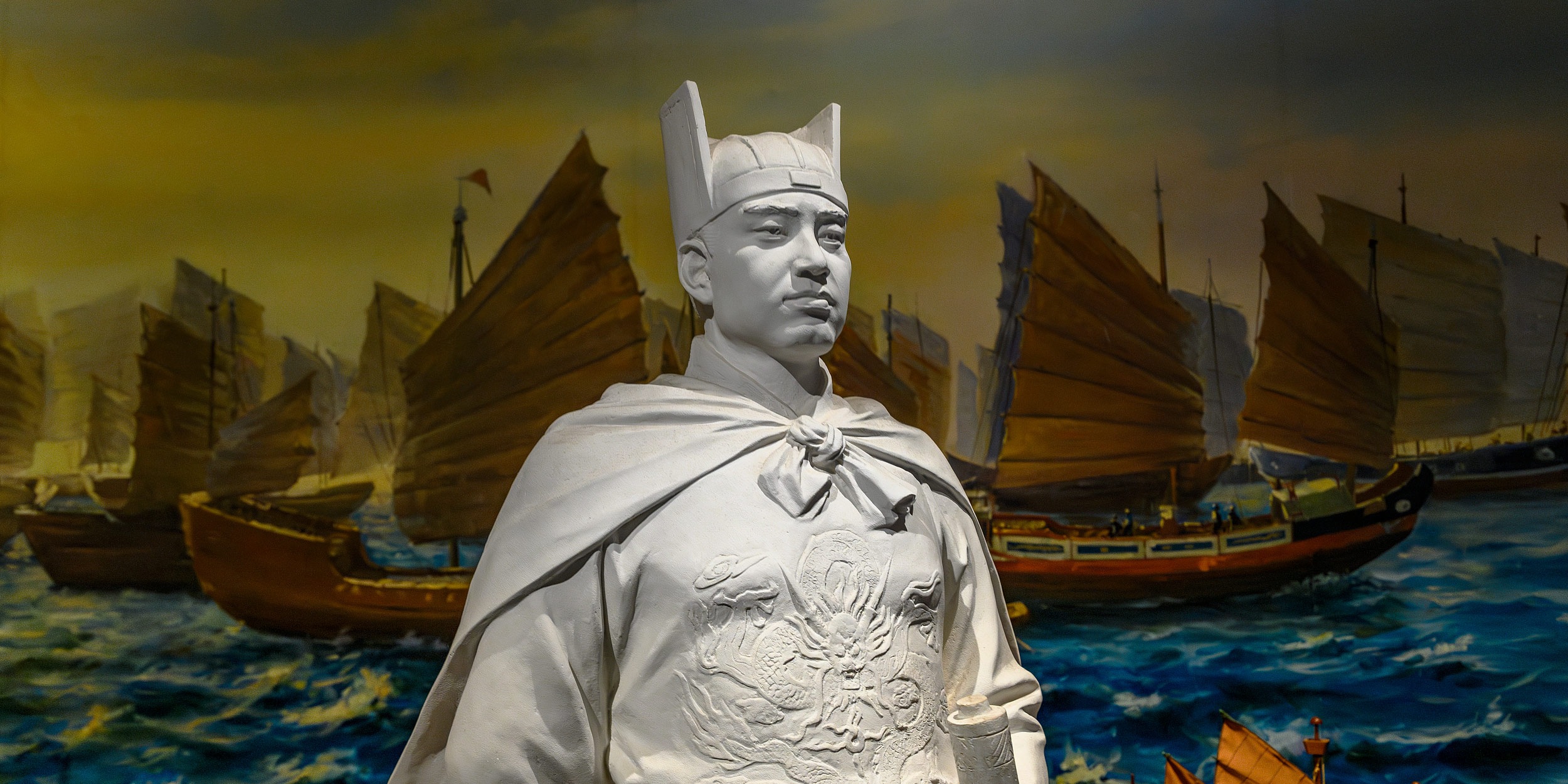
(Header image: A statue of Zheng He in Hangzhou, Zhejiang province, 2024. 500px Essential)