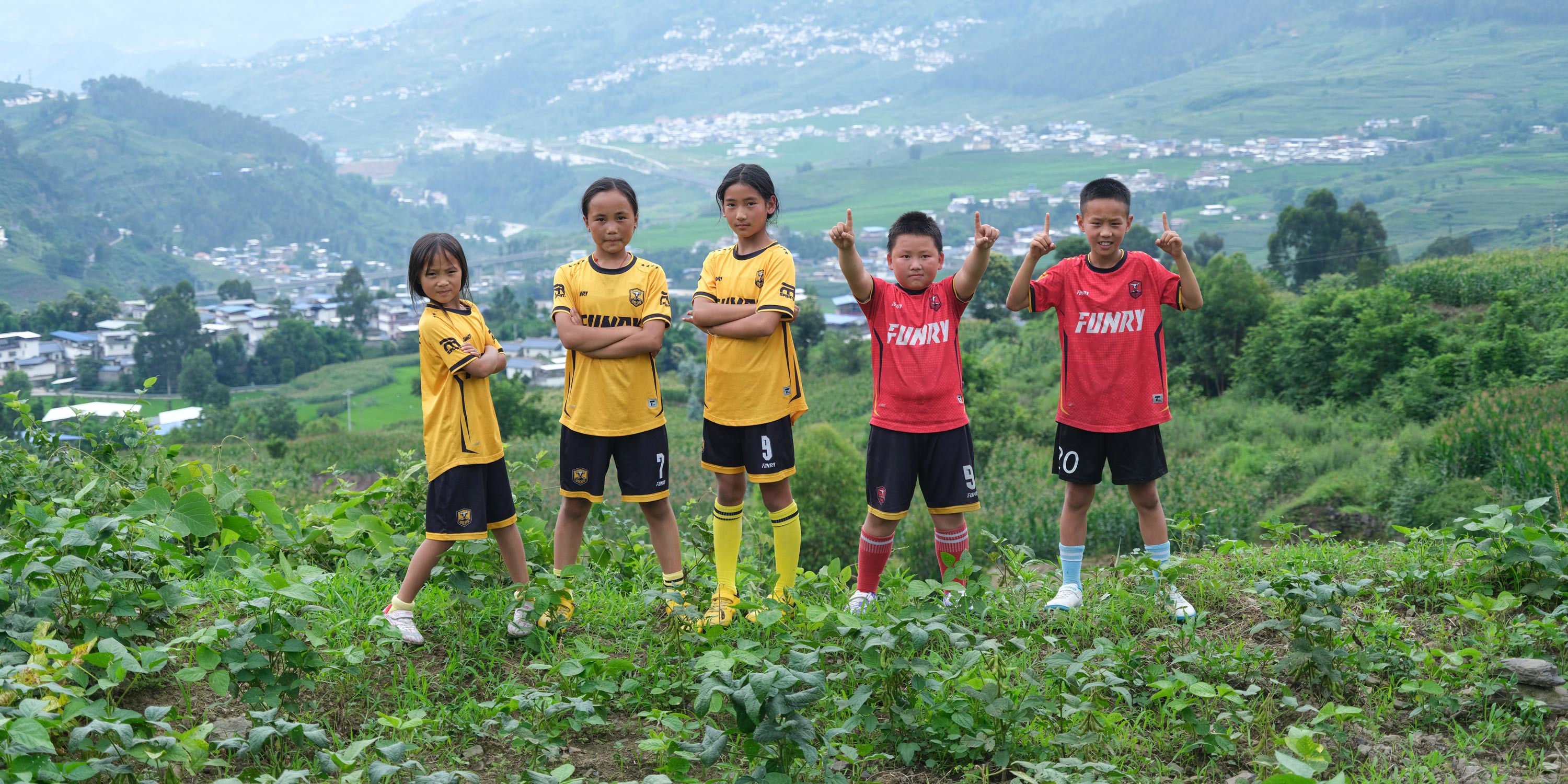
1,300 Meters Up, a Sichuan Soccer Hero Brings the Game Home
On a rain-washed weekend morning, mist clings to the peaks surrounding Ze’e Village in the southwestern Sichuan province. Over the sound of a rushing mountain stream, 24-year-old Jifu Lama leads a procession of children in matching kits. They navigate through rice paddies, along irrigation canals and over earthen mounds until they reach their destination: a soccer pitch carved out of a former cornfield.
Perched halfway up a mountain at an altitude of 1,300 meters, Lama’s pitch looks like a vibrant green terraced field folded into the sweeping landscape of Sichuan’s Daliangshan region. Standing in the center circle, the young coach directs his players — mostly children aged 6 to 13 from six neighboring Yi ethnic villages — to lace up their boots, arrange the cones and begin their warm-ups.
Ze’e Village is remote, accessible only by winding mountain roads, but the children’s imaginations stretch far beyond the peaks. During the buildup to the 2026 World Cup, the young athletes devoured match highlights on smartphones. Winning and losing are secondary to the star players: the children argue passionately over the goals scored by superstars like Cristiano Ronaldo, Kylian Mbappé, Lionel Messi and Harry Kane.
Seven-year-old Aluo, a first-grader with lightning-fast footwork, idolizes France’s Mbappé. His cousin, Yang Xiaojun, a skinny third-grader, became a die-hard Gareth Bale fan after watching a clip of the Welshman’s legendary bicycle kick.
When they score on this mountain pitch, the kids leap into the air, spinning to land in Cristiano Ronaldo’s iconic, arms-down “Siu” celebration.
For these children, soccer is bright spot in childhood marked by economic hardship. Local data shows rural per capita income in Daliangshan is around just 12,700 yuan ($1,770) a year. To make a living, parents migrate to factories in the southern Guangdong province, Wuhan in the central Hubei province, and the northern Inner Mongolia Autonomous Region, returning only once a year for the traditional Yi New Year.
Raised by aging grandparents in households with multiple siblings, these “left-behind” children have few outlets for their energy. A piece of candy or a lucky draw at the school gate used to be the highlight of their week. Now, soccer offers them friendship, structure and a window to the outside world.
To keep them invested, Lama implemented a reward system. Players earn four points for every practice they attend, which they can exchange for free gear. That is how Hu Feifei, one of the girls who recently joined the squad, earned her jersey, socks and boots.
Hu remembers when the pitch was nothing but sand dumped over uneven soil. When it rained, they played in puddles and went home with scraped knees, but they were happy. Today, thanks to a corporate sponsor moved by the team’s story, they play on an artificial turf pitch that Lama proudly claims is “better than the ones in the county town.”
The sponsor discovered them because of Lama, who is no stranger to the spotlight. But his viral fame is a chapter of his life tinged with both pride and heartbreak.
Lama’s obsession began in middle school when a friend gifted him a Neymar Barcelona jersey. The self-described rebellious teen found his anchor in soccer. To play, he transferred to a vocational school with a pitch.
To master the game, he did the unthinkable and dropped out, hiked to an altitude of 2,000 meters, and built a wooden hut on a flat peak. There, with no electricity and relying on a wood fire to cook, he trained alone for days at a time. His goal was to become a professional soccer player within five years.
He documented his solitary, high-altitude drills on short-video platforms. The stark contrast between the primitive, breathtaking environment and the boy’s fluid footwork captivated the internet. He amassed hundreds of thousands of followers, drawing the attention of FIFA on the eve of the 2022 Qatar World Cup. At his peak, he was earning up to 6,000 yuan a month from his videos.
But soon this felt wrong, money was not why he played soccer. “It felt like I was using soccer to make a profit,” Lama says. “It betrayed my original love for the game.”
However, his online presence earned him a spot in professional tryouts. It was here that Lama’s dream collided with reality. “My technique was too poor, I couldn’t understand the tactics, and my receiving and passing were all wrong,” he said.
In May 2023, he finally earned a spot with Jingchuan Wenhui, a fourth-tier club in the Chinese Champions League. Stepping onto the pitch, the cheers of the fans made the experience feel unreal.
It lasted exactly 45 minutes. Half a match that Lama doesn’t dare to rewatch. “My muscles were constantly tense, and I felt I performed too poorly,” he said.
The experience made clarified the insurmountable chasm between himself and real professional players, he said he could “never keep up with the rhythm and physical confrontation.”
The failure was a brutal watershed moment. But instead of continuing to chase trials across the country, Lama packed his bags and looked back to the dirt fields of Ze’e Village.
Today, he serves as an unpaid, unofficial soccer coach for two local primary schools. He runs training sessions five days a week and spends his weekends driving his minivan across the mountains to ferry kids to and from practice.
The transition from viral star to grassroots coach hasn’t been easy. The internet money has dried up, and his public welfare coaching model is financially unsustainable. He is considering charging a modest annual fee of 1,200 yuan for new recruits this fall, but he agonizes over whether the cost will price out the very kids who need the game most. He regularly visits skeptical parents, trying to convince them that soccer isn’t a distraction, but a vital tool for development.
“I want these children to start changing from this generation,” Lama said. “I want them to learn manners and be driven.”
In a region where educational resources are sparse and academic struggles are common, Lama sees soccer as a safety net. His vision is already bearing fruit: four of his sixth-graders recently passed a specialized sports exam, securing them spots in a superior middle school in the county town.
Eventually, Lama plans to build a fully registered professional club. He has already chosen the name: Leke, the Yi word for plowshare.
It is a fitting moniker for a young man breaking tough ground. “I don’t even have a first team yet,” Lama said, looking out over the mist-covered pitch. “I’ve only just lifted my foot to take the first step, and it hasn’t even landed yet.”
This piece was originally published by Caixin Global. It is republished here with permission.
Reporter: Zheng Haipeng.
(Header image: Players from Jijia Primary School pose for a group photo, imitating the signature moves of their favorite soccer stars, Ze’e Village, Sichuan province, June 2026. Zheng Haipeng/Caixin)