Do the Math: Why China’s First Fields Medals Are Just the Beginning
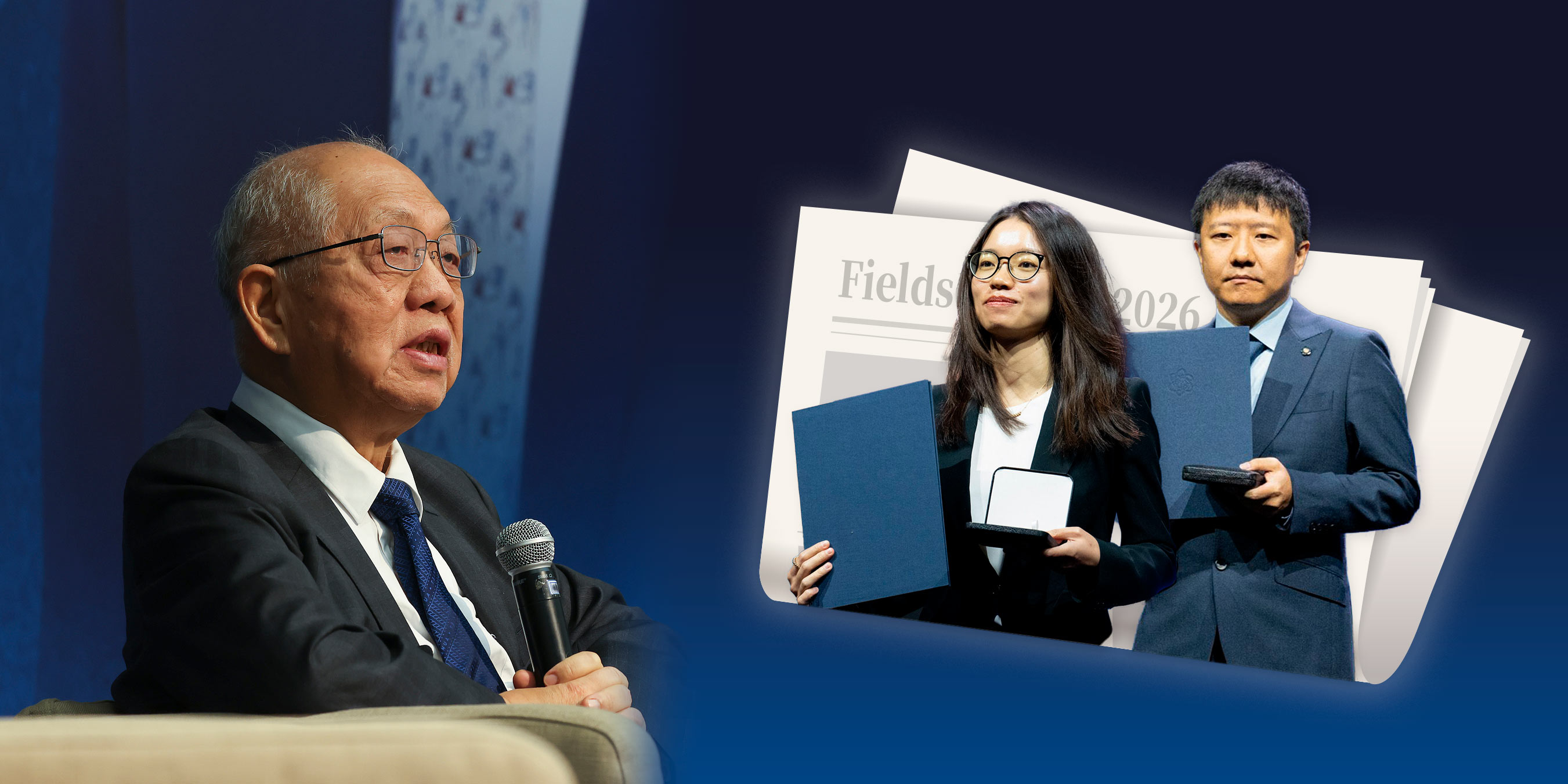
When Wang Hong and Deng Yu became the first Chinese nationals to receive the Fields Medal — the so-called “Nobel Prize for mathematics” — on July 23, few people were as pleased as Shing-Tung Yau.
“For China’s math community, this is something we’ve hoped to see for decades,” Yau, a Chinese American mathematician who was awarded the Fields Medal in 1982, tells The Paper.
“It gives us new hope. We can now envision the day when decisive breakthroughs are made by scholars trained entirely in China and are carried out on Chinese soil.”
Yau is the founding dean of Tsinghua University’s Qiuzhen College, which was established in early 2021 to strengthen the cultivation of mathematical talent. One of its flagship initiatives, the YAU Mathematical Sciences Leaders Program, recruits gifted high school-age students from around the world, placing them on an eight-year track running from bachelor’s degree to Ph.D.
In recent years, however, a training industry has emerged around admission to the college, with some parents viewing it as a shortcut to one of China’s top universities. Public scrutiny also intensified in July when several recruits reportedly faced expulsion during the initial preparatory semester after failing to meet Qiuzhen’s academic standards.
In interviews, Yau has openly criticized China’s long-standing reliance on math competitions and commercial test-prep programs, saying that they only make students proficient in taking exams and standardized problem-solving routines, which has had “an extremely negative impact on the development of mathematical talent.”
He reveals that the college is planning a comprehensive overhaul of its admissions and exam systems, with the aim of enrolling students who truly love mathematics, not those solely motivated by the desire to enter an elite university.
Following Wang and Deng’s accomplishment, Yau now hopes China can cultivate many homegrown scholars within the next decade who can forge their own intellectual paths and produce work that shapes the direction of mathematics worldwide.
Here, Yau talks with The Paper about his feelings on math education, basic research, and scientific innovation.
The Paper: How should we understand the importance of basic research?
Yau: People have various understandings of basic research. In my view, basic research should make meaningful contributions to the nation and society. China faces many technological bottlenecks, and we scientists have a responsibility to help overcome them.
At the same time, we cannot remain content with following in the footsteps of others. If we’re always solving problems that others have defined, merely improving on existing work, then even if we eventually surpass them, we are still allowing someone else to set the agenda. There is certainly a place for this kind of research, but it cannot be the whole story.
People often say that China is good at taking innovation from “2 to 100” — refining and scaling existing ideas — but lacks the capacity for “0-to-1” breakthroughs: original discoveries that set new directions.
Some lines of inquiry may appear to have little practical value today. Yet pursuing them can deepen our understanding of the laws of nature, and that deeper understanding can lay the groundwork for transformative discoveries. Above all, curiosity is the driving force behind 0-to-1 innovation.
When scientists began investigating quantum phenomena in the early 20th century, their goal was to unravel the mysteries of atomic structure and quantum effects. No one imagined that this research would revolutionize electronics, industrial technologies, and countless other fields, reshaping the modern world. Even today, many of the technological challenges that constrain China’s development are rooted in areas closely connected to quantum mechanics.
That is why basic research must serve two purposes simultaneously: address the pressing challenges facing the country while safeguarding the freedom to pursue curiosity-driven research.
The Paper: Why does China seem to lag behind in 0-to-1 innovation, and what is the solution?
Yau: In many areas, once someone else opens up an important new direction, Chinese scientists move in quickly and, in many cases, improve on it or even outperform the first pioneers. But genuinely new fields that we ourselves have initiated from the outset remain exceedingly rare. Taking that first original step is the most important challenge facing the development of basic research.
The history of mathematics offers many examples of theories that were initially misunderstood or dismissed, only to have their significance recognized years later. Yet many young researchers lack the courage to pursue this kind of work.
One reason is that such research requires extraordinary patience. An unconventional idea may take five or six years before its value becomes apparent. During that time, researchers might struggle to secure even basic funding, and their career advancement could suffer. Most people naturally shy away from such risks.
Also, basic research is inherently a long-term endeavor. It rarely produces immediate rewards, so many people lose interest over time. But genuine interest cannot be manufactured overnight — it must be cultivated from an early age. We need to inspire young people to develop a love of scholarship and a sense of wonder about nature. Without that inner drive, it is impossible to nurture first-rate researchers.
Many people’s aspiration for pursuing research has changed. Increasingly, scholarship is viewed as a means to acquire academic titles or prestigious appointments. When my generation entered academia, there was no option but to keep moving forward. By contrast, young people today generally enjoy far greater material security, yet they face intense external pressures that make them more vulnerable to anxiety. At the same time, parents and society have become overly protective of children. Only by changing the broader culture of scientific research can China achieve genuine success in basic research and produce truly original breakthroughs.
The Paper: Does this also point to shortcomings in China’s system for evaluating academic research?
Yau: In some respects, our system for encouraging academic research places too much emphasis on material incentives and too little on the intrinsic value of scholarship. At some universities, generous salaries and housing allowances are reserved primarily for scholars with fancy titles. As a result, many young researchers feel compelled to chase these credentials rather than focus on the pursuit of knowledge.
Another issue is that China’s academic evaluation system makes relatively little use of international peer review. At Harvard University, for example, tenure decisions are based on assessments from leading scholars around the world. In China, evaluations are often confined to domestic experts, and in some cases only to reviewers at the same institution.
China has relatively few researchers capable of achieving genuine 0-to-1 innovation — but the situation is changing. Many scholars returning from overseas have brought back new ideas, research cultures, and methodological approaches. That does not mean China must rely indefinitely on talent trained abroad. Outstanding scholars are also emerging from within the country. The key is to ensure that decisions are guided by experts who truly understand the field. Ultimately, we must chart our own course, but we should at least listen carefully to those with expertise.
Even where international evaluation has been introduced, many Chinese universities continue to judge research primarily by metrics such as publication counts and journal impact factors. Those measures are poorly suited to evaluating the most original and exploratory forms of research.
We need to encourage young scholars in Chinese universities to set their sights much higher. At the very least, a small but significant group should aspire to become world-leading researchers — people capable of producing groundbreaking work that shapes the direction of mathematics, and even basic research more broadly, for decades to come.
The Paper: China’s total research and development spending exceeded 3.92 trillion yuan ($581 billion) in 2025. Investment in basic research accounted for 7% of that, a record high but still far below the 15-20% seen in many developed countries. How do you view this gap?
Yau: Research cannot be driven solely by immediate applications or by what may prove useful over the next five years. Basic research must not be neglected simply because its practical impact is delayed. More often than not, its true significance becomes apparent only after 10, 20 years, or even longer.
In fact, basic research is not especially expensive. Most fundamental research relies on thinking, reasoning, and mathematical deduction; its principal resources are the minds of scholars. Although some experimental fields like high-energy physics require substantial investment, China’s major research institutions are fully capable of supporting such work.
Generally speaking, allocating around 10% of total national R&D spending to the most fundamental areas of basic science would be sufficient. What matters most is that we take a long-term view and invest not only for today’s needs but also for the future.
The Paper: You have long advocated identifying and nurturing talented young students. Why is this important for basic research?
Yau: I have been at Qiuzhen College for five years. Every Monday, I teach a course on the history of math, focusing on the most influential mathematicians of the past three centuries and the paths they took in their intellectual development. Almost all of them developed a passion for math at the age of 12 or 13.
The future of China’s basic sciences depends on such young people, too. At that age, their minds are not yet constrained by established thinking; they possess tremendous intellectual flexibility. But as people grow older, their habits of thought become more fixed, making it more difficult to produce the kind of 0-to-1 innovation that opens new frontiers. That is why identifying and cultivating exceptional talent must begin early.
Some people argue that this approach runs counter to the principles of compulsory education or educational fairness. But requiring every student to meet exactly the same standard can, in fact, bury the rare young talents we most need to nurture. That would be the greatest injustice of all.
We should establish a systematic mechanism for identifying and developing the small fraction of students with exceptional gifts, providing them with specialized education. That is consistent with the educational principle of teaching students according to their individual abilities, and that is what genuine fairness looks like.
The Paper: What qualities do you feel define a true scientist?
Yau: A scientist must possess an open mind and a broad intellectual outlook, and they must build a rigorous academic foundation. No matter how difficult it may be, the fundamentals must be mastered — and math is especially important. Interdisciplinary learning and cultivating the humanities are also important. We should strive for broadly educated scholars rather than narrow specialists.
Original thinking is key. American students often ask unusual, even eccentric, questions. That curiosity is fascinating, and it frequently leads them to creative research. Chinese students, by contrast, tend to be more inclined to follow established rules and are often reluctant to question accepted ideas. We should protect their curiosity, encourage them to think boldly, and give them the confidence to ask questions.
Ultimately, the spirit of science is about seeking to understand the mysteries of nature and uncovering the objective laws that govern the universe — not about pursuing fame or prestige.
We should create an environment in which researchers are free to explore nature and pursue scholarship out of genuine intellectual curiosity, allowing them to remain true to that original motivation. Young scientists should not spend their careers chasing academic titles or even a Nobel Prize. The purpose of scholarship is to discover the truth and beauty of the natural world.
Reported by Teng Han.
A version of this Q&A originally appeared in The Paper. It has been translated and edited for brevity and clarity, and is republished here with permission.
Editors: Wang Juyi and Hao Qibao.
(Header image: A collage shows Shing-Tung Yau in 2025 (left), and Wang Hong (center) and Deng Yu in 2026. Visuals from VCG, reedited by Sixth Tone)