Check in, Log on, Stay for Months: Life at China’s 9-Cent Internet Café
Outside an unassuming three-story building in downtown Kangyi Town, in the eastern Shandong province, hangs a sign that reads: “Striving to be the cheapest internet café in China.”
With charges as low as 0.6 yuan ($0.09) an hour, it’s certainly not false advertising. Yet step inside and you will find not just gamers chasing rock-bottom prices, but also a mix of locals and out-of-towners with myriad tales of misfortune, many looking to rise from their own rock bottom.
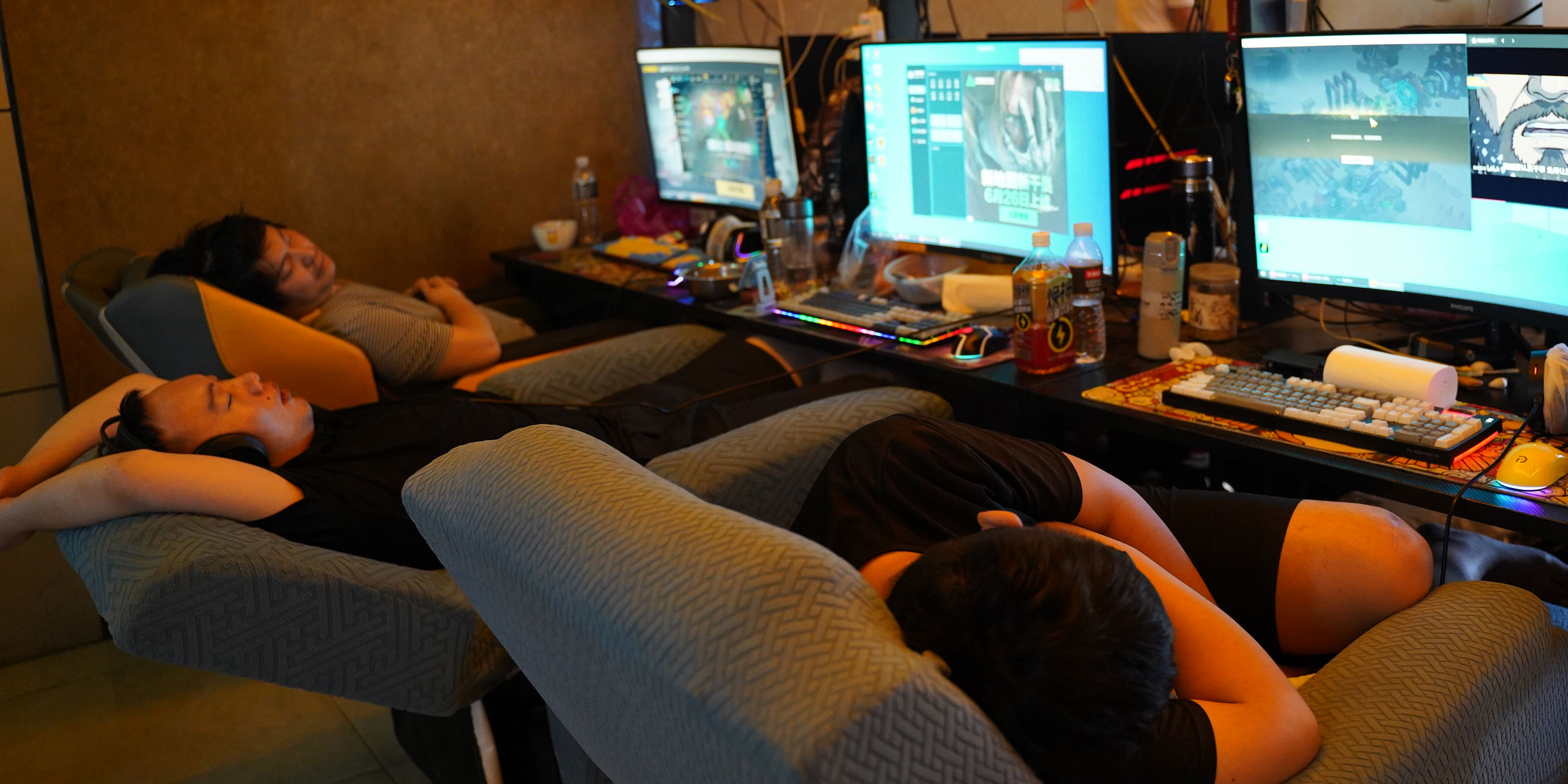
Here, customers can bathe and do laundry for free, enjoy a lunch of meat and vegetables for just 10 yuan, and even sleep in reclining esports chairs. For those looking to get back on their feet, it’s the ultimate low-to-no-cost option.
Like many of its patrons, the café’s owner, Wang Zhongkai, is also just trying to survive. After struggling to keep the doors open for more than a decade, the 38-year-old decided to slash his prices last year to attract more foot traffic.
The move certainly accomplished that — although it’s also inadvertently created a shelter for people in hard times.
After seeing a video about the internet café on Douyin, the Chinese version of TikTok, Wang’s first out-of-town customer traveled 800 kilometers from neighboring Jiangsu province to “seek refuge” — and ended up staying for eight months.
Changing fortunes
China had roughly 122,600 licensed internet cafés last year, up 12% from 2024, according to the Internet Access Service Association of China. However, data from the Ministry of Culture and Tourism shows that average annual revenue fell from 216,000 yuan to 197,000 yuan over that same period.
Hardware is the biggest investment. With ever-changing technology, a new computer costing 15,000 yuan can lose a third of its value within a year, with software requiring constant paid-for upgrades.
Wang’s is one of only two surviving internet cafés in Kangyi. The business today has more than 150 computers of various specs, including 35 priced at 0.6 yuan an hour. The other machines in the main hall range from 0.9 yuan to 3 yuan an hour, while private one-person rooms are available for 99 yuan a day.
From nearly empty every day, Wang has seen occupancy increase to about 90%. At nighttime, the second floor is illuminated by the shifting colors of the PC screens, with the faces of customers — almost entirely men — aglow with yellow, green, red, and blue hues. Some are fast asleep, wrapped in summer blankets, headphones dangling from their neck.
Over the years, Wang, a father of three, has tried many ways to increase his income. He tried opening a grocery store on the side, which saw him lose 500,000 yuan in about six months. To recover, in 2023, he moved to Beijing — leaving his wife in charge of the café — to become a daijia, a designated driver for hire, working 15 hours a day. One day, he was so exhausted that he fell asleep while riding his electric bike and crashed.
He knows all too well that sometimes people just need to get through a rough patch. While living in the capital, he would pay 15 yuan to spend the night at an internet café where he could charge his e-bike and get hot water.
Wang returned to Kangyi in 2025. Today he helps his customers find low-cost rooms in town for as little as 200 yuan a month, with no deposit. For those who can’t even afford that, he lets them sleep for free in the café’s luxurious esports chairs.
He also advertises day-labor gigs available nearby, such as sorting packages at a courier depot or casual shifts at a machinery plant. Most of his customers decline, however, either because they’re not fit enough to handle manual labor or can’t stomach the idea of being bossed around.
His wife and mother-in-law are responsible for preparing lunch every day at the café, with one meat dish, one vegetable dish, and mountains of rice and steamed buns. Most diners pay 10 yuan, but those without a penny eat for free.
The showers and an industrial-size washing machine are also free to use — Wang even provides soap and detergent.
Despite the increased foot traffic, Wang’s profit margins remain wafer-thin. He says his family has invested more than 700,000 yuan in new computers, yet their revenue streams comprise only the cut-rate internet fees, sales of food and drink, and the occasional livestream on Douyin, during which some viewers will send virtual gifts. Except for relatives, the business has only one employee — an elderly male cleaner.
Boosting opportunities
Qiang Yu, a 30-something from Huaibei in the eastern Anhui province, has spent every day and night in the “0.6-yuan zone” for nearly a year. Like many others here, he makes money as a “game booster,” which involves playing video games to level up someone else’s account. His specialty is the online role-playing game Legend of Mir 2.
High-level accounts in popular games are worth tens of thousands of yuan, and cheating can lead to a permanent ban by game developers. Account owners are usually unwilling to hand their username and password to strangers, but Wang has built a reputation among several clients, offering a personal guarantee for any losses. He regularly farms out orders to the boosters at his internet café — and doesn’t even take a cut.
In the past, Qiang did manual jobs — digging gravel by the railway tracks, getting paid by the meter, his hands raw and blistered at the end of a shift, as well as toiling at factories making garments, lights, and electronics. It left him with a “crushing depression,” he says.
Qiang now earns just over 100 yuan for 12 hours’ work and survives on just 25 yuan a day. If, in a year, he has 10,000 yuan in his pocket, he plans to go home and clear the weeds that have taken over his courtyard.
Cao Ti Lie, a gamer who asked to be identified only by his username, arrived in Kangyi from Foshan, in the southern Guangdong province, in June. He grew up in video arcades, and now regularly livestreams to 60,000 subscribers on Douyin as he competes in the classic King of Fighters ’97.
Gaming used to be fun, he says; now it’s a full-time job. “The heart of the boy I was is dead. When you have to face life, it gets erased.”
The 41-year-old previously ran a business in Foshan and was making 30,000 yuan a month, but bad investments and a gambling habit saw his debts pile up. His wife left with their children, and then his mother suffered a stroke and broke her hip, losing the ability to care for herself.
Soon after spotting a video about Wang’s internet café, he hopped on a train here. His only goal is to save enough money to cover the costs of his mother’s nursing home.
Future is now
Wang’s day starts at 8 a.m. He scrubs five toilets, restocks the fridge, wipes down the keyboards, picks up any trash from the night before, and then takes his spot at the front counter.
He sees plenty of local faces come and go, but many of the out-of-towners are now permanent fixtures. In February, the café hosted about 40 people on Chinese New Year’s Eve, an important day on the calendar for family reunion.
Mao Lifen, a gamer from the northern Shanxi province who arrived in May, says he tries not to think about the future. He used to have a plan — work at a factory for five years, save up, and open a fruit shop. This was derailed when he and his colleagues had a falling out with the factory management and quit.
He went to work in food delivery and partnered with a friend to open a restaurant, maxing out several credit cards to the tune of 100,000 yuan and losing it all. Mao then tried starting a business with another friend, who ran off with all their money. A string of bad investments appears to have killed his interest in making plans.
His only thought now is to get through this year. “I’ve got food and drink — what is there to be unhappy about?” he says. At Wang’s internet café, he takes boosting orders for the first-person tactical shooter game Delta Force. When he’s not playing, he likes to walk up to the rooftop to look at the trees in the distance.
Mao likes this life that requires next to no human contact: everyone stares at their screen, submerged in the game. With his headphones on, there is no “outside world.”
This year, a wannabe entrepreneur from out of town visited Wang with a view to copying his business model elsewhere. Wang laid it out for him: 150 computers plus renovations, licensing, and other expenses mean at least 2 million yuan upfront; profits will unlikely keep pace with the equipment’s depreciation; and a minimum of three or four employees are needed to run 24/7. The visitor listened patiently and immediately abandoned the plan.
Wang knows he’s too deep into the industry to pull out. When he was young, he dreamed of making a fortune and owning a luxury car, but now “I know my limits,” he says. With a 30-year mortgage and still owing 110,000 yuan for equipment, his only wish is to draw customers and stay afloat.
(For privacy reasons, Qiang Yu and Mao Lifen are pseudonyms.)
Reported by Jiang Wanru.
A version of this article originally appeared in White Night Workshop. It has been translated and edited for brevity and clarity, and is republished here with permission.
Translator: Kiong Xin Xi; editors: Wang Juyi and Hao Qibao.
(Header image: Customers sleep in the esports chairs, at Wang’s internet café in Kangyi Town, June 2026. Jiang Wanru/White Night Workshop)