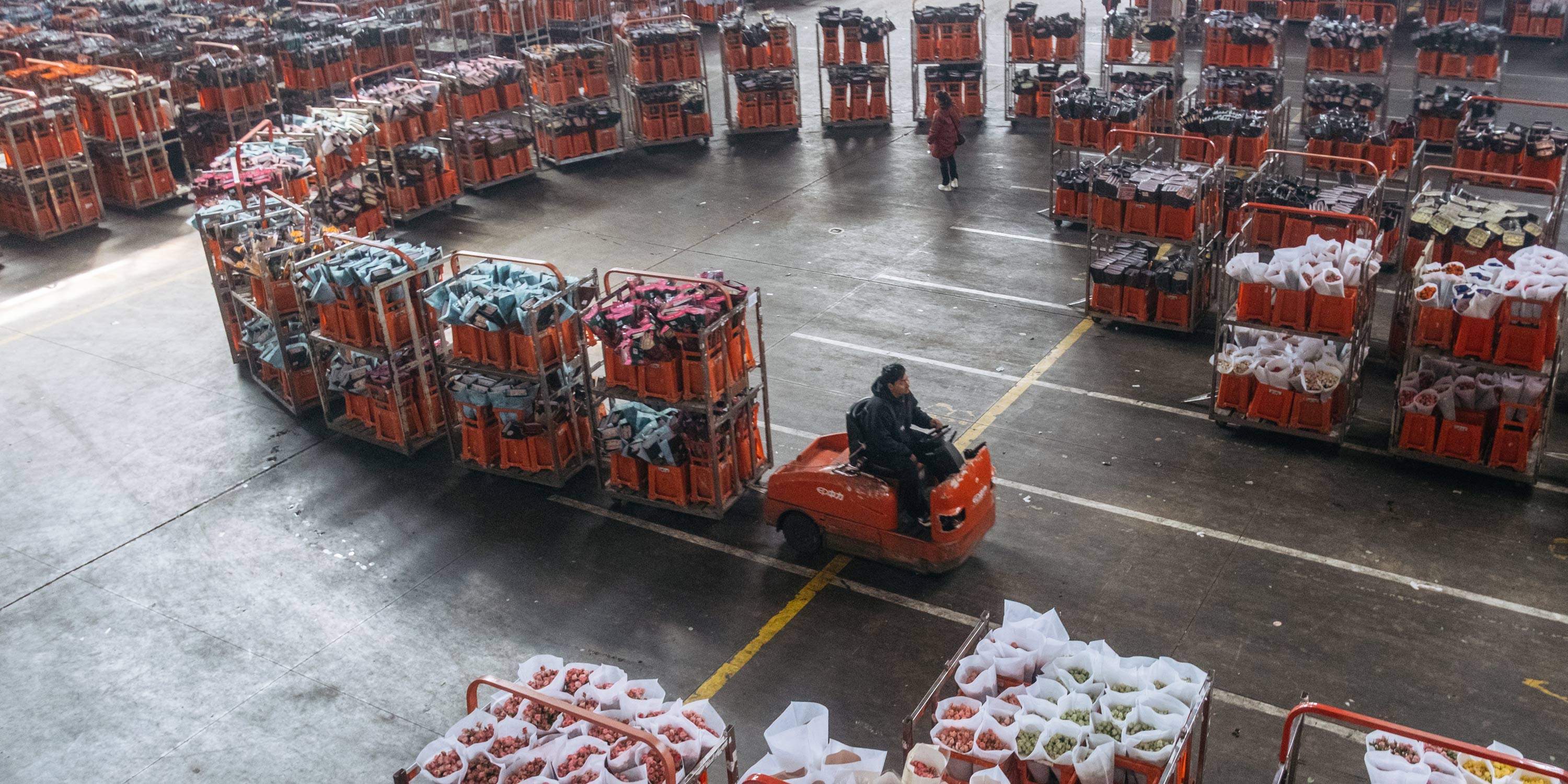
How China Delivers a 14-Yuan Bouquet Over 2,000 Kilometers
On China’s major e-commerce platforms, a bouquet of fresh-cut roses from the southwestern Yunnan province sells for just 14 yuan ($2), with free delivery to most parts of the country.
For consumers, this is an ordinary online purchase: tap to pay on a phone screen, then wait for the flowers to arrive at the door. But behind that simple transaction is a complex logistical challenge. Cut flowers are highly perishable. They lose moisture quickly and must travel more than 2,000 kilometers from Yunnan to major cities like Shanghai. Harvesting, sorting, packing, transportation, and last-mile delivery all have to happen within a narrow window.
How can a product worth less than 20 yuan cover the costs of packaging and inter-provincial delivery while remaining affordable as an everyday online purchase? The answer lies in how far China’s supply chain has evolved.
The first factor is scale.
In 2025, China’s express delivery companies handled 198.95 billion parcels, or nearly 550 million per day. Around 90% were shipped between different cities or regions.
Such enormous volumes allow logistics companies to build fixed routes, operate frequent departures, and invest in large-scale sorting centers. The costs of warehouses, vehicles, information systems, and automation equipment can be distributed across hundreds of millions of parcels.
In cities with dense order volumes, trucks can consolidate packages heading to the same areas, while couriers can complete more deliveries along compact routes. Adding another parcel does not require rebuilding the entire logistics system from scratch. Instead, existing infrastructure becomes more efficient as volume increases.
But scale alone is not enough. A huge number of parcels can also create new problems, including congested warehouses, idle vehicles, and inventory stored in the wrong places.
What has made China’s logistics system distinctive is its size coupled with the widespread application of supply chain management.
Other countries also use supply chain management, but China has applied it in a market with a combination of scale, density, complexity, and cost pressures rarely seen elsewhere. It has turned complex logistics systems into everyday services that even low-priced goods can use.
One example is demand forecasting.
As parcel volumes increase, companies need to predict not only what products consumers will buy but also where demand will come from and how much inventory and transport capacity each region will require.
This is why presales have become increasingly important, especially during China’s major shopping festivals. Rather than waiting for consumers to place orders on the day of a promotion, platforms use presales to collect advance commitments from buyers.
This gives retailers a clearer picture of expected sales volumes and buyer locations. They can prepare inventory, organize picking and packing, and adjust sales plans ahead of time. Logistics companies can reserve warehouse space and transportation capacity before order volumes surge.
Presales are only one forecasting tool. Companies also analyze historical sales, browsing trends, promotional plans, and real-time orders to estimate demand. The goal is to prepare resources before a sudden increase in orders overwhelms the system.
But predicting demand is only the first step. Goods must also be placed in the right locations — this is the warehousing question of supply chain management.
While forecasting has become increasingly sophisticated, China’s warehousing capacity has also expanded significantly. But warehousing is not simply about the size and number of facilities. Location is also crucial because it determines how far goods must travel after an order is placed and how many transfers are needed before reaching consumers. Logistics costs depend not only on how quickly goods move, but also on where inventory is positioned.
Take the major e-commerce platform JD.com as an example. In the first half of 2026, JD Logistics expanded its fulfillment network by opening new warehouses in the eastern Shandong province and other regions. Its domestic network now includes more than 3,600 warehouses across over 2,800 county-level areas, allowing merchants to stock goods closer to consumers and fulfill orders from nearby facilities.
In the past, deliveries during major shopping festivals could take weeks. Today, some presold goods are moved in advance to regional distribution hubs. Once buyers near these warehouses make the final payment, delivery can begin almost immediately, with some orders reportedly arriving within hours of payment.
For manufactured goods or everyday household items, placing inventory close to major consumer markets reduces delivery distances and logistics costs. Fresh produce, however, requires a different, more technology-intensive kind of logistics system.
Returning to Yunnan’s cut flowers, the challenge lies in speed and coordination.
At a fresh-flower cold-chain distribution center in Kunming, Yunnan’s provincial capital, five sorting lines operate at high speed. Automated equipment identifies each shipment’s destination and directs it onto the appropriate route. The center can process around 20,000 flower parcels per hour, with each parcel sorted in as little as three minutes — 1.5 times the efficiency of manual sorting.
The center began operations in 2021 and underwent a major upgrade in 2024. Its daily flower shipments increased from an initial 2 tons to more than 260 tons. After sorting, flowers quickly enter a transport network combining air freight, high-speed rail, and refrigerated trucks. Express air services can reach more than 28 cities within 24 hours, and over 90% of China’s major cities nationwide within 48 hours.
The logistics system behind fresh flowers is far more than simply transporting a box from one city to another. It is a complete chain covering harvesting, pre-cooling, sorting, packing, cold-chain transport, and final delivery. The goal of this system is to minimize transfers and reduce the time flowers spend outside controlled conditions.
Refrigeration, protective packaging, and air transport all increase costs. But for products whose value declines with every delay, faster and more controlled delivery reduces damage and extends their selling life.
This is why the key post-harvest steps, including pre-cooling, grading, and packing, must happen close to the farm, without delay. Origin-based sorting and cold-chain hubs allow flowers from multiple producers to be collected, processed, and shipped efficiently, transforming fragmented agricultural production into a reliable supply chain.
Demand forecasting, inventory positioning, warehouse placement, and AI-enabled dispatching may appear to be separate processes. In reality, they work together toward the same goal: reducing unnecessary waiting and avoiding inefficient movement.
What consumers ultimately see is often only a modest delivery fee, or simply a “free shipping” label. That price is not the result of a single cheap step. It reflects the coordination of order processing, inventory management, warehousing, transportation, and last-mile delivery.
This is the result of supply chain management applied at scale: a system that allows consumers across China to experience the increasingly ordinary reality of placing an order and receiving it almost instantly.
The 14-yuan bouquet of roses is therefore more than a cheap online purchase. It represents a shift in how people shop and access goods across one of the world’s largest consumer markets. The supply chain design behind it is what allows these expectations of convenience, speed, and choice to become an everyday reality.
Portrait artist: Wang Zhenhao.
(Header image: A worker transports flower bouquets at a warehouse at the Dounan Flower Market, Kunming, Yunnan province, February 2026. Wu Huiyuan/Sixth Tone)