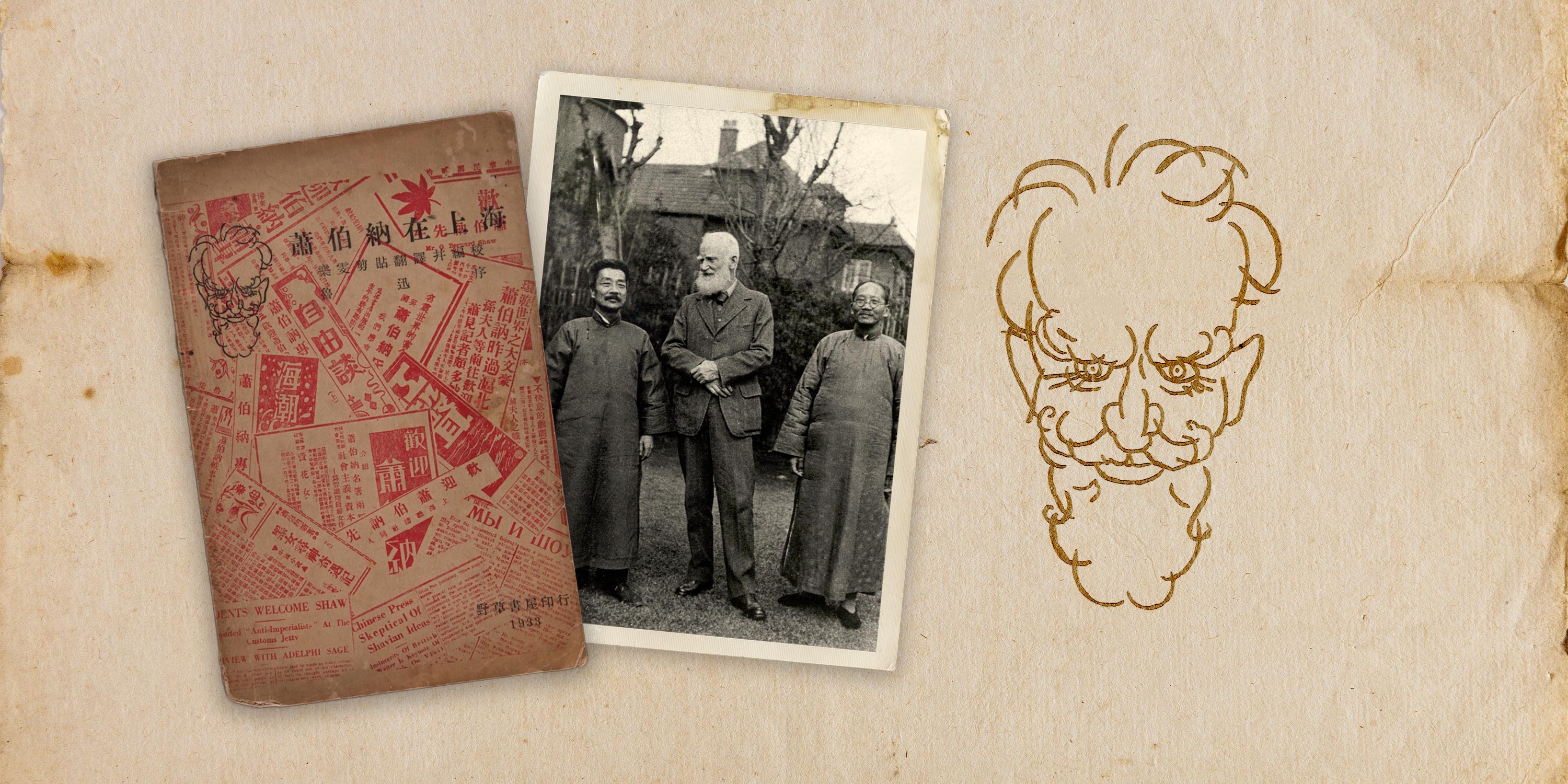
Shaw in Shanghai: How the Irish Writer’s 1933 Visit Inspired China’s Literati
Editor’s note: The theme of the third Shanghai Public Relations Academic Symposium on Irish Literature, held on July 26, was playwright George Bernard Shaw’s eight-hour visit to Shanghai in the 1930s, when China’s cultural and anti-imperialist movements were gaining momentum. The following is an account of the writer’s time in the city and its impact on Chinese intellectuals.
When George Bernard Shaw, the Irish playwright and novelist, paid a brief visit to Shanghai as part of his global voyage in 1933, the city’s intellectuals were thrilled.
Before his arrival, articles about Shaw had been published in various newspapers and magazines. Some discussed his Communist advocacy in Hong Kong, while others talked about how his satirical writing style had influenced European society.
According to a biography of Soong Ching Ling, the Chinese politician and wife of Sun Yat-sen, sometimes called the “father of modern China,” Shaw arrived at Wusongkou port — today the Wusongkou International Cruise Terminal in northeastern Shanghai — at 6 a.m. on Feb. 17 aboard the Empress of Britain, accompanied by his wife, the political activist Charlotte Payne-Townshend. At 5 a.m., Soong went to Wusongkou with Yang Xingfo, a social activist and patriotic democrat, to welcome the couple. At Shaw’s invitation, she joined him on board for breakfast.
More than 200 reporters rushed to Wusongkou early that morning, but Shaw initially refused to go ashore, telling Soong that apart from her, there was no one in Shanghai he wanted to meet, nor anything he wanted to see. But in the end, Soong persuaded him to pay a visit to the city. They took a steamship to Lanlu Wharf in today’s Yangpu District, where he finally went ashore. The reporters waiting at Wusongkou left empty-handed — not a single photograph of Shaw was taken.
At 10:30 a.m., Soong and Shaw disembarked and set out for the city’s downtown. Shaw met and talked with several left-wing Chinese intellectuals, including Yang, former Peking University president Cai Yuanpei, literary icon Lu Xun, writer and linguist Lin Yutang, and the American journalists Harold Isaacs and Agnes Smedley.
Later, at the invitation of the Chinese branch of PEN International, a global association of writers founded in London in 1921, Shaw and other Chinese intellectuals visited the World College on Route Ferguson (now Wukang Road) to attend a gathering with local PEN members. When Shaw met Mei Lanfang, the renowned Peking opera artist and founder of Shanghai’s Left Theatre Club, he expressed his puzzlement over the differences between Eastern and Western theater.
“Will you please tell me how a Chinese actor can do anything in the midst of such infernal uproars as one hears on your stage?” he asked. “In our theater, they put a man out if he sneezes. But you have gongs and cymbals and the competition of half the audience and innumerable vendors. Don’t you object?”
Mei explained that Peking opera was a folk art first performed in the open air, and drums and gongs were then used to attract people to the show. This tradition had simply endured.
Around 3 p.m., Shaw finally spoke with some Chinese and foreign reporters in the garden of Soong’s residence, discussing socialism, national oppression, Eastern culture, and revolutions, among other topics. Afterward, Soong accompanied Shaw back to the Empress of Britain, which then carried the playwright northward to Beijing.
Although Shaw spent just over eight hours in Shanghai, his visit sparked considerable discussion and reverberations among the city’s left-wing intellectual circles. The writer and poet Yu Dafu wrote in Free Talk, a supplement of the Shun Pao newspaper, that he hoped Shaw could tell the world, in his own sarcastic tone, about Japanese imperialism and its invasion of China.
At the time, intellectuals including Lu Xun and the poet and translator Qu Qiubai were working to build a central stronghold for China’s left-wing cultural movement. After Shaw’s departure, they, along with partners Xu Guangping and Yang Zhihua, began compiling reports from various newspapers and periodicals about the Irish novelist’s short visit. The collection was published in March 1933 by Yecao Shudian, or Wildgrass Bookshop, under the title “George Bernard Shaw in Shanghai.”
In the preface, Lu wrote: “Those who truly welcomed him were the Chinese people, as well as the literary and artistic circles that stood by the people. The Chinese people did not regard him as a ‘revolutionary leader’ or a ‘thoroughgoing socialist writer,’ much less as an idol. They regarded Shaw as a loyal friend of the oppressed people of the world, and of China.”
Editor: Hao Qibao.
(Header image: Visuals from the Shanghai Lu Xun Museum, reedited by Sixth Tone)