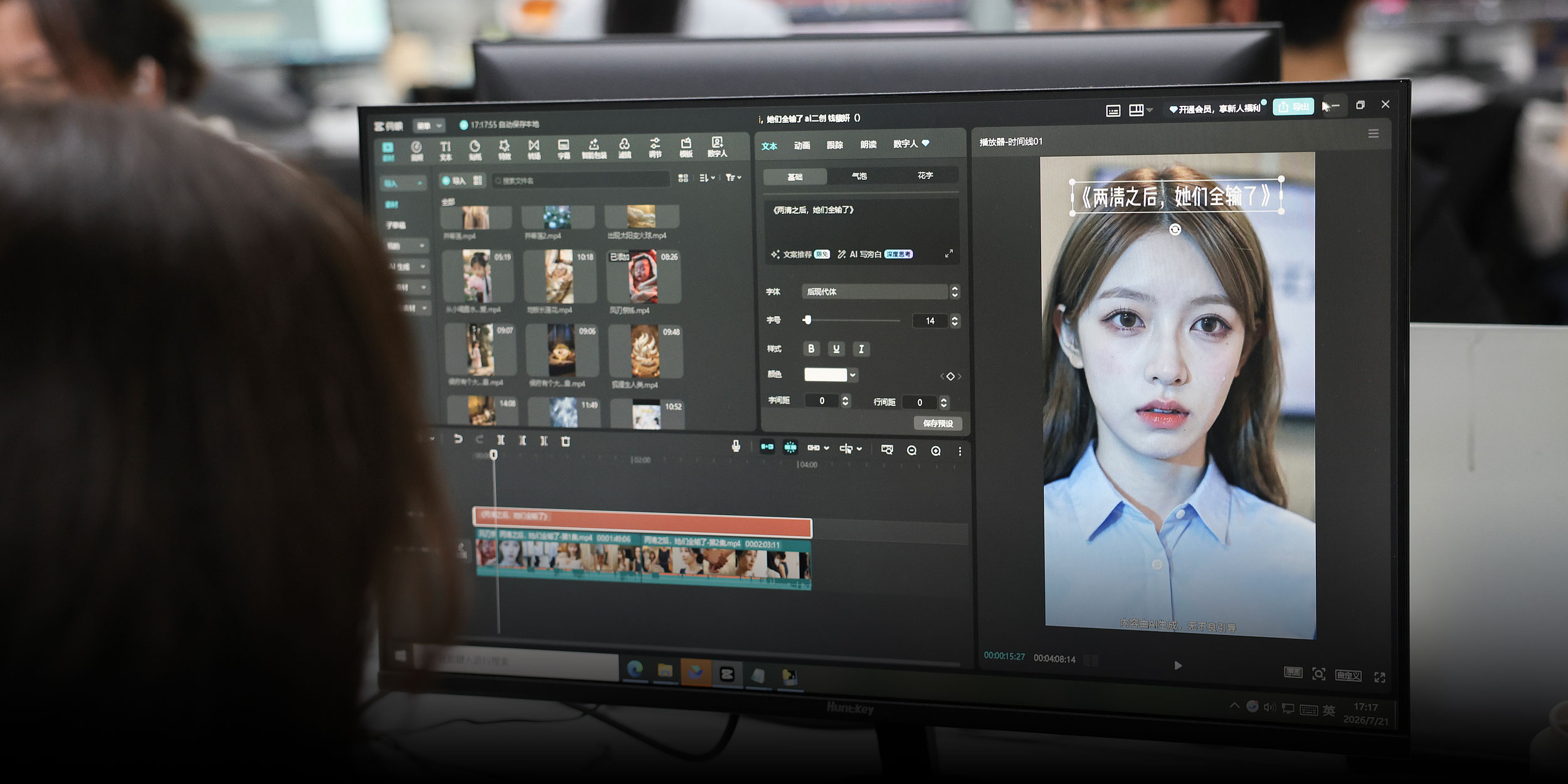
China’s Short-Drama Boom Calls for a New AI Crew
One graduate trained to restore ancient artifacts now generates AI video clips for short dramas. Another, schooled in landscape design, builds virtual scenery instead of physical sets.
Both are part of a hiring surge across China’s film industry, as AI creates demand for hybrid creative roles and cuts production timelines from months to days. Recruitment for AI video editors jumped 179% year over year in June, state broadcaster CCTV reported.
At one cultural communications company in Zhengzhou, capital of China’s central Henan province, monthly production of AI-generated short dramas has risen from a handful to nearly 100, according to CCTV. The expansion has created demand for AI video editors and “card pullers,” who write prompts, generate footage, and select clips that fit a production’s characters and plot.
The shift is drawing workers from fields including design, animation, digital media, and information technology, according to recruitment platform Zhaopin. AI film roles typically pay between 8,000 and 20,000 yuan ($1,100 to $2,800) a month, depending on experience.
“This indicates that AI is not simply a substitution, but a technological enabler that is driving the transformation of traditional professions and roles,” Li Qiang, a vice president at Zhaopin, told CCTV.
AI is also changing how short dramas are made. Some productions that once required crews of dozens can now be completed by a few people, or even one creator handling scripts, storyboards, visuals, and effects. CCTV reported that AI has compressed some production cycles from months to days, with certain episodes completed in hours and effects and previsualization work becoming three to 10 times faster.
Director He Ziqiang, an early adopter of AI filmmaking tools, has added AI storyboard artists, image generators, card pullers, and editors to his team, many without formal film training.
“Anyone can make their own film, as long as they have ideas,” He told CCTV. “This will greatly enrich artistic creation and vitality, enabling more talented ordinary people to express themselves through AI.”
The hiring surge comes as China’s short-drama industry’s annual output value approached 90 billion yuan in 2025, nearly double the previous year, while some AI-generated productions have reported net profit margins above 50%.
Li Yuan, who is not related to Li Qiang, founder of a Henan-based AI film company, told domestic media his firm had cut the cost of producing a drama from 300,000 yuan to 50,000 yuan while increasing output.
“We thought large models would take longer to nail video fluency, but they got it done in the first quarter of this year,” Li told state media.
But he also cautioned that AI short dramas remain at an early stage, with both the technology and audience tastes still evolving. “Only when the market stabilizes can creators and platforms offer better products,” he said.
Editor: Apurva.
(Header image: Staff at a short-drama production company use AI tools during post-production in Jiaxing, Zhejiang province, July 21, 2026. VCG)