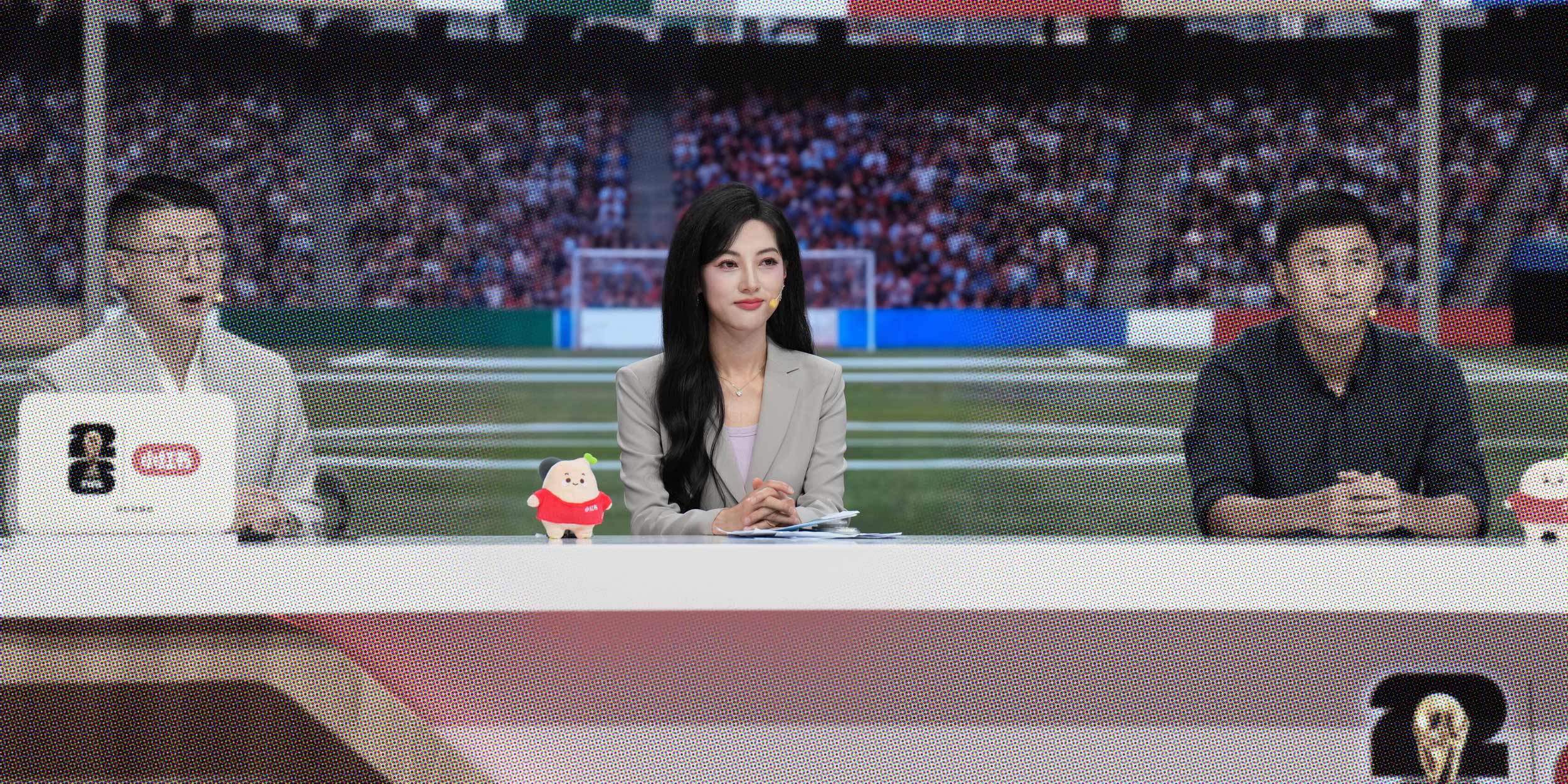
Game Changers: China’s Female Football Commentators Take Their Shot
Editor’s note: Once confined by gender stereotypes to largely decorative, in-studio roles, China’s women are breaking down barriers in the male-dominated world of live football commentary — and at the forefront is Liu Chang. With nearly a decade of experience, the 34-year-old was part of the commentary team formed for the 2026 FIFA World Cup by the lifestyle platform Xiaohongshu, or RedNote. Here, Liu talks about her passion for the “beautiful game,” her online critics, and her unforgettable farewell to the former France and Real Madrid star Karim Benzema.
For two days before the 2026 FIFA World Cup final, football fans could finally take a break. I couldn’t.
After England’s semifinal defeat to Argentina on July 16, I had to continue livestreaming, reviewing the match in detail, and chatting with viewers online. That day, I still had a program to record. During a major tournament like the World Cup, commentators work around the clock. We can only really rest after the final game.
In China, most matches this time started in the early hours of the morning. For a 3 a.m. kickoff, we usually arrived at the studio around 11 p.m. or midnight to prepare, and we wouldn’t finish work until after 5 a.m. the next day. Once I got home, I would record a post-match analysis video, edit and publish it, then sleep until the afternoon. After waking up, I would immediately begin preparing for the next match. Sometimes I slept only two or three hours a day.
As I began commentating on bigger matches, I knew my voice was reaching a larger audience. But that also brought more criticism. I often saw comments on social media saying they weren’t used to a female commentator, that the voice was too shrill or overly emotional.
I don’t shy away from this feedback. I want to hear genuine reactions from viewers, even though it might be painful.
As for the harsher comments, you have to look at them case by case. Take the criticism about shrill voices — there are historical reasons behind that perception. Honestly, growing up, I hardly ever heard a woman cover a football match. We were used to female commentary for figure skating, synchronized swimming, or diving — sports associated with graceful and delicate imagery, where a softer voice seemed a natural fit.
But football is intense, full of passion, and constantly changing. The drama of the game is inseparable from emotion. So I completely understand why some viewers initially felt uncomfortable hearing a female voice. That’s why I adjusted my vocal technique, shifting to a deeper, fuller tone by relying less on head resonance and more on chest resonance. When emotions run high, I can use professional methods to control my pitch.
Of all the comments, what I care about most is how people evaluate my accuracy. My colleague Wu Tong (another female commentator who covered the 2026 World Cup) and I genuinely want to provide fans with an accurate and reliable reading of the game.
Some viewers noted that our commentary felt even-keeled and impartial — a compliment that, to me, reveals a double standard. If a female commentator shows visible emotion or a hint of bias, viewers are far quicker to mark it down to a lack of professionalism.
There’s been a noticeable change in public perceptions of female football commentators in recent years, though. Today, Chinese fans have a far richer array of ways to engage with a match. Once, they simply stared at the screen. Now they travel to the games, share updates on social media, and create highlight videos on players and teams. Given how much modern sports coverage has evolved, it was only natural that audiences would begin expecting something different from the commentary box.
That means commentators can no longer present themselves as distant authorities. If you want to connect with viewers, you need to be on their wavelength.
When I watched football as a kid, the commentators seemed unreachable — they represented a kind of solemn authority. But expectations have changed. Today, fans prefer commentary with personality, someone who understands internet culture and knows how to weave memes into a broadcast.
This is where my generation has an advantage. I’m a fan first, so I naturally approach the game from a fan’s perspective. When I’m not commentating, I spend much of my time scrolling through sports forums, hunting for hilarious memes and the wildest hot takes.
Over the line
The 2010 FIFA World Cup in South Africa was the first major tournament I followed from start to finish.
My interest in the Spanish national team began in 2008, when gathering information wasn’t nearly as convenient as it is today. Many overseas Chinese fans would share updates from Spain online, and we would meet to discuss the matches and the players. It was a lively community built around a shared passion.
That tournament became the starting point of my connection with other fans. I had only recently left school, had little money, and couldn’t afford many forms of entertainment. Football became one of the few joys that didn’t cost a thing. The game felt pure: there was no script, only the unpredictability of competition and the possibility of victory or defeat.
We were full of curiosity, and football was a window into a world I longed to understand.
I’ve always loved sports, but after graduating from Beijing’s Communication University of China, I initially worked for nine years at CCTV-7 (a China Central Television channel that, at the time, focused on agriculture and military affairs).
Choosing a career in sports media was not an easy decision. My family did not support it at first. By then, I had been taking on more football-related freelance work, often staying up late, while my regular job also required lots of business trips. It became difficult to balance my health, energy, and workload. I kept asking myself: Could I make a living from football?
I decided to take the leap. In 2017, I joined (Chinese tech giant) Tencent, working in the football media. It was a risk, but working in football brought me real joy. It allowed me to fulfill a long-held dream to attend matches, meet players, and share my insights with fans.
During my years at Tencent, I tried almost every kind of role: interviewing players, interacting with guests before and during matches, and working on the front lines of major tournaments. I found all these experiences fascinating.
But after trying so many roles, I realized that what I loved most was still the game itself. Whenever I watched a match, I felt an overwhelming urge to give it a voice — to capture what was happening on the pitch. And there was only one role that could satisfy that impulse.
Calling the shots
My first commentary assignment came by accident. It happened during an English Premier League match between Chelsea and Everton seven or eight years ago. I was supposed to only host the coverage, but just before kickoff the production team got word that one of the commentators would not arrive in time. It was a late-night broadcast, and the studio had only me and one guest. So I stepped in.
If it happened today, with my understanding of the profession and the entire workflow, I probably wouldn’t have dared go on air at such short notice. But I didn’t think much about it at the time. I was just excited — ridiculously so. I had no real grasp of how to share the microphone or coordinate with a partner. I just said whatever came to mind. Fortunately, my partner was highly experienced. Knowing I had been drafted in at the last minute, he didn’t put any pressure on me. It also helped that I’d followed the Premier League for years and knew both teams well.
After the match, I went home to sleep, feeling pleased. The next day, I watched the recording to see where I could improve, only to discover that all my commentary had been cut. It was probably because the platform didn’t want anyone to notice that its scheduled guest hadn’t shown up. Plus, female football commentators were then still a rarity.
My commentary that first time wasn’t preserved, but I had impressed both the production crew and my co-commentator, and the response in the live chat was encouraging. It showed me that commentary was perhaps something I could pursue.
That experience didn’t immediately make me a commentator, but it gave me confidence that I could handle a full match. When my next opportunity came, I put myself forward.
And so, in 2019, I “transferred” to PP Sports (one of the first Chinese platforms to livestream sporting events). The platform broadcast a wide range of competitions at different levels, which gave me invaluable opportunities to practice. There’s a “10,000-hour rule” behind mastering a craft, and in my industry, people can’t deliver a confident, insightful commentary without having handled hundreds of games. After every assignment, I would listen back, reviewing my performance, identifying mistakes, and thinking about improvements.
For late-night matches, platforms often rely on younger commentators. I did my share of games that attracted little attention, where information on the teams and players was scarce. I had to research everything myself. That, too, was part of the learning curve. I still take on many lower-profile matches now. Yet for commentators, each game deserves the same preparation and professionalism.
From my first assignment to where I am today, it took at least six or seven years.
The final whistle
The commentary box is a place of “magic” for me. I’m naturally a low-energy person, but when that countdown to kickoff begins — “five, four, three, two, one” — it feels as if a switch inside me suddenly flips. It doesn’t matter whether you have prepared for years or just days;, the moment has arrived, and you need to deliver.
The commentary box becomes my creative space, and for the next 90 minutes or so, I’m given the power to tell a story.
It is where storytelling meets the unpredictability of professional football. I look forward to every match because the game has no script. No matter how much analysis and prediction you do, you can never know how the action will unfold.
Of all the matches I’ve covered, one of the most unforgettable was (former France international striker) Karim Benzema’s final match for Real Madrid on June 4, 2023. About an hour or two before kickoff, we received the news that Benzema would be leaving the club (after 14 years). Both my partner and I found it hard to process emotionally. We had watched him develop at Madrid, and an entire generation of fans had grown with him.
As I quickly gathered all the memories I had of Benzema, a line from the song “Da Er Wen” (by Singaporean singer Tanya Chua) came to mind. So, when the match finally ended and the camera lingered on Benzema, I read out the lyrics: “My youth was not without its scars / There was rivalry, there was sacrifice / I learned to be earnest, learned to be loyal, and only those who adapt survive.”
It was a broadcast that could never be replicated. After that, I never had another opportunity to weave song lyrics into my commentary.
At the 2026 World Cup, the match that stayed with me most was defending champion Argentina’s knockout-stage encounter with Cabo Verde.
Before the tournament began, I didn’t know much about Cabo Verde. It was only after they emerged as an exciting newcomer that I started doing my homework. Their three group-stage matches showed a team defined by remarkable discipline and collective spirit. But even then, I never expected them to produce such an extraordinary performance against Argentina in the Round of 32. They denied Lionel Messi a goal, scored, and pushed their opponents to the brink. Even in the final minutes, the Cabo Verde players continued pushing forward, forcing the Argentina goalkeeper Emiliano Martínez into a spectacular save.
Judging by the viewers in our livestream, many Chinese fans likely only logged on to check the score after waking up that morning. But when they saw the match was still going — that it had gone into extra time — they rushed to the livestream, eager to find out how the drama would play out.
It was a match and feeling I will remember for the rest of my life.
That, to me, is the magic of football. It can be incredibly distant — many matches are played thousands of miles away, and most fans may never have the chance to watch them in person. Yet at the same time, it can feel incredibly close. It moves you emotionally, making your heart rise and fall with every moment. And when the people around you support the same team, a sense of intimacy emerges almost instantly. That sense of kinship transcends language and borders, creating a shared emotional bond among people who may otherwise have nothing in common.
My greatest lesson from football has been that nothing is truly decided until that final whistle is blown. Life is the same — until the end, everything is possible.
As told to reporter Li Yiming.
A version of this article originally appeared in Fir Record. It has been translated and edited for brevity and clarity, and is republished here with permission.
Translator: Chen Yue; editors: Wang Juyi and Hao Qibao.
(Header image): Liu Chang (center) commentates alongside Chinese referee Ma Ning (right) and commentator Yu Xinmiao (left) during the 2026 FIFA World Cup final, July 2026. From Liu’s Weibo)