Before China’s First Emperor: Unearthing the Long Rise of the Qin
Wang Hui still remembers everything about the sensational tomb-robbing scandal that launched his career.
It was the early 1990s, barely a decade into China’s transition from planned to market economy, and grave robbing had become a lucrative cottage industry in the Chinese countryside — a rare way for villagers to get rich. So when a local farmer in northwestern China’s Gansu province uncovered bronzes while digging for oracle bones, it kicked off a feeding frenzy.
The looters who descended on the site — now known as Dabuzi — were embedded in a highly specialized chain covering target scouting, excavation, transportation, trafficking, and smuggling. At its peak, there were reportedly tens of thousands of grave robbers and dealers in Dabuzi and the surrounding Lixian County. Their numbers were so great that they generated entire side businesses, with people setting up camp near the tombs to sell them water, food, and cigarettes.
Finally, in 1993, the problem became too big to ignore. After the influential China Youth Daily published a shocking expose on the extent of the problem — priceless artifacts being sold off for pennies on the dollar and entire tomb complexes stripped bare — the Gansu provincial government dispatched an archaeological team to the area to crack down on looting and salvage what they could.
“When we arrived, the entire area looked like a battlefield, full of massive pits,” recalls Wang, a member of the archaeological rescue team and now a professor at Shanghai’s Fudan University. “As we dug, we used the cigarette boxes we found inside the tombs to guess who had been there. Expensive ‘Hongtashan’ and ‘Ashima’ brand cigarettes — those were probably smoked by antiquities dealers. ‘Benma’ and ‘Fenghu’ were for the local villagers, while cheap brands from elsewhere meant laborers from across China.”
The looting of Dabuzi was catastrophic: It scattered countless artifacts across the world and triggered nearly two decades of repatriation work by Chinese authorities. But northern China is filled with ancient burial sites, and there was little reason at first to think the tombs themselves were of any special importance.
It was only after the team started digging that they realized the robbers had stumbled onto one of the most important Chinese archaeological discoveries of the past century: the Xichui necropolis, the first royal burial ground of the Qin people.
Although famous for unifying China after the chaos of the Warring States period (475–221 BC), very little is known about the Qin’s early history. Originating in a remote backwater far from China’s ancient heartland, the Central Plains, they appear only rarely in surviving histories from the period.
That left historians and archaeologists to piece together fragmentary evidence from oracle bones and bronze inscriptions. In this context, the discovery of Xichui changed everything, bringing new attention — and new resources — to a millennia-old mystery: Why was it the Qin, and not any of their rivals, that unified China?
Holes in the history books
In 230 BC, a Qin army swept out of the Hangu Pass and into the Central Plains, the heartland of Chinese civilization.
Over the next nine years, the other six of China’s seven remaining Warring States fell, one by one. By 221 BC, only Qin remained. With China unified for the first time in centuries, the Qin king proclaimed a new dynasty — and gave himself the title of Qinshihuang, or the Qin’s “first emperor.”
Qinshihuang’s empire would outlive him by only four years, collapsing in 206 BC before being replaced by the longer-lived Han dynasty (206 BC–AD 220). But the title — and the scope of his conquests, which stretched from Liaoning in the northeast to the coast of the Gulf of Tonkin in the south — would largely endure for the next two millennia.
The speed of the Qin’s rise was extraordinary, and the reasons for it have been the subject of intense debate among generations of Chinese scholars.
But due to a lack of textual sources from the Qin itself, the terms of this debate were largely set by later histories — most notably Sima Qian’s monumental “Records of the Grand Historian” and Jia Yi’s celebrated essay “On the Faults of Qin,” both written during the ensuing Han.
These accounts, composed well after the fact, generally attribute the Qin’s success to the “Shang Yang reforms”: a series of institutional and economic policies promoted by the fourth-century BC Legalist philosopher Shang Yang. Together, they are credited with growing the Qin’s population, strengthening its military, and making the Qin the most powerful of the Warring States.
If that narrative seems too tidy — a single set of reforms magically transforming a poor state into the most powerful war machine in Asia — many historians would agree. The Qin’s rise from a marginal tribal polity to the state that unified China took more than eight centuries. By the time of Shang Yang’s reforms, Qin was already a major player in Warring States-era politics.
Nor was Shang Yang the only reformer of the Warring States era. But his reforms took root in a way few others did. Why? What was Qin like before he came on the scene? And how was it, unlike the other states, able to break the stalemate and impose its will across China?
The lack of reliable sources hasn’t stopped modern scholars from trying to reconstruct early Qin history. As early as a century ago, the great historian Wang Guowei attempted to apply his famous “dual evidence method” — corroborating transmitted texts with newly unearthed materials such as oracle bone and bronze inscriptions — to trace how the Qin people gradually expanded eastward.
Yet, with little archaeological evidence to go on, research into Qin’s early and middle periods remained stalled for decades — until the tomb-robbing incident at Dabuzi.
It took nearly a decade to confirm the site as the Qin royal tombs, but with Xichui as a starting point, Chinese archaeologists could finally begin systematically tracing Qin history.
Progress was fast. In 2004, shortly after returning to China from doctoral studies in Japan, Wang — then deputy director of the Gansu Provincial Institute of Cultural Relics and Archaeology — formally launched the “Early Qin Culture Archaeological Survey, Excavation, and Research Project.” In the decades since, archaeologists have made rapid progress: uncovering the earliest known Qin remains, pinpointing the first county ever established by the Qin, and identifying most of the nine capitals founded by the Qin as they pushed eastward from the western frontier into the Central Plains.
And the more Qin relics they uncover, the more archaeologists and historians have come to question the picture painted by Sima Qian and Jia Yi.
“Tigers and wolves”
For most Chinese people, the phrase that comes to mind when speaking of the Qin is “a state of tigers and wolves.”
Sima Qian was the first to use the term in relation to the Qin. In his “Records of the Grand Historian,” the phrase appears twice. The first time, it’s attributed to the great poet Qu Yuan, then serving as a minister to a rival state, who uses it to try to dissuade his king from making an official visit to Qin. Later, Su Qin, a Warring States strategist, invokes the same label to rally the other six states into a last-ditch alliance against the Qin’s overwhelming power.
But how did Qin become such a formidable opponent?
Historical texts provide only a sketchy account. Sima Qian, for instance, describes the Qin’s origins as follows: The distant ancestors of the Qin people were descended from Zhuanxu, grandson of the Yellow Emperor and one of China’s legendary Five Emperors. They had once been a major tribe under the Shang (c. 1600–1046 BC) kings before being relocated to the western frontier after the rise of the Western Zhou dynasty (c. 1046–771 BC).
During this period, a chieftain of this tribe, Feizi, was granted the fief of Qin in recognition of his skill in horse breeding. After the Western Zhou fell, Duke Xiang of Qin escorted the Zhou king to the new capital and was enfeoffed as a feudal lord, officially making Qin one of the states of the Eastern Zhou (c. 770–256 BC).
The archaeological record backs up some of these details. To start, early Qin material culture shows clear links to the Shang and Zhou. The layout of Qin ancestral temples, the style of its palace architecture, and the types of bronze ritual vessels used all follow Zhou tradition, while its large burial pits — including dog sacrifices, chariot-and-horse pits, and even human sacrifices — reflect Shang practice.
But archaeologists have found something else: evidence that the Qin people intermingled closely with the various non-Chinese tribes known as the “Western Rong.”
“Rong” was a broad term used by people of the Central Plains to describe various non-Zhou groups, many of which were quite different from each other.
One of the most important of these was the Bronze Age Siwa culture, centered in what is today southern Gansu.
Current archaeological evidence suggests that, after the Qin moved west, they developed a close but complicated relationship with the Siwa and other tribes inhabiting the region, one that gradually evolved from coexistence to conflict and finally to Qin domination.
When the Qin first moved westward, they initially settled in the Liya site in present-day Qingshui County, Gansu. It was at Liya — currently the earliest identified Qin cultural site — that Liang Yun, a professor at Northwest University and a key member of the Early Qin Culture Project, unearthed a paired burial containing the bodies of a man and a woman.
The woman’s grave contained Qin-style pottery, while the man’s contained Siwa-style artifacts — an arrangement that Liang believes points to intermarriage between Qin and Siwa peoples.
“When the Qin first arrived (in Gansu), they had little foundation there and could only survive in regions where indigenous power was relatively weak,” he says. “This burial indicates that relations between the Qin and Siwa populations were relatively harmonious at the time — or at the very least, there was intermarriage.”
But circumstances changed after the Qin expanded further into nearby Lixian. Unlike Qingshui, Lixian was densely populated by Siwa communities and rich in resources such as salt, gold, and copper. Competition over land and mineral wealth between Qin and Siwa led to repeated clashes and eventually resulted in the extermination of the Qin branch living in Lixian, Liang says.
Fortunately for the Qin, another Qin group had remained in Qingshui. Their leader secured military support from the Zhou, then led the Qin back into Lixian, where he avenged their defeat and established a new capital.
From that point onward, Qin gradually subdued the Siwa, either destroying them outright or incorporating them into Qin rule.
Liang argues that this experience — and later, frequent warfare against nomadic peoples looking to expand from the Eurasian steppe — left Qin fundamentally different from the more established states of the Central Plains.
The Qin’s rise was extraordinarily difficult; its territory had to be seized bit by bit from western tribes, and several Qin rulers died in battle. “The Qin were deeply committed to militarism and expansion,” Liang says. “If you compare a state to a person, then the Qin’s interactions with the Western Rong were its childhood experiences — they shaped its ‘cultural genes.’”
In other words, Qin had already developed a strongly militarized culture more than four centuries before Shang Yang’s reforms.
“Many people see Shang Yang’s reforms as the cause of the Qin’s rise,” Liang adds. “In reality, they were the result. Why did (the Qin leaders) embrace Shang Yang? Why were these reforms successful in Qin? Because the conditions were already there. Qin’s political culture was inherently suited to strengthening centralized authority and military power.”
From west to east
The Qin were certainly adept at warfare, but wanting to unify the realm was one thing — actually achieving it was another. So how did Qin pull off the impossible: vanquishing multiple entrenched rivals in a series of devastating campaigns, all in just a decade?
Once again, the answer may lie in the soil of China’s northwest.
Among the major Warring States, the Qin are often portrayed as the most geographically marginalized. Although Qin’s rivals recognized its military strength, the elites of China’s Central Plains regarded it as uncivilized and culturally backward — a belief that persisted even as the Qin expanded inexorably eastward.
But this belief, dutifully recorded and largely accepted as true by later historians, is being overturned by recent archaeological discoveries. What the Central Plains states saw as “uncultured” may in fact have been the fruit of Qin cultural and technological exchanges with Eurasian steppe cultures.
Long before the Han dynasty envoy Zhang Qian opened formal diplomatic contact with Central Asia in the second century BC — generally viewed as the beginning of the Silk Road and China’s integration into Eurasian trade networks — early Chinese states had begun developing commercial and cultural ties with the steppe.
And the Qin stood at a pivotal node on this East-West corridor. What eastern elites considered the periphery may have actually been a central location in an emerging cross-continent exchange of technologies and ideas.
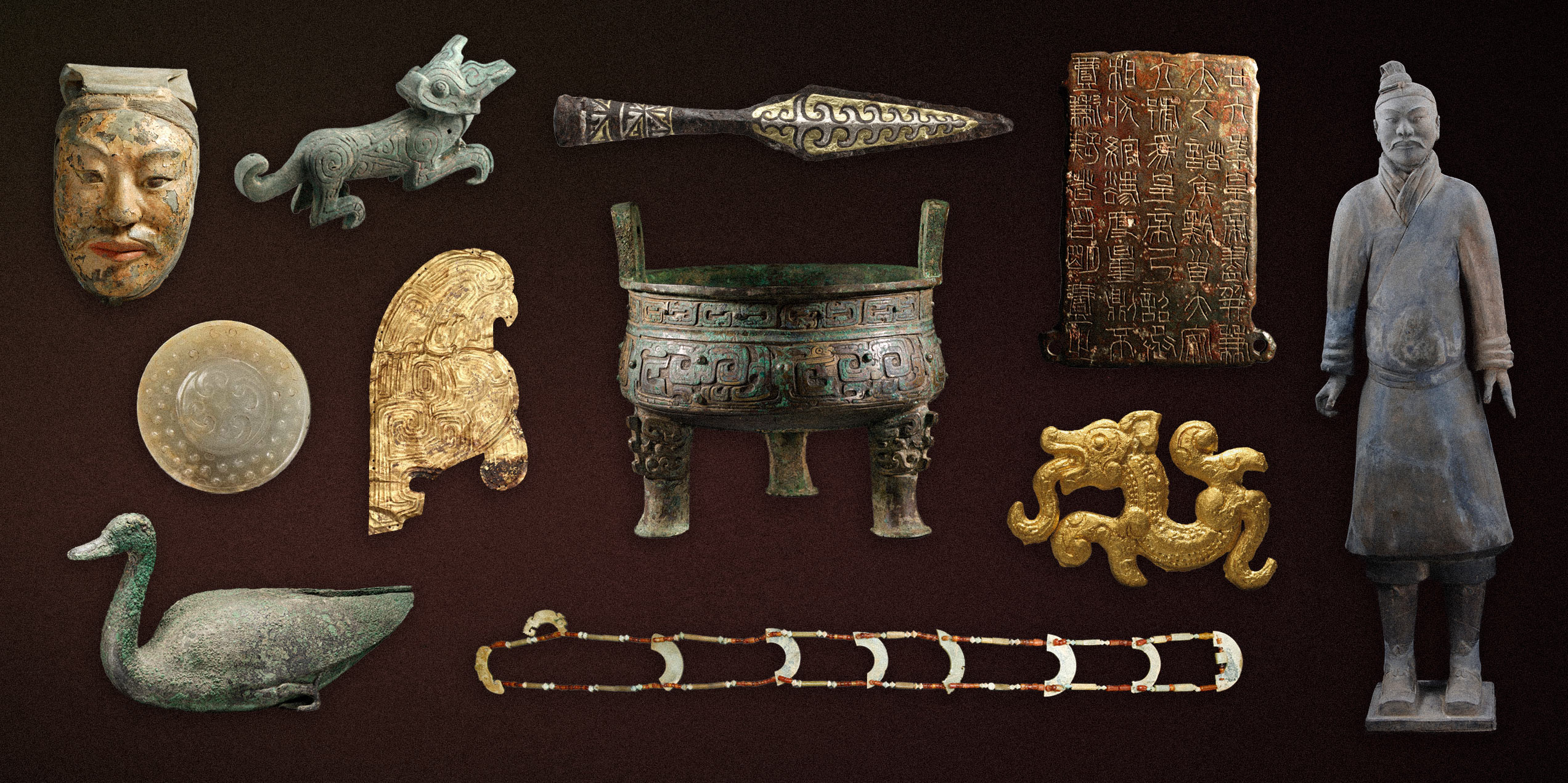
For example, archaeological evidence shows that, while the Central Plains states remained fixated on traditional materials like bronze and jade, the Qin had developed a taste for the gold artifacts popular on the Eurasian steppe.
Likewise, Qin animal motifs tended toward naturalism, in stark contrast to the abstract, stylized animal decoration found on Central Plains ritual vessels of the same era. In the sacrificial pits at the Emperor Qinshihuang’s Mausoleum Site Museum, archaeologists have found 46 examples of bronze waterfowl — swans, geese, and cranes — each life‑size, posed differently, and strikingly realistic. Even more remarkable is a solid gold camel figurine, so finely wrought that even its toenails are perfectly realized.
The influence of steppe cultures wasn’t limited to art. The Qin’s position also gave them a crucial technological edge.
Take metallurgy, for example. The Qin were early adopters of multiple important metalworking techniques. For centuries, the Central Plains region had favored the “lost-wax casting method” for casting ceremonial and military objects: melting metal, pouring it into a mold, and allowing it to cool and solidify. But gold pieces unearthed from Dabuzi demonstrate Qin mastery of a different process: the repoussé technique, in which gold is heated until soft and repeatedly hammered to stretch it into thin sheets or into the desired shape.
Breakthroughs in one area spawned others. Beyond metallurgy, the Qin built large-scale water conservancy projects such as the Zhengguo Canal and Dujiangyan — still functional today — which dramatically boosted agricultural yields. They invented the two-shaft chariot and introduced the “exotic livestock” of the northwest — donkeys and mules — as pack animals, improving carrying capacity and efficiency. Their craftspeople also invented new materials, including “Chinese purple,” a synthetic pigment that requires precise control of firing temperature and proportions of raw material to produce.
According to research by Wang Zijin of Northwest University, by the late Warring States era, Qin held a leading position over the other six states in multiple technological fields, including water conservation, transportation, and machinery.
They also had a highly advanced state system that enabled the deployment of these technologies at scale.
Archaeologists have found evidence of an early quality-control process known as wu le qi ming, in which artisans were required to carve their names on the objects they produced so their supervisors could trace each item back to its creator.
Perhaps the best-known example is the “Lü Buwei Halberd,” forged in the second half of the first millennium BC. Its inscription identifies four individuals involved in the weapon’s manufacture: the highest supervising official, the workshop master, the workshop assistant, and the individual craftsman who produced it, suggesting that Qin weapons production operated under a highly structured chain of accountability.
Excavations at the Emperor Qinshihuang’s Mausoleum Site have likewise shown that Qin bronze trigger mechanisms were produced to tight specifications. Components made by the same workshop group were interchangeable, while different types of crossbows were distributed systematically across different sections of the battle formation. This suggests that Qin had achieved standardized, interchangeable, large-scale weapons production — a factor now regarded as a key military advantage in Qin’s wars of unification.
“In my view, Qin’s greatest technological advantage over the six states was not any single invention, but the establishment of a large-scale standardized production system,” says Qian Wei, Dean of the Institute for Cultural Heritage and History of Science & Technology at the University of Science and Technology Beijing. “That organizational innovation was the decisive factor behind Qin’s victory.”
Systemic change
The Qin’s moment of glory lasted less than a quarter-century: a decade to conquer the six Warring States, then 15 years for it to all fall apart.
Yet the Qin’s legacy has endured — its achievements and failings remembered, debated, and ceaselessly revisited.
That’s not just because it was the first empire to unify much of what is today China, or because of its standardization of writing, currency, and weights and measures. Much of its importance stems from its political system, which centralized imperial authority through a commandery-county administrative structure — a governing logic that would shape China for more than two millennia.
Unlike the nobility-based system of the earlier Zhou dynasty, which was based on blood ties, the commandery‑county system was centrally administered. Officials at all levels were directly appointed, evaluated, and transferred by the central government. That allowed central power to reach down through the bureaucratic apparatus, from prefecture to county to township to village, and from there to every household in China.
The question of how this system evolved has long puzzled scholars, with some arguing it wasn’t an indigenous invention at all, but another technology the Qin borrowed from the Western regions — specifically the Achaemenid Persian Empire.
This seemingly far-fetched idea has a certain logic. If the Qin interacted extensively with the Western Rong and other steppe nomads during its rise, then it may also have encountered — directly or indirectly — civilizations further west.
The late Sinologist Jao Tsung-I was one of the first to suggest there may have been some connection between Qin and the Achaemenids. As evidence, he pointed to a linguistic coincidence. After unifying China, Qin referred to commoners as qianshou (“black-headed people”), a phrase previously unseen in Chinese sources. In the Cyrus Cylinder, created in the 6th century BC in honor of the Persian conquest of Babylon, Persian subjects are likewise referred to as “black-headed people.”
Does that mean the Qin had been influenced by Persian norms? Jao chose his words carefully, merely expressing “some suspicion” of a link between the two, without reaching a firm conclusion.
Another scholar, the late Duan Qingbo — former director of the excavation team at the Emperor Qinshihuang’s Mausoleum Site Museum — was bolder. He repeatedly proposed that the political civilization of the Persian Empire may have influenced the Qin’s imperial institutions. In his view, Qin policies such as the commandery-county system, codified laws, imperial roads and relay stations, the standardization of weights and measures, script unification, the use of grandiose imperial titles, and the implementation of large-scale construction projects all bore striking similarities to the policies of the Persian king Darius I (c. 550–486 BC).
But Duan’s views have gained little support from other scholars.
According to Wang, the founder of the Early Qin Culture Project, similarities between the two empires merely reflect the comparable challenges they faced. Both Qinshihuang and Darius I ruled vast territories populated by diverse peoples and cultures. Given the circumstances, centralization was a natural choice, as were standardization, road construction, legal codes, and other forms of administrative integration.
“Look at the roads, for example,” Wang says. “The Roman Empire also built extensive road systems. Does that mean Rome copied Persia?”
Wang adds that many core features of Qin political culture took shape in the state’s early developmental stages. Take its approach to ethnic conflict: Through centuries of exchange and warfare with the Western Rong, the Qin developed a sophisticated approach to managing conquered populations. What began as military conquest and forced relocation gradually expanded to include conciliation, trade, and reward systems. Administratively, the Qin governed tribes through specialized structures, including subordinate states and frontier districts known as dao.
“This approach was later used extensively during Qin’s unification of China,” Wang notes.
Northwest University’s Liang acknowledges that the Qin likely did have some exchanges with Central and Western Asia. At Yuandingshan cemetery in Lixian, for example, archaeologists unearthed a bronze model chariot with wheels that suggest it was Central or Western Asian in origin.
“But that’s it,” Liang says. “Aside from a few luxury items, there is no evidence that the Qin Empire was influenced by Persia.”
More evidence can be found in the Qin’s burial customs. Funerary rituals often reflect core aspects of a people’s identity. “The state religion of Persia was Zoroastrianism, which holds that burying corpses pollutes the earth,” Liang says. “That is why Persian royal tombs are cut into rock. In stark contrast, Qin tombs were dug deep into the earth — the deeper, the better. The two worldviews are polar opposites.”
As for the commandery-county system, Liang has no doubt it was a Qin invention. In fact, he led the archaeological team that identified the first-ever county established by the Qin. “That was more than 2,700 years ago,” he notes. “More than a century before Darius I.”
Liang is more interested in other questions, such as where the Qin originally lived and how they served the Shang. And while scholars now have a relatively clear picture of the Qin’s repeated capital relocations during its eastward expansion, the locations of one or two capitals remain debated.
These questions have been unresolved for centuries, but new archaeological discoveries are finally putting them within reach.
“Don’t be impatient,” Liang says. “Remember, the Early Qin Culture project has only been going on for a little over two decades — that is far too short by archaeological standards. The Qin people walked a path of more than 800 years.”
Visuals: Ding Yining and Fu Xiaofan.
(Header image: Visuals from the Shanghai Museum, reedited by Sixth Tone)