Alone and Adrift: How a Chinese Businessman Survived Six Days in Open Water
After plunging into the deep, dark, icy water, Qin Jianping quickly fought his way to the surface. He felt disoriented but could still hear the buskers playing for tourists taking a late-night stroll along the nearby promenade.
In those first few minutes, he was confident someone would soon spot him and call for help. But then the waves began slowly dragging him further from shore.
It would be another six days before he reached land again.
To survive in open water, the 41-year-old entrepreneur says he clung to buoys, ate raw crabs, and attempted to keep warm using his own urine, all the while enduring an onslaught of jellyfish.
On the day he was finally rescued by two fishermen, the Chinese authorities and his family had already begun to believe he was dead.
Cold and alone
Qin had only intended to stop off in Haikou, capital of China’s southern Hainan province, for a few days. He arrived on the island on May 27 after making a business trip to a cooking oil refinery in nearby Guangdong province.
A decade earlier, Qin had launched a failed lychee wholesaling business in Haikou, leaving him penniless. He wanted to revisit the place where he had met financial ruin.
Upon his return, he wandered through a night market and enjoyed some local street food. Feeling it was too hot to sleep, he drove to a seaside plaza off the city’s central Binhai Avenue to make some business calls and take an evening stroll along a seawall.
Qin talked on the phone for about an hour, until his battery was almost dead. Around 11 p.m., he rounded a bend that took him away from the crowds and into a secluded area. He remembers slipping in the darkness, losing his balance, and suddenly falling over the edge into the sea.
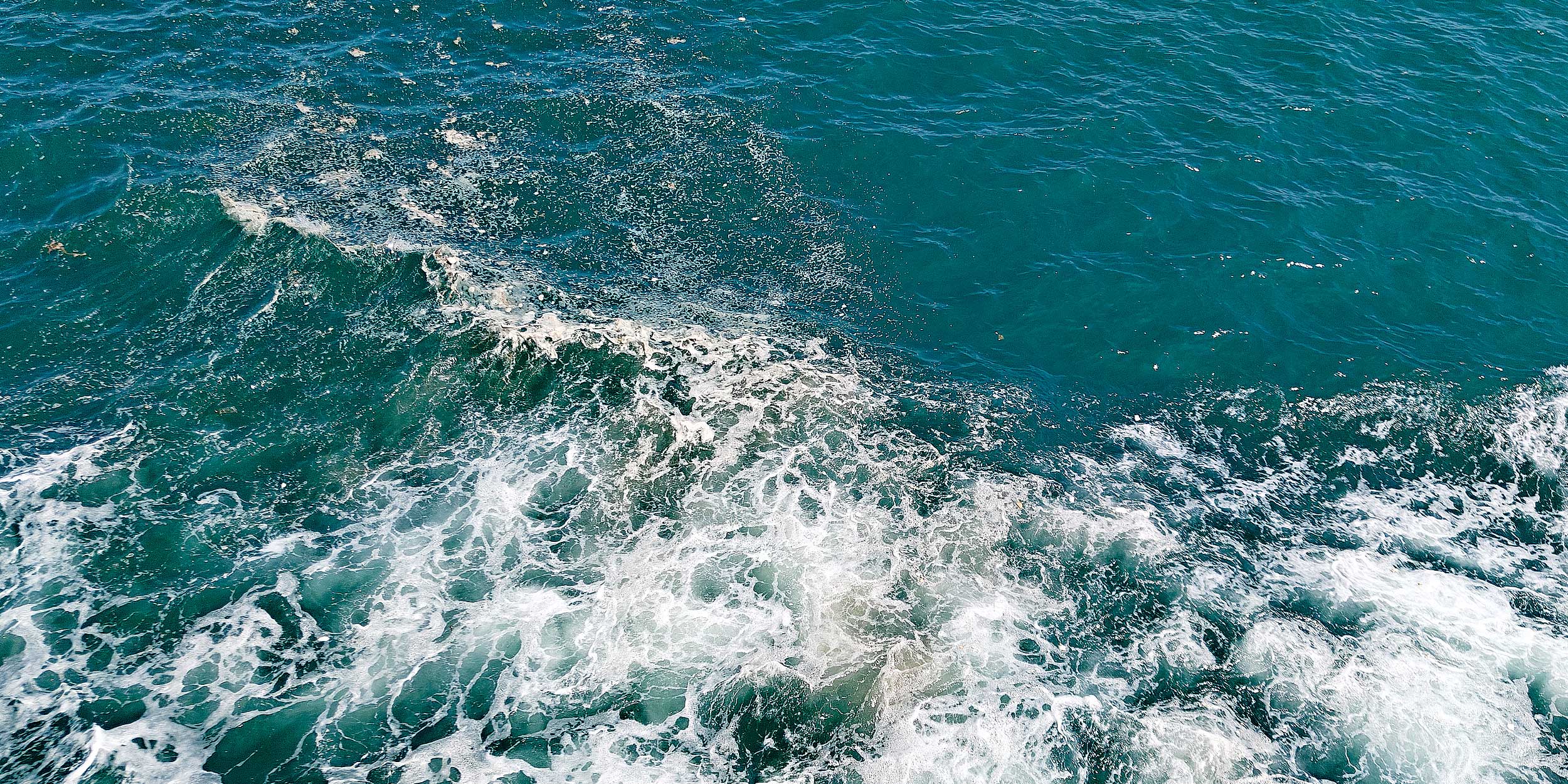
With the tide still receding, over the next few hours Qin was pulled kilometers out into the Qiongzhou Strait, which connects the South China Sea and the Beibu Gulf.
Despite the bitter cold, he initially attempted to swim back to shore, but the currents and seaward wind were against him. He could only tread water and watch as the Haikou coastline shrank into the distance — and then disappear completely.
During that first night, Qin began noticing jellyfish rising from the depths. He says he could see only their ghostly silhouettes in the water as they attached themselves to his body.
By now, Qin was too exhausted to swim and had no idea which direction would take him to safety, yet he was determined to remain calm. “You can’t panic,” he says. “Once you’re in panic mode, you can’t do anything.”
Waves were pounding him relentlessly. Qin tried floating on his back to conserve energy, but seawater kept rushing into his mouth and nose. Instead, he had to tread water, keeping pace with his heartbeat. He resolved to wait until the sea calmed before making another attempt to swim.
Drifting alone in the darkness, the seawater stinging his eyes, he told himself, “If you are able to swim and don’t panic or swallow seawater, it’s actually hard to sink.”
When dawn finally broke, the jellyfish retreated to the depths, and soon the blazing sun had turned the sea a pure shade of blue. At one point, Qin thought he saw a coast guard vessel and a jet ski, maybe 700 to 800 meters away, but he couldn’t swim toward them. “The more you try, the harder the water batters you, and it carries you farther away,” he says.
The wind and waves felt gentler in the day, but there were strong undercurrents. After the predawn ebb, the tide slackened and began to rise. Believing he might be facing shore, he tried swimming with the incoming tide, only to encounter a series of rip currents that swept him in the opposite direction.
He still held onto the hope that other currents might carry him back to shallower coastal waters.
Later, Qin recalls spotting a passenger ferry. As he had long dispensed with the shirt, shorts, and shoes he’d been wearing when he fell, he stripped off his underwear and waved it above his head to draw the crew’s attention, but the swell of the water was too high. Just days earlier, Qin had traveled on a ferry just like it from Guangdong to Hainan. Now he could only watch it sail away.
Blank horizon
As a businessman, Qin has seen many ups and downs in life.
Born to an impoverished family in Guilin, a picturesque city in the southern Guangxi Zhuang Autonomous Region, he left education after middle school and joined the military, serving as a cook in Foshan, Guangdong. Standing just 1.63 meters tall, he had hoped army life would toughen him up.
After being discharged at 22, he opened a 24-hour restaurant with an army buddy in Dongguan, a nearby industrial city. As neither knew much about running a business, the eatery eventually closed.
Qin then returned to his hometown, bought a truck, and started a wholesale vegetable operation, buying produce from farmers and reselling it to urban vendors. After building up some capital, he teamed up with another former serviceman to lease some lychee orchards in Haikou. Unfortunately, poor market conditions wiped them out.
Over the next decade, Qin clawed his way back one odd job at a time. He now owns a wholesaling business selling grain, cooking oil, and sugar, as well as a chicken farm.
He was going to need every ounce of his resilience to bounce back this time. Exhausted, thirsty, hungry, disoriented, and badly sunburned, he says days would pass without him seeing a single vessel — and he’d abandoned all hope of swimming back to shore.
To find warmth in the frigid sea, he had made himself as small as he could and then urinated, but the relief was fleeting.
One evening, Qin spotted a buoy roughly 2 or 3 meters in diameter topped with plastic rods supporting a navigation light, likely placed to mark a fishing spot.
Summoning all his remaining strength, he swam over and grabbed it. He then scrambled on top, wedged himself between two plastic rods, and promptly fell asleep. He recalls dreaming that he was back home, discussing business with someone. At one point during the night, the buoy rocked violently, and Qin was thrown back into the water.
Qin no longer had the strength to swim or pull himself up. He says that he concluded the only way was to surrender to the sea. “If you try to fight it, you will lose,” he explains.
After drifting for some time, he came across a chain of buoys connected by thick jute ropes. He grabbed the line but was suddenly struck by a strong current, causing his hands — fragile from days of being in saltwater — to slice open. He still didn’t have the energy to climb onto the buoy.
Seeing that the submerged portions of the buoys were covered with seaweed and barnacles, Qin pulled off handfuls of seaweed and ate it. He then noticed tiny crabs among the growth, so began catching them, crushing them in his teeth, and swallowing them whole. The inside of his mouth was also softened and damaged by the seawater, yet he estimates he devoured dozens of the crustaceans as he moved from buoy to buoy.
However, Qin continued to lose strength. He says he was also starting to have hallucinations, usually fragments of scenes he had witnessed as a child.
“Logically, I should have been thinking about my wife and children, my father and mother, but my brain was out of my control,” he explains. “It just kept showing me old memories.”
Thoughts of his family also brought a renewed sense of urgency. If he disappeared, he thought, people would assume he had absconded with their money — how would his wife face them? “I knew I couldn’t just leave this mess behind without a single word,” he says. “I owed my parents an explanation. I owed my wife and children an explanation. I owed my relatives and friends an explanation.”
Staring at the blank horizon, it became increasingly difficult to keep hoping a ship would appear, but Qin says he had faith that if he held on just a little longer, help would arrive.
“I believe I’m a good person. I’ve never done anything bad,” he says. “I still have so many things left unfinished. I just didn’t believe this was how I was meant to die.”
Salvation day
At nighttime, the jellyfish returned. Qin remembers their backs glowing in the dark as their tentacles clung to his body, stinging him intensely. He began slipping in and out of consciousness, losing all sense of time.
Finally, on the morning of June 2, he was spotted in the water by Zheng Shizhong and Fu Tingsan, two fishermen from Hainan’s Chengmai County. Qin recalls hearing the low rumble of their boat. By then, his head was almost completely submerged. “I couldn’t breathe. I was desperately trying to blow water out,” he says.
When the fishermen pulled him aboard, Qin was barely conscious. They say the skin on his entire body was blackened, and there were large, infected wounds under both armpits from chafing in the saltwater. Qin vaguely remembers them wrapping him in several thick jackets to stop him from shivering.
It took the boat 90 minutes to return to shore, with the landing point about 60 kilometers by road from where Qin had fallen into the water.
One day earlier, Mo Jianxiu, Qin’s wife, had been invited to a police station in Haikou to sign paperwork closing the official investigation into her husband’s disappearance. Qin was first reported missing by a friend in Guangdong on May 30 after he failed to appear at an arranged meeting, and his family contacted Haikou police the next day after speaking to one of the people Qin had called while at the seaside plaza.
Qin’s friends and business partners launched searches for him in Guangdong and Hainan. After finding his car, police reviewed the dashcam footage to determine his last-known location at the seaside plaza.
On June 2, Mo and several relatives visited the spot to burn paper offerings, believing Qin was already dead. She filled three bottles with seawater to represent her husband’s remains. By then, people were already speculating that Qin had run off with his creditors’ money, but Mo refused to believe it.
Then everything changed. Police contacted one of Qin’s friends with the news that he’d been found alive and was receiving emergency treatment at the Chengmai County hospital.
When Mo finally saw her husband, she hardly recognized him. His body was covered in wounds, with tubes protruding in every direction, and he was vomiting thick black fluid. “I was speechless,” she says.
In the intensive care unit, she gently wiped Qin’s eyes, which were swollen shut and seeping blood-tinged fluid. They spoke very little. Even when talking to reporters on June 12, Mo said she still had not asked her husband what he had endured at sea.
Qin was moved to a general ward after a day, and on June 7 he was well enough to be driven home to Guangxi by his family. Later, during a media interview, he casually peeled dead skin from his body, saying, “I’m not an invalid.”
When Mo met with reporters, Qin was asleep in their hotel room. His phone had been lost at sea, so over the previous few days he had been using hers to make business calls and pay his employees.
Qin had returned to the ebb and flow of everyday life — but now his family was by his side.
Reported by Ge Mingning.
A version of this article originally appeared in The Paper. It has been translated and edited for brevity and clarity, and is republished here with permission.
Translator: Carrie Davies; editors: Wang Juyi and Hao Qibao.
(Header image: Waves in the Qiongzhou Strait, 2025. 500px/VCG)