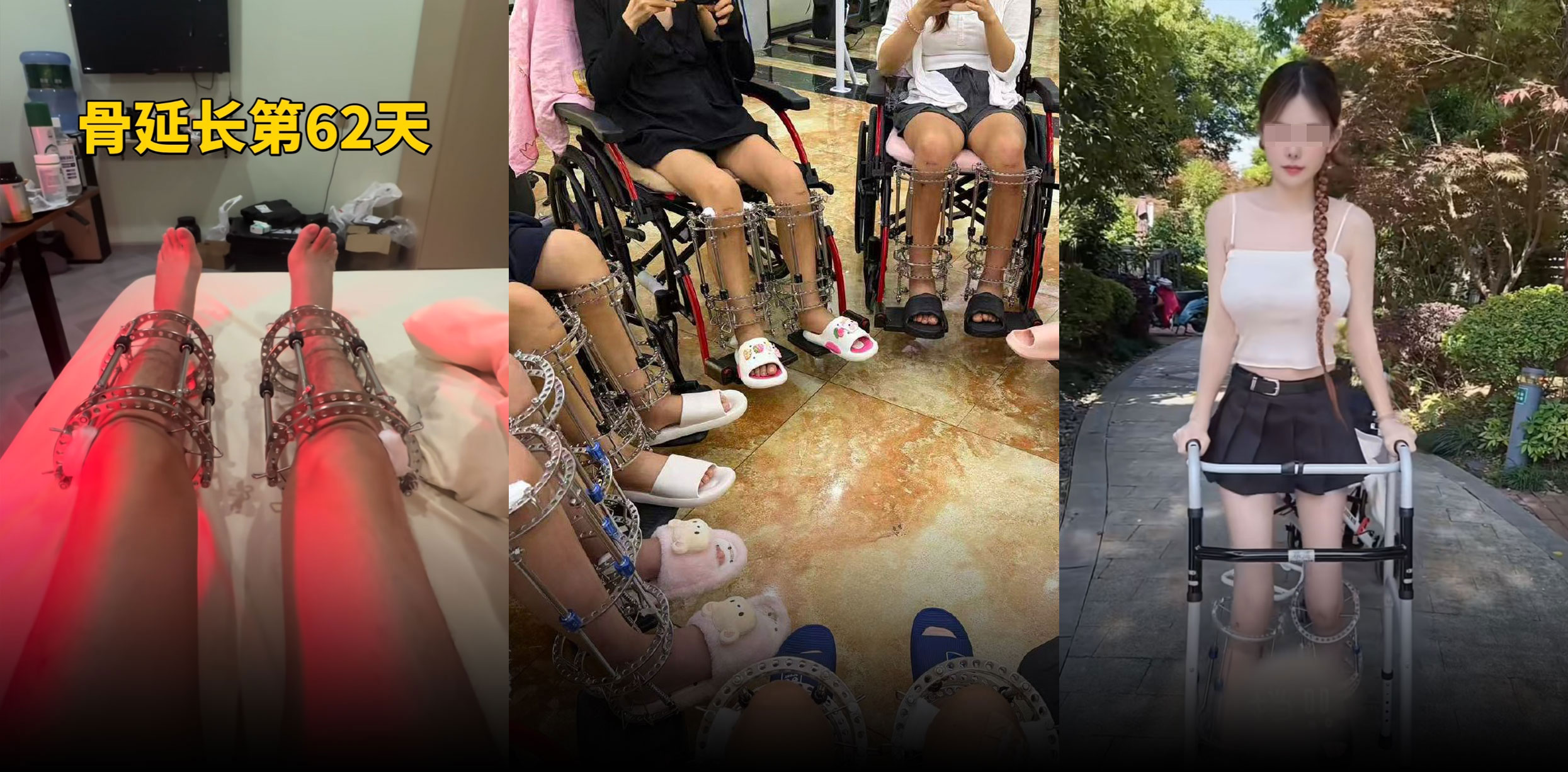
Investigation Uncovers China’s Underground Height Surgery Market
A Chinese investigation has uncovered a black market for expensive limb-lengthening surgeries in China and Southeast Asia — and those who have undergone the surgeries are often left with lifelong pain, infections, and regret.
The investigation, published Monday by domestic media outlet Jiemian News, identified numerous underground surgical facilities operating across China and abroad. The market comprises orthopedic surgeons and brokers, many of whom are former patients who underwent limb-lengthening and use their own stories to attract clients. Brokers can earn a commission of 15,000 to 80,000 yuan ($2,100 to $11,700) per referral, depending on their rank and the surgical institution they refer to.
Limb-lengthening surgery involves cutting the femur or tibia in two and attaching a metal frame that pulls the bone segments apart at a rate of 0.5 to 1 millimeters per day, while stimulating new bone growth.
Patients can choose between two methods: external fixation, in which an adjustable metal cage is fixed to the outside of the leg and secured to the bone with pins, and intramedullary nailing, in which a metal rod is inserted into the bone and advanced from within. External fixation has a 15% to 20% complication rate, whereas intramedullary nailing has a lower rate of infection and leaves minimal scarring. In China, costs typically range from approximately 100,000 yuan for external fixation to 400,000 yuan for intramedullary nailing.
While cosmetic limb-lengthening is legal in countries such as the U.S., Germany, and South Korea, China banned the practice for cosmetic reasons in 2006. The regulation limits the surgery to medical necessities, such as birth defects, injuries, tumors, or infections that cause limb deformities.
Jiemian News identified two major limb-lengthening rings in China: one in Kunming, capital of the southwestern Yunnan province, and another in Nanjing, capital of the eastern Jiangsu province. In Nanjing, a ringleader surnamed Li quoted 120,000 yuan for the procedure — plus 36,000 yuan for recovery in a rented apartment — but refused to disclose the surgeon’s identity or location, citing the need for secrecy to protect them from repercussions for performing the surgery illegally.
The report details how Chinese influencer Wu Shuang, a pseudonym, opted for limb-lengthening surgery in Laos earlier this year due to insecurities about her 1.54-meter height. She told domestic media that the operating room was messy and that the staff weren’t wearing masks. After the surgery she experienced complications, including infections and pain that she likened to “being stabbed by needles” and “knives cutting through tissue and bone.”
Originally, Wu was scheduled to have surgery in Yunnan, where her medical records would be falsified to show she suffered from bowlegs or knock-knees to justify the surgery. However, because the surgery was reported to Chinese authorities by competing limb-lengthening brokers, Wu was forced to seek the procedure in Laos instead.
Brokers often operate through groups on the messaging app WeChat, answering questions and sharing videos to attract new clients. Many of these brokers, unable to return to work due to complications from their own limb-lengthening surgeries, remain in the industry to recruit others.
The interviewees approached by Jieman News all reported having felt “lured” into surgery by brokers. Feng Jiqiu, also a pseudonym, said brokers added her to a WeChat group of over 100 people. She said that seeing messages about successful surgeries and deposits actively being paid within the group gave her a false sense of security. Five years after her surgery — performed in Turkey — Feng continues to suffer from chronic bone infections.
Chinese psychologist Wang Kui said that unrealistic beauty standards can lead to self-blame and irrational attribution, in which individuals blame their failures on their looks and believe changing their appearance will solve their problems.
Looking back, Wu admitted she can no longer comprehend her former decision. “Why would a perfectly healthy person pay a huge sum of money to have their legs broken?” she said.
Editor: Marianne Gunnarsson.
(Header image: Left and right: Screenshots from the social media accounts of influencers sharing their experiences with limb-lengthening surgery. Middle: Limb-lengthening surgery patients at an underground surgical facility. From Douyin and Jieman News)