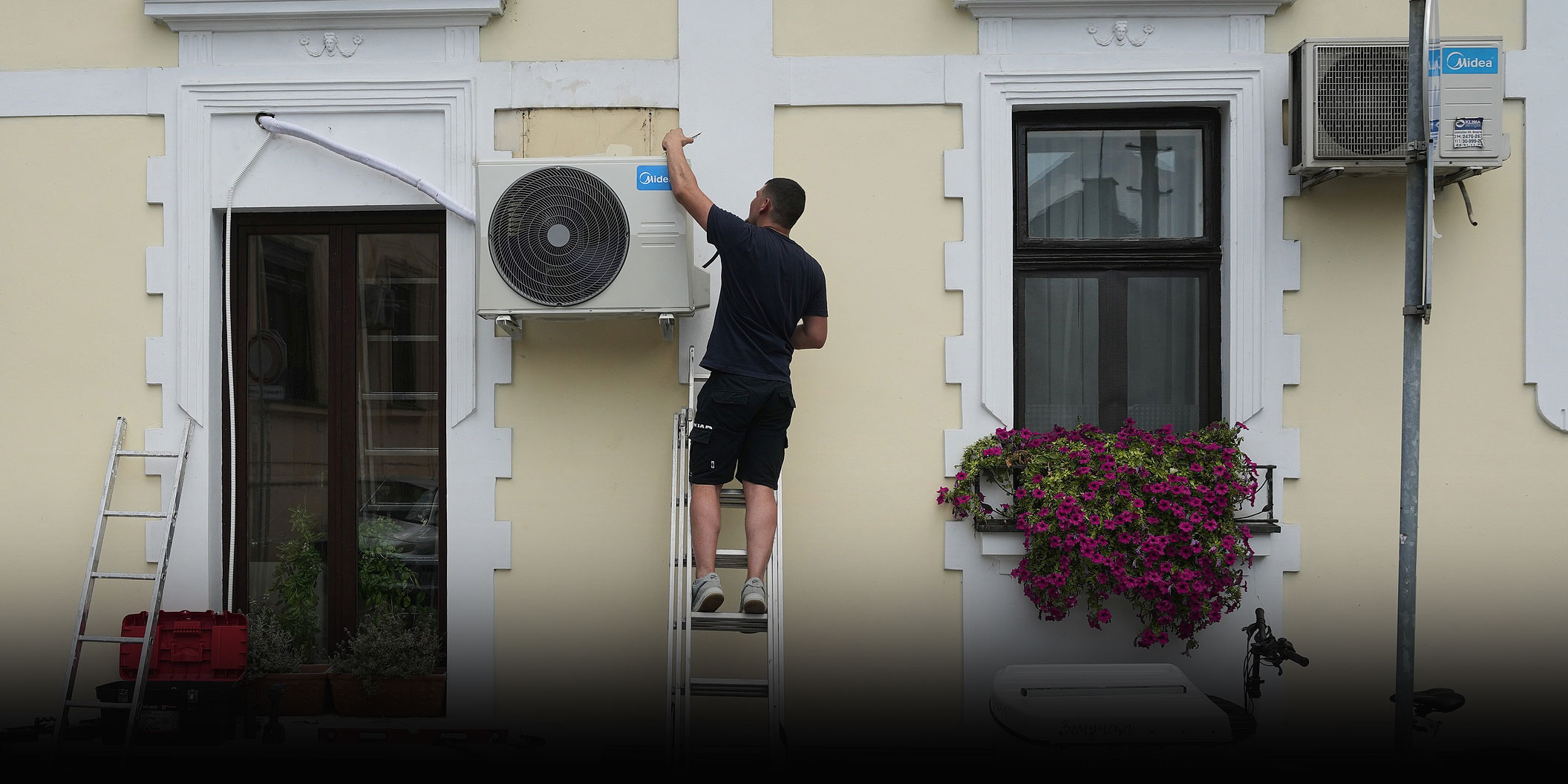
As Europe Swelters, Chinese AC Sales Heat Up
Europe’s summer heatwave has driven daily high temperatures consistently beyond 40 degrees Celsius in several countries — and with them, a sharp rise in demand for cooling products, especially China-made portable air conditioning units.
Western Europe’s typically mild summers have meant air conditioning has historically not been a necessity. According to data from the International Energy Agency, the overall ownership rate of air conditioning equipment in Europe is only about 20%.
But this year’s heatwave, beginning in late May, has caught the continent off guard. Germany reported a record-high temperature of 41.3 degrees Celsius last Friday, while France reported approximately 1,000 excess heat-related deaths as of Tuesday.
As a result, portable air conditioners — often cheaper than standard installations, costing 400 to 1,000 euros ($455 to $1,100) per unit — have become some of the most sought-after products during this year’s heatwave, with Chinese manufacturers emerging as the biggest beneficiaries.
“People have been flocking to air-conditioned libraries during the day,” Zhang Yuan, who works in the architecture industry in Munich, told Sixth Tone. “I also saw people using the fountain at the University of Munich as a makeshift pool.”
Zhang said that many Western European homes, schools, nursing homes, and hospitals were never designed for sustained high temperatures. In contrast to Southern European residents, Western Europeans do not rely heavily on air conditioning, nor are they used to organizing their days around escaping the heat.
Buildings in Germany tend to prioritize measures such as shading, natural ventilation, and low-energy fans, Zhang said. But if nighttime temperatures fail to drop or a room lacks ventilation, traditional strategies such as using thick walls for insulation and nighttime heat dissipation become ineffective.
Zhang added that air conditioner installation is often more complicated than in China, since outdoor units typically require approval from landlords or homeowners’ associations, especially in older buildings where changes to façades are tightly regulated. High installation costs, noise concerns, and limited contractor availability have further slowed adoption.
According to domestic media, portable split-type air conditioners, largely manufactured by Chinese companies such as Gree, Hisense, Midea, and Dreame, are in high demand and out of stock in many stores. In a post on X, one consumer said he “traveled 200 kilometers” around Austria to buy the last Midea PortaSplit — one such air conditioner — in stock.
German software developer Adrian Kübel even built a website to track the real-time inventory of Midea PortaSplits at more than 1,100 stores across Germany. The website currently shows that only one store has units in stock.
“The market penetration rate of traditional split-system air conditioners in Western European countries is only about 6%, meaning that the market holds immense potential demand for cooling products,” Xiong Xueqin, the regional sales director of Midea RAC Europe, told Sixth Tone.
Specifically developed for Western Europe after years of targeted research, Midea’s PortaSplit has seen its sales jump to 200,000 units in 2026, double from last year. Priced at 1,000 euros per device, it weighs under 10 kilograms, is quiet, and doesn’t require professional installation.
Faced with surging demand, Xiong said the company has ramped up production. Once manufactured, products take around 15 to 25 days to reach Europe via the China-Europe Railway Express.
Chinese consumer electronics manufacturer Dreame has also reported strong demand for its 400-euro portable air conditioner, the P-Wind. Wu Jun, head of the company’s air conditioning department, told Sixth Tone that since the P-Wind was launched locally in late May, weekly sales in June have exceeded 1,000 units, with the initial batch expected to sell out by July.
According to China’s General Administration of Customs, from January to June 2025, China’s air conditioner exports to EU countries increased by 43.2%, reaching a total value of $3.76 billion.
Editor: Marianne Gunnarsson.
(Header image: An installer sets a new air conditioning unit during a hot summer day in Belgrade, Serbia, June 30, 2026. Darko Vojinovic/AP Photo/VCG)