How Chaoshan Business Was Built on Morals, Not Contracts
This is the second article in a series on China's southern Chaoshan region, exploring the history, culture, and identities behind its recent resurgence in the spotlight. Read Part 1.
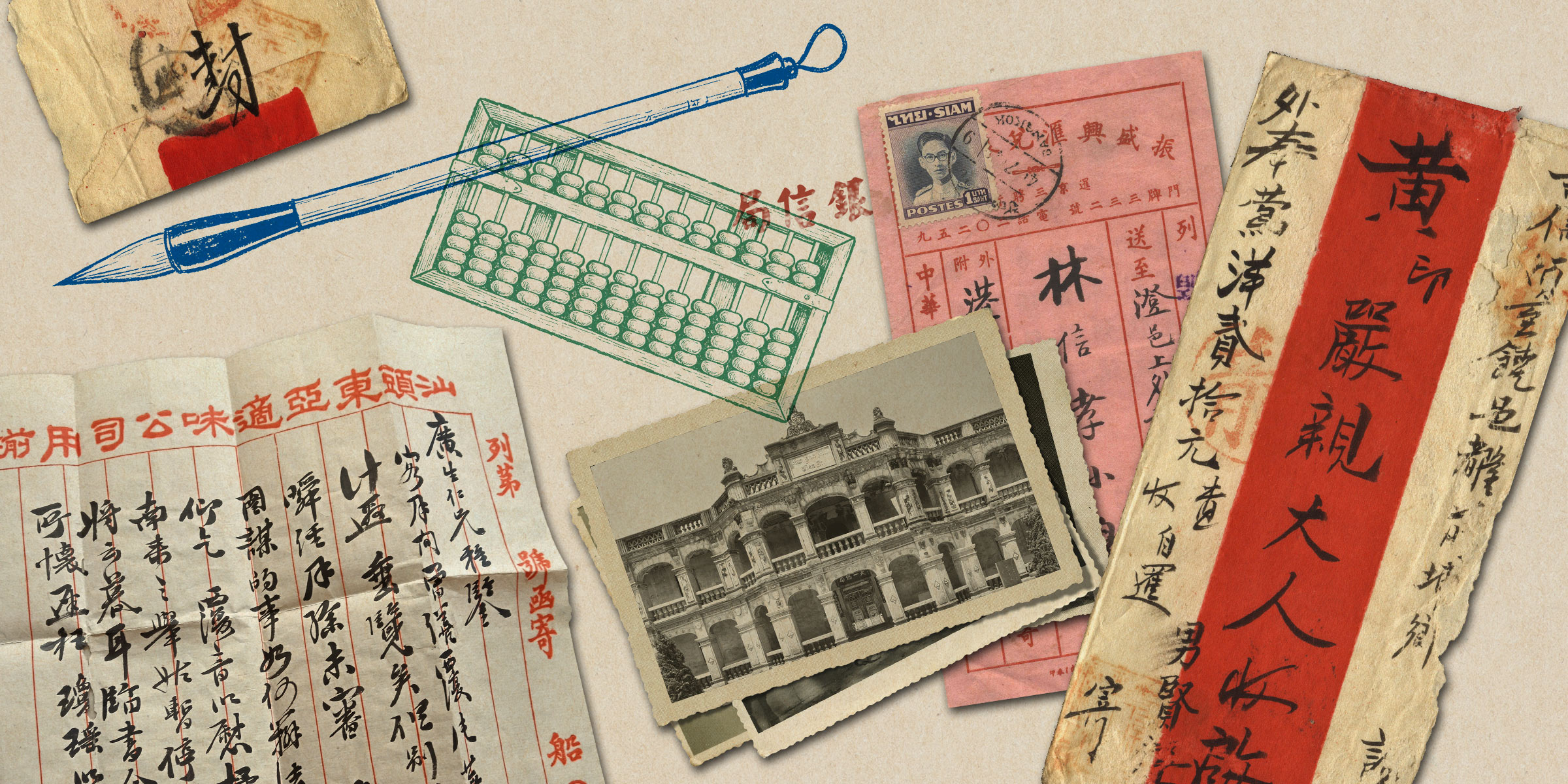
In the Chinatowns of early 20th-century Bangkok, Chinese laborers who had just collected their wages would make their way to the qiaopiju, a private institution that handled remittances and correspondence on behalf of overseas Chinese communities. They would reach into their pockets and hand over nearly all their monthly earnings to the man behind the counter.
Most of these migrants had come from villages in the Chaoshan region, the eastern part of China’s Guangdong province, driven across the seas by war, poverty, and the pressures of survival. The money they earned wasn’t just for themselves. It was for the families they had left behind. And so, every payday, their priority was getting that money home as quickly as possible.
The clerk would flip open the ledger, record the amount, and ask for the recipient’s name, village, and household. Since many of these workers were illiterate, the qiaopiju also doubled as a letter-writing service. In the Chaoshan dialect, the men would dictate the words they wanted their families to hear:
“Has mother’s illness improved?”
“I sent the money. Please take good care.”
When it was all done, the worker would leave with nothing but a handwritten receipt. A few days later, the letter and remittance would depart Bangkok, via Hong Kong, Shantou, and other relay points, before finally reaching home.
More than a century on, the archive of qiaopi documents has been called the “Dunhuang of overseas Chinese history,” and in 2013, it was inscribed in UNESCO’s Memory of the World Register. Much of the scholarship and artistic work surrounding qiaopi has focused on the letters themselves. These texts represent an irreplaceable collective memory, written jointly by emigrants and the families who waited for them. But qiaopi was never just about the letters. It was also about the money. That is where my research, conducted during my doctoral studies at the Institute of Asia-Pacific Studies at Waseda University in Japan, was focused.
Every qiaopi sent generated a handling fee for the qiaopiju. But my research found that, for many of these firms, the fee was only one piece of the revenue picture. The more significant profits often came from the currency exchange business. Look closely at the qiaopi documents themselves, and a curious pattern emerges. Many Chaoshan emigrants ended up in Thailand, where they earned Thai baht. Yet the currency recorded in their remittances was frequently Hong Kong dollars.
Why Hong Kong dollars? Because at the time, Hong Kong served as a crucial trade and financial hub connecting Southeast Asia with South China. Many qiaopiju operated exchange offices in Hong Kong, or worked with local money changers and banks there, converting baht into Hong Kong dollars before completing settlement and earning on the spread.
Some firms went further, weaving trade directly into the remittance process. After receiving baht from an emigrant in Thailand, they might use those funds to purchase rice, sugar, or cloth to ship to Hong Kong for sale; with the Hong Kong dollars earned, they would then buy goods needed in the Chinese market and ship them on to Shantou. In this way, money that would otherwise have to cross borders in cash was instead settled through the flow of goods. This reduced the risks of transporting cash while generating additional profit.
In other words, the qiaopiju was never simply a money-and-letters operation. It was a transnational commercial network that wove together trade, finance, and the lives of migrant communities.
But the truly remarkable thing about the qiaopiju isn’t its business model. It’s the question of why anyone trusted it in the first place.
Think about what those workers were handing over: nearly a full month’s income — money they had worked hard for, and which their families back home relied on. No wire transfer. No bank guarantee. No protective legal contract. Yet this web of private remittance houses, stretching thousands of kilometers across borders, held together for more than a century and almost never collapsed.
If your first instinct is to say “they had no other choice,” you’re only half right. The real answer lies in a mechanism far older than any contract: a trust-based network built on shared origins, kinship ties, reputation, and long-term relationships.
For Chinese emigrants living far from home, trustworthiness was not just a matter of personal character. It was a matter of survival. Overseas Chinese communities in Southeast Asia at the time lacked robust legal protections, and China itself was mired in prolonged instability, leaving ordinary migrants with little recourse to state power when things went wrong. In such environments, what people could rely on was the networks around them: relatives, fellow villagers, and clan associations.
What a worker trusted, therefore, was never just the clerk standing behind the counter. It was the vast web of relationships that the clerk represented. A person’s conduct reflected not only on themselves but on the reputation of their family, their clan, and their community’s collective judgment of them. To break faith meant losing more than a transaction. It risked forfeiting the trust of an entire hometown network. It could mean being unable to make a life abroad, and dragging the reputation of family members back home down with you.
This is why qiaopiju were extraordinarily reluctant to renege on their promises, and why workers who had been paid in advance worked hard to honor their commitments. What held the system together was not legal enforcement but the continuous pressure of monitoring and accountability within the relational network itself.
This kind of trust, grounded in the familiarity of a close-knit community, is different in kind from the trust that modern commercial society derives from contracts and institutional safeguards. In the Chaoshan world, the sum of these relationships, obligations, reputations, and promises has a name that is both simple and deeply resonant: qingyi — a word that might be translated as moral obligation, emotional loyalty, or simply: doing right by people.
In much of modern business thinking, commerce and personal feelings are treated as belonging to separate spheres. Contracts, rules, and institutions are meant to keep personal relationships out of business. In that logic, qingyi belongs to private life, while trade belongs to the market.
But in Chaoshan culture, things work differently. For Chaoshan people, qingyi is not merely a matter of personal sentiment. It also functions as a credit mechanism. It helps people identify trustworthy partners, reduces the risks associated with information asymmetry, and enables cross-border transactions even in the absence of legal protections. Qingyi and business are not in tension with each other. They are mutually sustaining.
In practice, many qiaopiju took on far more than remittances and letters. They helped emigrants trace lost relatives, gathered news from home, forwarded medicine and supplies, and extended credit to their customers. During the War of Resistance Against Japanese Aggression, when transport routes were cut and foreign exchange became nearly impossible to obtain, huge volumes of qiaopi remittances could not complete all the old cross-border financial procedures. To ensure that emigrants’ families could keep going, many qiaopiju would often send out payments on credit to workers who had fallen on hard times.
Strictly speaking, these services increased costs and raised risks. But for a qiaopiju, the long-term relationship and trust it had built with its clients were themselves valuable assets. Qingyi, in this light, was no longer simply a moral expectation. It became a social mechanism capable of generating trust, organizing cooperation, and connecting resources across great distances. It sustained transnational families. It undergirded transnational commercial networks. It was both a cultural value and a practical resource, one of the essential foundations on which business could continue to run.
And so, when those workers walked out of the qiaopiju with nothing but a thin slip of paper in their hands — a receipt that was not legally enforceable in the modern sense — they knew the money would get home. Not because of rules. Because of relationships. Not because of the law. Because of qingyi.
Perhaps this is what is most enduring about Chaoshan culture. It never placed commerce and qingyi on opposite ends of the scale. Through generations of transnational migration and commercial life, the two gradually merged into a single social logic. The qiaopiju are long gone. Yet in the overseas Chinese communities of Southeast Asia today, people still instinctively ask where a new acquaintance is from, what dialect they speak, and who they both know. In business partnerships, reputation, trust, and long-term relationships still matter. The wisdom of turning relationships into credit, and credit into cooperation, has outlasted its era. It remains alive. It is the enduring grain of Chaoshan commercial culture.
Translator: Dasha Cowley; portrait artist: Wang Zhenhao.
(Header image: Visuals from the author and VCG, edited by Fu Xiaofan/Sixth Tone)