The Soybean That Built Northeast China
In 2020, I traveled to Kaishantun, a town in the Yanbian Korean Autonomous Prefecture near the China-North Korea border. It fit every stereotype of the deindustrialized Northeast. Young people had left. The government had built two rows of barracks-style apartment blocks for the elderly residents who remained. Kaishantun railway station had long been abandoned. On the station sign, the space for the next stop was blank. North Korea lay only a few hundred meters away.
On the walk back, I wandered into a derelict movie theater and discovered several reels of old film. Later restored, they revealed something astonishing: clips of a symphony orchestra and a traditional folk orchestra.
What kind of small town could support two orchestras of its own?
As I dug deeper into the history of my home region, Northeast China, I found that part of the answer lay in a crop that today frequently appears in international headlines: soybeans. A century before China became a major importer of American soybeans, it was the world’s leading producer.
In August 1872, three Japanese army officers, disguised as merchants and acting on the orders of General Saigō Takamori, traveled through “Manchuria,” the term they used for Northeast China. Saigō was studying relations between Japan, Korea, and China as he prepared a future campaign against Korea. A year later, the officers submitted their “Report on an Inspection of Manchuria,” one of Japan’s earliest intelligence briefings on China. The report includes a detailed discussion of soybeans:
“From winter through spring, soybeans are continuously transported by inland waterways. Regardless of the cold, day and night, dozens of horse-drawn carts move in a single direction. Large merchants purchase the beans and pile them into circular mountains more than two rooms across and over 6 meters high … The quantity stored is beyond counting.”
In 1885, another Japanese military officer, Kikuchi Setsuzō, passed through Northeast China on his return from the Russian Empire. Along the way, he studied how Qing forces fed their military horses, which he regarded as superior to those of Japan and Russia. Qing troops processed the residue left after soybean oil extraction into pressed soybean cakes for animal feed. Each cake weighed about 12.5 kilograms and could feed three horses for a day. Kikuchi even claimed such soybean resources would be “indispensable” for training military horses.
In the 19th century, Kikuchi was among the few who grasped soybeans’ strategic significance. The crop had reached Europe and North America in the 18th century but remained largely a botanical curiosity. A handful of enthusiasts, such as the Austro-Hungarian agronomist Friedrich Haberlandt, sought to introduce soybeans into Western diets. Yet while they imported the crop, they did not import the culinary traditions that had made it a staple across Asia.
In East Asia, by contrast, people had accumulated more than a thousand years of experience cooking and consuming soybeans. They also recognized the crop’s value as animal feed. After the Meiji Restoration in 1868, Japanese rice farmers gradually abandoned traditional fish-based fertilizers in favor of soybean cake. Between 1882 and 1902, Japan’s soybean imports increased four-hundredfold.
The Russo-Japanese War of 1904–05 finally alerted the world to soybeans’ importance. European military observers noted that both sides relied heavily on the crop. Japanese forces consumed soybeans directly and used them in military logistics. Russian forces fed them to cavalry horses. Soybean oil served as a raw material for soap and as a lubricant for artillery equipment and wagon axles.
The soybean trade expanded rapidly. A 1911 report from the Customs Service in Shanghai observed that “It is only in the last three years that soya beans have become important in intercontinental commerce,” calling their rapid emergence from obscurity “one of the most remarkable commercial events of recent times.” In the same year, the U.S. ambassador in Beijing told the State Department that Northeast China had until recently been largely unknown for its commercial potential, despite supplying soybeans to global markets. He observed that its economic trajectory was now drawing attention in major cities including New York, London, Hamburg, and Seattle, and attributed this shift to soybeans, whose rapidly growing demand he characterized as “phenomenal in trade annals.”
Estimates suggest that Northeast China accounted for between 16% and 42% of global soybean production between 1908 and 1930, shipping soybeans, soybean oil, and soybean cakes to the rest of China, Japan, and Europe. Until the eve of World War II, China produced more than 80% of the world’s soybeans. The crop became widely known as the “Manchurian bean.”
Soybeans were also among the most important exports of a then largely impoverished China. After World War I, their importance grew rapidly, and by the 1920s they had overtaken tea and silk to become China’s leading export, accounting for more than 20% of export earnings.
As trade expanded, so did Japan’s territorial ambitions. In the run-up to Japan's formal annexation of Korea in 1910, Yanbian became a frontier along the China-Korea border where Chinese and Japanese spheres of influence met directly. Japanese strategists viewed the wider Yanbian area as a gateway to the interior of Northeast China and sought to build a railway linking the Korean port of Chongjin with China’s inland Northeast. General Hasegawa Yoshimichi, commander of Japanese forces in Korea, regarded Yanbian as a vital supply corridor for sustaining colonial rule on the peninsula. He advocated occupying the region to secure access to strategic commodities such as soybeans.
Over the following three decades, Japan steadily expanded its influence in Northeast China. In 1931, Japanese forces seized the region and took control of its economic resources. This expansion, justified in the name of protecting economic “lifelines,” would later extend across Asia during the Pacific War to the oil fields of Burma, Sumatra, and Borneo; the rubber plantations of Malaya; and the chromium and iron deposits of the Philippines.
In Yanbian, war and colonial rule only reinforced the region’s economic importance. Beyond soybeans, Japanese authorities coveted the region’s timber. In Kaishantun they established the Eastern Manchuria Rayon Pulp Company, whose output eventually surpassed that of most producers in Japan. After the Chinese Communist Party won the civil war and founded the People’s Republic of China in 1949, the new state’s flagship pulp and paper enterprise was established in the same town.
Factories brought more than jobs. They brought hospitals, movie theaters, and even symphony orchestras.
Yet by then Northeast China was no longer the sole center of the global soybean trade. By the early 20th century, American farmers were already familiar with soybeans, using them to replenish soil and support other crops. After the Russo-Japanese War, however, the crop’s industrial potential attracted growing attention.
One unlikely champion was Henry Ford. He used soybean protein and soybean-oil derivatives in automotive components and in 1941 unveiled a prototype car with body panels made largely from soybean-based plastic. To demonstrate its strength, he famously struck it with an axe.
Ford’s soybean car was hardly a commercial success, but it generated publicity for the crop. When Japan severed America’s access to Asian supply routes during the Pacific War, soybeans were transformed from an industrial curiosity into a strategic resource. Combined harvesters and advances in plant breeding helped American farmers scale up production.
By the 1950s, the center of gravity in soybean production had shifted decisively to the Americas.
One final piece was still missing from the modern soybean map: Brazil. In the early 1970s, a major El Niño event, a climate pattern that warms the Pacific Ocean, devastated the Peruvian anchoveta fishery, a key source of animal feed, driving demand for soybean meal. Prices surged, and in 1973 the Nixon administration imposed restrictions on soybean exports.
History then took an ironic turn. Japan, heavily dependent on imported American soybeans, increased its investment in South American agriculture, while Brazil’s agricultural research agency, Embrapa, developed soybean varieties suited to tropical conditions. The result was a dramatic expansion of Brazilian production.
In 2024, more than 70% of China’s soybean imports came from Brazil. When trade tensions between China and the United States intensified in 2025, Brazil became China’s principal alternative for former U.S. suppliers.
Northeast China remains the country’s most important soybean-growing region, producing the beans that become tofu and soy milk on Chinese tables. But it no longer supplies the world with soybean oil and soybean meal. Once-thriving industrial towns have been swept up in the tide of deindustrialization, leaving behind abandoned railway stations and empty movie theaters.
From an unassuming plant in Northeast China to one of the world’s most traded agricultural commodities, the soybean’s history is ultimately a story of globalization. A soybean harvested in Paraguay may be processed in Argentina, sold to China by a trading house in Geneva, and eventually find its way into milk, cakes, or meat products. It shapes what we eat, how we farm, and how nations interact with one another. It also shapes the fate of countless small towns, including places like Kaishantun.
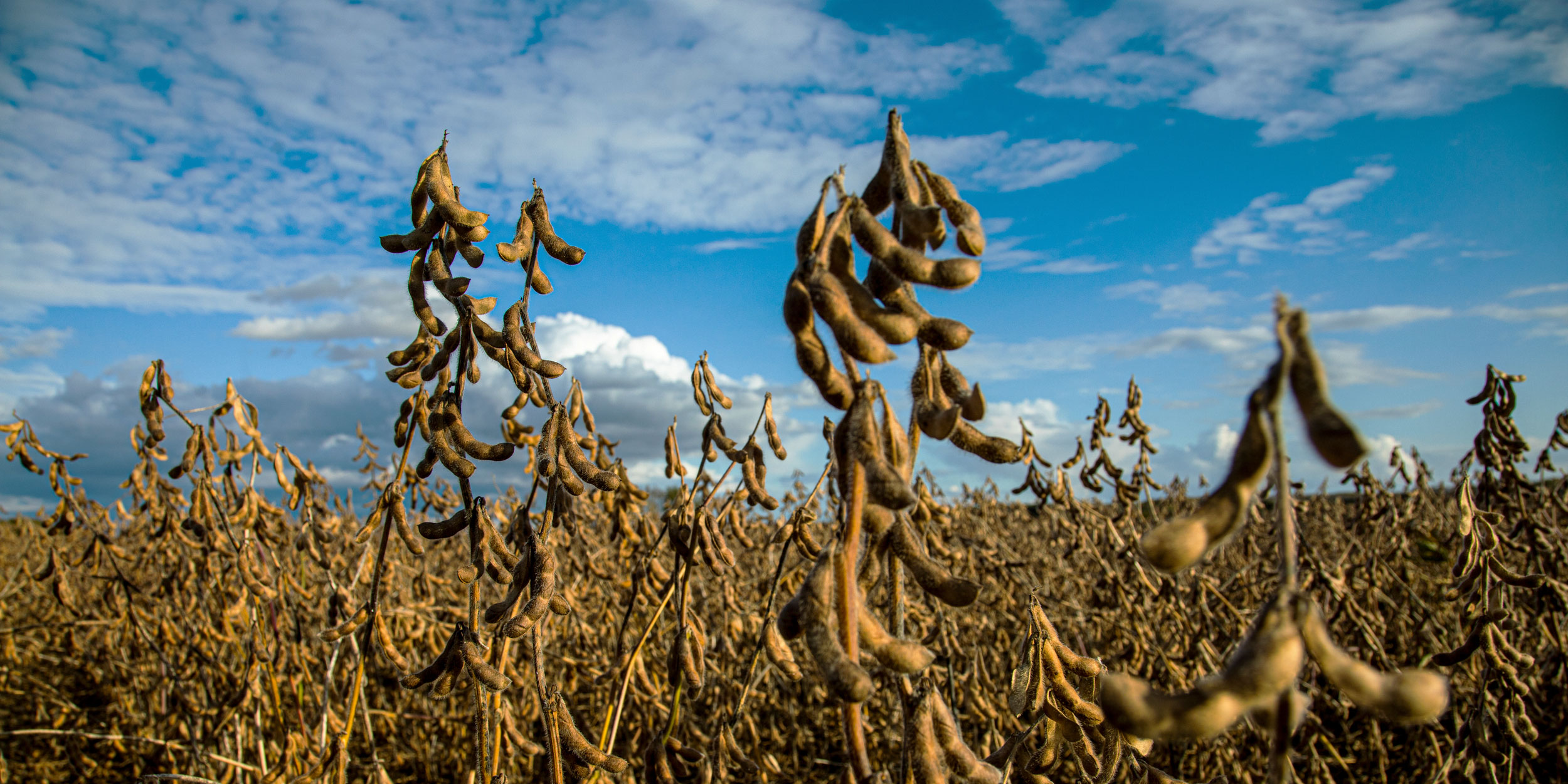
(Header image: A soybean field in Xingkai Lake Farm, Heilongjiang province, 2023. VCG)