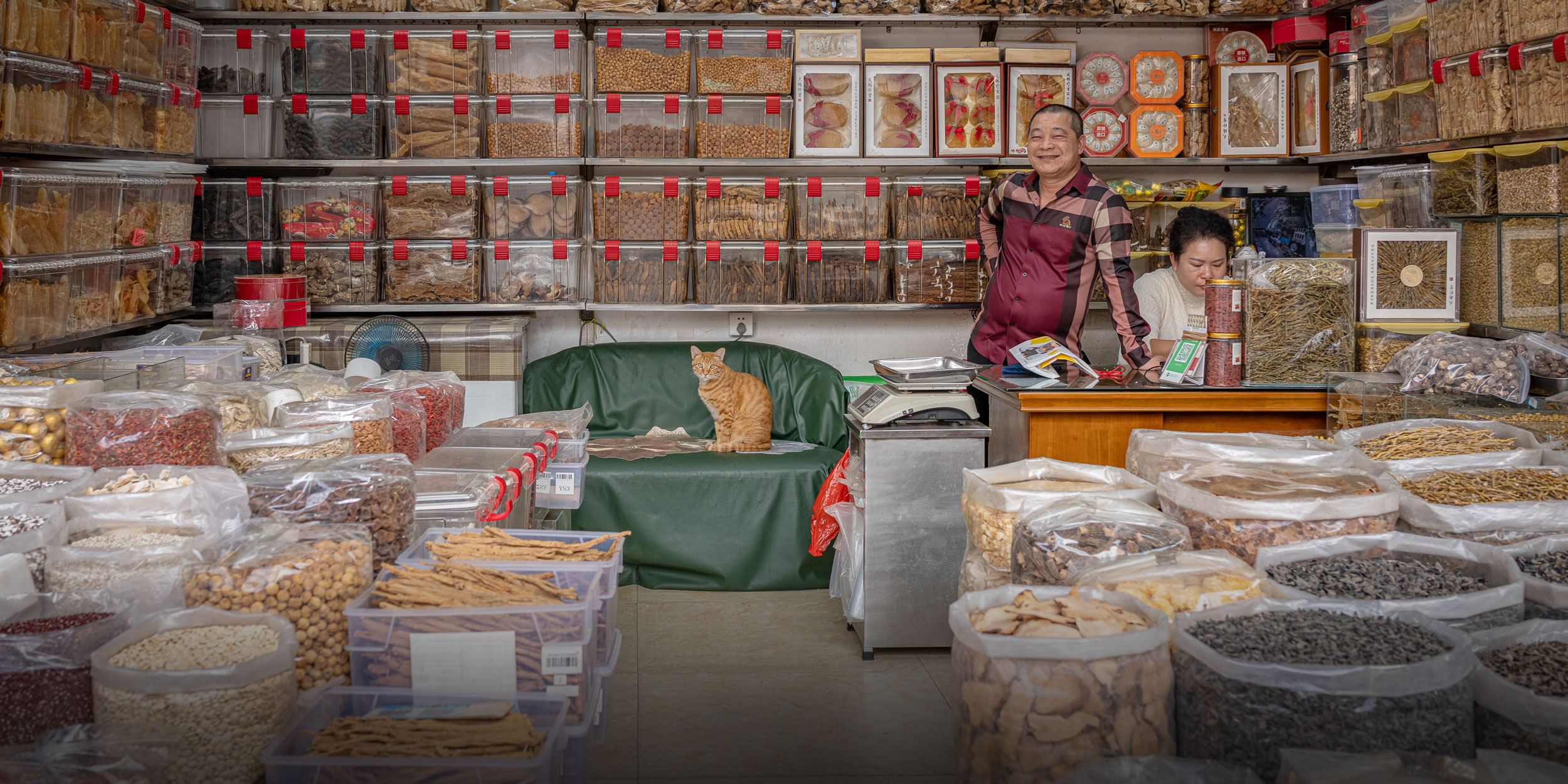
Through the Eyes of Shop Cats
“These days, it’s much harder to find shop cats in Shanghai than it was 10 years ago.”
Marcel Heijnen would know. Over the past decade, the Dutch photographer has traveled across China, photographing cats in aging storefronts, crowded workshops, and narrow alleyways.
Along the way, he witnessed neighborhoods in transition. Old lanes gave way to cafés. Family-run shops became modern retail spaces that no longer needed cats to keep rats away. “I’m glad that I started 10 years ago, just taking some photos,” he told Sixth Tone, “because some of those photos that are in the books can’t be taken anymore now.”
Since 2016, Heijnen has published a series of photobooks dedicated to the shop cats of Hong Kong, Guangzhou, and Shanghai. In 2026, the project was brought together in “Hide-and-Seek: China’s City Cats” — the title plays on the word for “hide-and-seek” in Chinese, literally “hiding cats” — a four-volume collection featuring photographs from nearly 20 cities across the country.
Heijnen first arrived in Asia in 1992 and spent more than three decades in the region as a graphic designer, musician, and photographer, primarily dividing his time between Amsterdam and Hong Kong. A lifelong cat lover, he began photographing the animals after realizing he missed having feline companions of his own.
“For me, the series works as a cross-cultural bridge,” Heijnen told Sixth Tone. “Chinese readers feel deep nostalgia for the vanishing alleyways and local neighborhood life, while international audiences get an intimate glimpse into everyday Chinese culture through these cats.”
In an interview with Sixth Tone, Heijnen reflects on a decade of photographing China’s changing cityscapes, his approach to shooting on location, and the stories his images tell about neighborhoods in transition.
The interview has been edited for length and brevity.
Sixth Tone: How did your cat photography project get started?
Heijnen: I moved to Hong Kong without much of a plan, except that I wanted to do more photography. I lived in Sai Ying Pun, where a new metro station opened in 2015. During my daily walks to a nearby coffee shop, I noticed many shops had cats resting on counters or goods. I took a few photos with my iPhone, and people suggested I make a book about these shop cats, so I started this project.
At the very beginning, I simply shot cats in shops. Soon I realized photographing cats was a great way to record local culture. I started to try different shooting styles, and one of them was capturing hidden cats. Later, when I posted these photos on Instagram, people really enjoyed the fun of searching for cats in the pictures. That is how the interactive hide‑and‑seek style came into being.
Sixth Tone: Do you draw up detailed shooting plans before you travel to a new city or just go with the flow? What’s your usual routine when you’re out photographing?
Heijnen: I seldom make detailed plans. I just go with the flow. When I arrive in a city, I carry my camera all the time and wander around to look for old neighborhoods. Sometimes I only have a rough travel idea, and even decide my next destination randomly during the trip. I often walk 10 to 20 kilometers every day while shooting. Occasionally, I will search for local old areas online for reference, but most of my trips are like adventures.
Sixth Tone: Beyond pure luck, what practical observation tricks help you quickly spot cats hidden inside cluttered herbal shops or jumbled secondhand stores?
Heijnen: I have developed a special eye for finding cats after long‑term shooting. I can even sense which shops are likely to have cats and focus my attention there.
If I find a cat but it is not in an ideal position, I will wait patiently. Sometimes the cat will move to a better spot, or another cat will appear, which creates a more wonderful scene. It is a combination of observation, patience, quantity of shots, and luck.
Sixth Tone: You don’t speak Chinese. As a foreign photographer wandering local alleys, how do you earn shop owners’ trust and get permission to shoot freely?
Heijnen: Being a foreigner has been more of an advantage than a barrier. Locals often become so accustomed to the scenes around them that they overlook these shop cats, while outsiders tend to notice them more easily.
I have lived in Asia for 31 years, and China’s rapid changes still fascinate me. Language barriers have never really been a problem. Simple gestures are usually enough to show that I just want to photograph their cats, and shop owners quickly understand my intentions. In all my years of shooting, I have never been turned away.
I have many warm memories. The most unforgettable involves the cat featured on the cover of my large-format art album. The cat lives in a historic hotel in Chaozhou (Editor’s note: A city in the southern Guangdong province), where I stayed last year. Several photos I took there were selected for the cover and inside pages of the book. A few weeks after the album was completed, I returned to present a copy to the hotel owner — and to the cat. It was incredibly friendly and even wandered into my room.
Sixth Tone: What are the main differences between how Western audiences and Chinese audiences respond to your works?
Heijnen: Cat‑themed content is attractive to audiences all over the world, so there are similarities.
Chinese audiences see these photos with strong nostalgia. They recognize the familiar street scenes, old shops, and local lifestyle, and the works remind them of their own cultural roots.
Western audiences are more curious about Chinese urban culture and traditional street life behind the photos. They are interested in understanding China through these pictures. But overall, everyone loves the fun of finding hidden cats and the warm atmosphere in the works.
Sixth Tone: Over this near‑10‑year project, what major shifts have you witnessed in Hong Kong, Shanghai, and Guangzhou, and how have those changes impacted shop cats?
Heijnen: It is indeed much harder to find shop cats in Shanghai than 10 years ago, though I can still find some in brick-house lanes and temples.
Overall, all three cities are becoming more modern. Shanghai has become extremely sophisticated, just like top international metropolises. Hong Kong retains a rough, original street style while integrating modern facilities, and the mix of old and new areas is very harmonious. Guangzhou’s city center is full of modern shopping malls and LED lights, while its old blocks still keep the traditional style.
The functional relationship between people and cats has shifted. Shop cats originally existed to drive away rats and protect goods in old, simple stores. Now, many old shops are renovated or closed, and the new commercial spaces are cleaner and do not need cats to catch rats. Therefore, the number of shop cats is decreasing year by year, especially in Shanghai.
Sixth Tone: Traditional old shops continue to disappear. How do you feel about this shift?
Heijnen: I don’t feel overly sad about urban renewal and reconstruction. I think the best approach is to renovate old buildings instead of tearing them down completely. I notice that more and more people in Shanghai are aware of heritage protection and choose to retain old buildings.
Urban progress and modernization are wonderful too. The high‑tech facilities and new urban styles are also fascinating. I hope cities can strike a balance: inherit historical heritage while embracing modern development, and China is doing well in this aspect.
As urban spaces change, cats will move to new places such as cultural and creative parks and internet‑famous stores, and form new interactions with people.
Sixth Tone: What lasting value do you hope this decade of photographic documentation brings to contemporary audiences? And will you keep this cat photography project going into the future?
Heijnen: When people flip through my books, they not only have fun searching for cats but also recognize the traditional culture and warm neighborhood life in the pictures.
Documentary works do not have to be heavy and serious. This light‑hearted cat‑themed project can let more people feel the charm of old neighborhoods easily. Even though modern urbanization is advancing rapidly, a large number of traditional old neighborhoods still exist in China, and my works let more people notice and cherish them.
I will definitely keep this project going. I keep exploring new cities in China all the time, and also revisit cities I shot years ago to record changes. My shooting focus has always been urban areas, so I mainly plan to expand to more small- and medium‑sized cities in China, not rural villages.
I have already done a spin‑off project and published a book about cats in Istanbul. Some friends suggested that I shoot in Morocco, which I may try in the future. I once thought about shooting in Amsterdam, but I found that cats there are not deeply integrated into local culture, so it is not attractive enough. I will continue this cat photography project in different countries and cities.
(Headere image: A shop cat in Guangzhou, Guangdong province. Courtesy of Marcel Heijnen)