A Privet Matter: Why a Farmer Hacked Down China’s ‘Lonely’ Tree
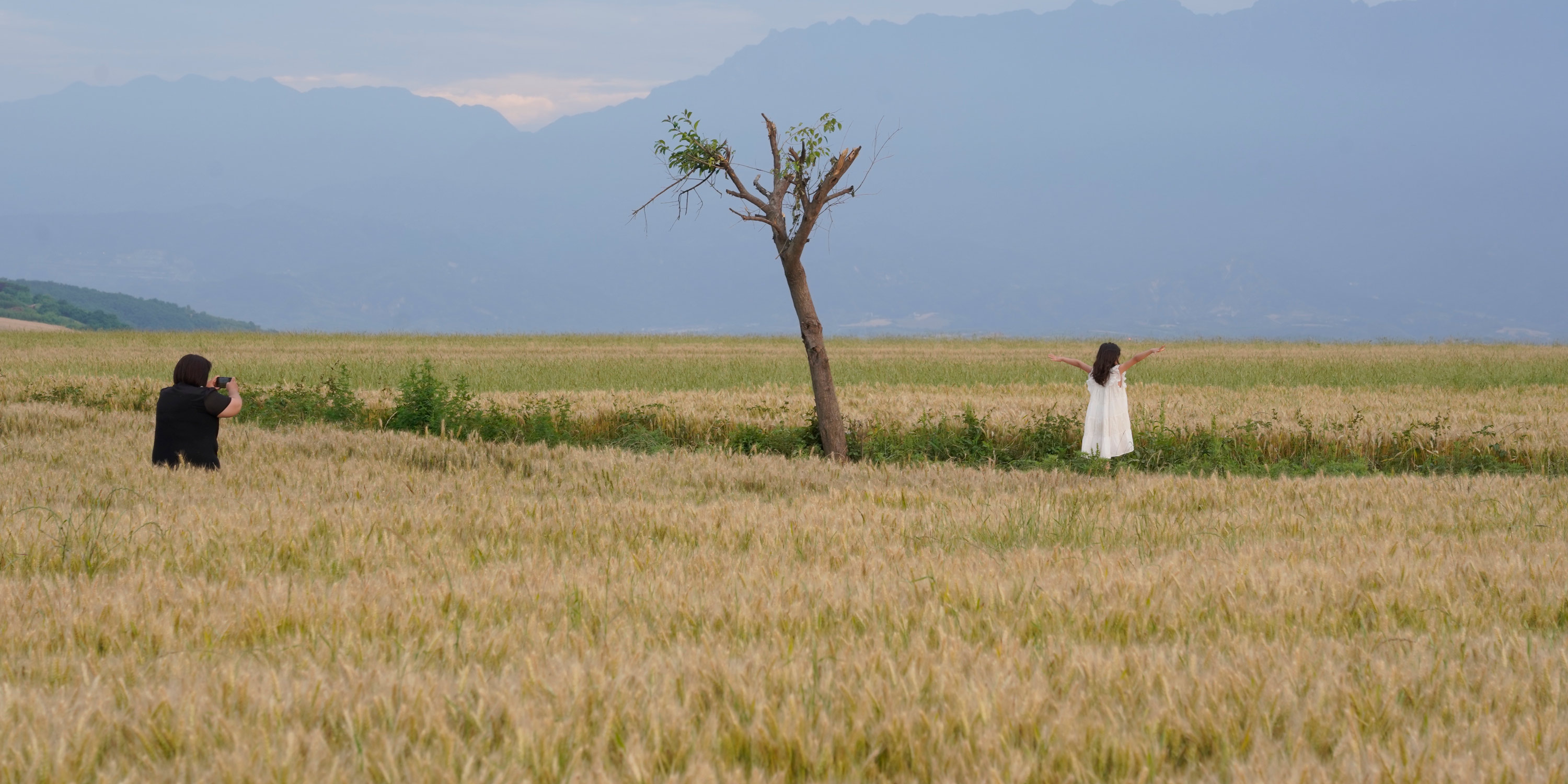
It began with a viral video filmed using a drone. The camera sweeps over vast, golden wheatfields, the surrounding peaks shifting like ocean waves, before settling on a single glossy privet, the only tree for acres around.
Within days of the video being released on Chinese social media in March, a once-quiet corner of China’s northwestern Shaanxi province suddenly became a hot destination, with tourists, vloggers, and influencers flocking to capture this tall, “lonely” tree at the foot of the Qinling Mountains.
Then, one day, Liang Yali grabbed an axe and hacked it to bits.
Forty-eight hours earlier, the 67-year-old farmer from Baimiao Village, part of the provincial capital Xi’an, discovered that tourists taking snapshots had trampled a large path through her wheatfield, which runs next to the privet.
Seeing the damage, Liang says she was so angry she “nearly coughed up blood,” adding that as she looked at the tree, she thought to herself, “I really have no choice.”
Rising around dawn on May 26, Liang hiked more than 150 meters along a steep, winding road to reach the fields before setting up a ladder and then chopping at the privet’s branches, some of which were as thick as her forearm. After a while, only one branch refused to break. She eventually yanked it down with a rope, reducing the tree to a bare trunk.
When she noticed someone was filming her, she urged them to post the video online: “Tell everyone the tree’s been cut down and to stop coming and trampling my fields.”
Exhausted, Liang set down her tools and looked across the plateau, unaware that her actions would be seen by millions — and that things were about to get a lot worse.
Treading a fine line
“Only by standing beneath the tree can you feel that sense of freedom and healing,” reads a social media post from May. Short videos also show people leaning against the glossy privet, stroking its trunk, and reaching up to touch its leaves.
For two months, tourists descended on the village to chase that “perfect shot” — a solitary tree cast against distant mountains, golden wheatfields, and a blue sky filled with fluffy white clouds. “You have to come many times and be patient,” says a photographer who visited the spot five times.
Unfortunately for Liang, the ideal position to take the picture for those with only a smartphone was in the middle of her field.
On May 22, a steady stream of people were spotted walking through Liang’s crops — women danced in colorful shawls, while men crouched among the stalks shouting directions. “They weren’t worried at all about the awns pricking them,” says one villager, who felt angry at the sight but wasn’t comfortable confronting strangers.
The crowds peaked two days later, when a fair opened in the nearby town. Villagers recall a line of vehicles stretching almost 500 meters parked along the wheatfields that afternoon.
At 7:20 p.m., Liang received a call alerting her that her wheat had been trampled. It wasn’t the first time, and previously only a few dozen stalks had been damaged. That had upset her, but she didn’t want to spoil people’s fun.
This time, however, the zig-zagging path stretched nearly 25 meters and was almost 1 meter wide. “It was wide enough that if you walked straight in, your body wouldn’t even brush against the wheat,” Liang says. Stalks lay snapped and twisted in every direction, their roots still anchored in the soil. “I nearly dropped dead from rage,” she adds.
After standing on the field’s edge for nearly an hour, Liang returned home to care for her adult grandson, who has severe cerebral palsy and requires round-the-clock supervision. She’s been looking after him for 18 years.
That night, Liang was unable to sleep. All she could think about was the trampled wheatstalks. Mechanized farming may have reduced labor, but buying seeds and hiring workers to help plow and till costs money, with expenses reaching nearly 2,400 yuan ($355) per acre. With just a few careless steps, more than half a year of hard work had been wasted.
The more she ruminated, the angrier she became. “The grain was practically already in our bowls,” she says.
The next morning, Liang grabbed a plastic cable from home and returned to her crops, picking up a 500-centimeter-long tree branch from the roadside on the way. Three cars were already parked beside her land when she got there, but fortunately no one was on it. She stuck the branch into the ground and ran the cable from the top to the glossy privet’s trunk, attempting to block the makeshift path.
She then went home to prepare breakfast for her grandson, but returned in the afternoon only to find a middle-aged woman in a red dress standing at the farthest end of the path. Liang’s cable barrier was nowhere to be seen.
When she confronted the woman, the out-of-towner argued that she was standing on a “path, not a field.” One of her companions then offered to compensate the farmer, but when Liang stepped aside to let them through, the woman and her friend ran off. Other onlookers there at the time gradually dispersed.
An idea takes root
Shortly after 6 a.m. on May 26, Liang got up, put on a colorful, striped silk blouse, khaki pants, and non-slip shoes, and grabbed an axe from the tool shed before setting off toward her field.
She had planned everything the night before. As the tree was about 4 to 5 meters tall, she had brought an aluminum ladder to reach the branches, and had arranged for a relative to watch her grandson.
Looking back, Liang has no memory of climbing the ladder or hacking off the branches. She only recalls looking down at her flattened wheat. “The blood rushed to my head,” she says. Then, with just a few whacks, most of the tree’s crown came crashing down.
Seeing the crown scattered on the ground, Liang felt a sudden pang of heartache. The privet was planted about 10 years ago among a row of saplings, but the other trees had been felled by villagers due to complaints that they blocked sunlight and slowed crop growth, or to create a wider road to accommodate large agricultural machinery.
Locals paid little attention to the tree, but during the busy farming season, villagers would gather in its shade to rest and rehydrate. “Now the other farmers won’t have a shaded place to rest anymore,” Liang recalls thinking.
Days before the tree was damaged, villagers had been discussing how to turn it into an attraction, possibly setting up stalls to sell snacks to tourists. Some saw it as a rare business opportunity.
However, as Liang swung her axe, those plans appeared to evaporate. The privet was still standing, but its limbs were gone, their severed ends exposing the pale yellow wood inside. Only one slender branch remained, rising straight upward.
By noon, Liang’s handiwork had already made local news — and people weren’t happy. Her own daughter called to express her upset, while Liang’s son and husband both warned that if she attempted it again, she should be ready to “wear silver bracelets,” a colloquial term for being arrested.
As the tree belongs to Baimiao Village, Liang knew she had no right to destroy it. Yet in the face of criticism, she has retained her trademark stubbornness. “What’s done is done. They can do what they want with me,” she says. “It was my field that got trampled. Who’s going to compensate me?”
Growing wheat on Xi’an’s Bailu Plateau, also known as White Deer Plain, is not easy. Arable land is generally found high on the area’s tableland, flat ground among the steep slopes.
Under the village policy, farm plots are reassigned every five years. Liang and her husband were allocated about 1.3 acres this year, directly next to the glossy privet. The elderly couple usually share the farm work, but because her husband was working on a construction site during the last sowing season, Liang had to sow the wheat seeds alone. However, the results were disappointing — the crops had grown noticeably shorter than those in neighboring fields and had blackened kernels.
Liang was already bracing for a poor harvest when she saw what tourists had done to their field.
Other elderly villagers who had also become fed up with the endless stream of snap-happy strangers quietly supported her, even asking why she didn’t fell the tree completely.
Younger residents and netizens saw it as a ruined opportunity to “cash in,” suggesting that Liang could have simply charged tourists to photograph the privet. However, she has little time for social media trends. “Isn’t it all just a bit of fun for people with nothing better to do? How can you make someone pay just to take a photo?” she says, adding that she was never angry about people taking photos. “It was that the grain we’d worked so hard to grow had been ruined before we’d even had a chance to harvest it.”
On June 12, the village committee announced that no action would be taken against Liang for damaging the tree. “The villagers rely on these small plots of land for their livelihoods, and crops are more important than trees,” a local cadre told a domestic media outlet. “Besides, the tree will flourish again next spring.” The cadre added that Liang had promised not to touch the tree again.
Growth potential
Liang had assumed things would quickly return to normal once she’d made the glossy privet less attractive. But no such luck. The incident appears to have made the tree even more famous. Even as temperatures rise, tourists continue to brave the relentless sun to photograph it.
Most visitors on the morning of June 1 were retirees from nearby villages. Many had learned about the glossy privet from their children living and working elsewhere, who had seen posts about it online. “We’ve got nothing better to do, so we might as well come up and take a look,” said one elderly man, who rode a tricycle with his wife in the cargo bed.
By afternoon, there were even more cars and motorcycles along the road. Many people were simply passing through on their way to or from local tourist attractions. Yes, the tree had been cut, but at least they could say they had seen it. “Checked it off the list,” says one visitor.
Among them were photography enthusiasts with drones — the same ones who’d come when the crown was still intact. Hearing the tree had been reduced to a bald trunk, they now rushed to capture before-and-after comparison shots. One felt that the chopped tree possessed a new appeal, saying, “It has an even more lonely and desolate feel.”
Liang has not returned to the field since that fateful day. “I can’t bear to see it again, it’s too heartbreaking.” When she heard that people were still flocking to take photos, she says her chest tightened.
The trunk is still alive, and in less than a year it will sprout again. Pointing to it, one resident of a neighboring village revealed that next year he plans to haul a generator out to the field and host an evening gathering by the tree. He even hopes to hire a theater troupe to come and “put on a grand performance for several nights running.”
Reported by Cong Zhixiang and Wang Xiyuan.
A version of this article originally appeared in The Beijing News. It has been translated and edited for brevity and clarity, and is republished here with permission.
Translator: Carrie Davies; editors: Wang Juyi and Hao Qibao.
(Header image: A girl poses in front of the tree as a family member takes photos of her in Liang Yali’s wheatfield, Xi’an, Shaanxi province, May 31, 2026. Cong Zhixiang/The Beijing News)