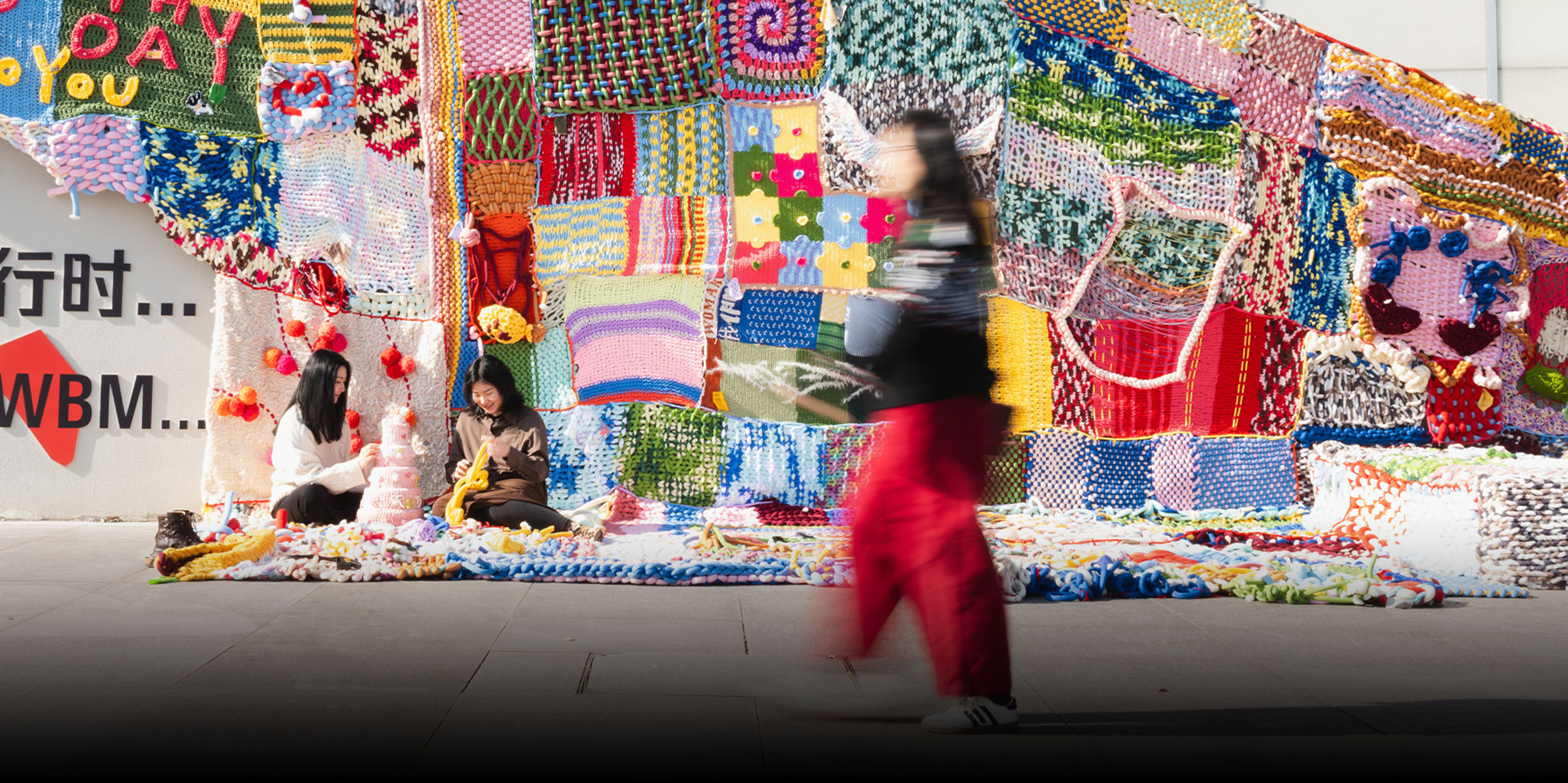
String Theory: Yarn Crafts Find a New Generation in China
On a Friday afternoon, a small group of young women gathered at Zhongshan Park in downtown Shanghai. But this wasn’t a cocktail hour or professional networking event — it was a yarn-weaving workshop.
The workshop, organized by 26-year-old Wu Jiazheng, intended to help weavers connect, learn, get help with yarn projects, and build community. At first, the conversation between the strangers, all aged between 25 and 40, revolved around weaving techniques, but it soon drifted to work and daily life.
A weaving enthusiast herself, Wu runs the workshops as a side hustle for 78 yuan per person ($11.50), posting schedules and locations on lifestyle platform Xiaohongshu, also known as RedNote. Each session usually draws around 10 participants.
“One participant told me she comes to weave because it allows her to ‘breathe,’” Wu tells Sixth Tone. “In a fast-paced city like Shanghai, finding a creative outlet like this feels really comforting.”
Over the past year, yarn crafts such as knitting, crocheting, and weaving — traditionally viewed as practical domestic skills for women — have gained popularity among young people like Wu, especially in major cities, who turn to yarn work not just to relax amid the bustle of urban life but also as a way to express their creativity and individuality.
The trend has gained significant momentum online. On Xiaohongshu, content related to knitting and crocheting has amassed over 1.5 billion views.
Enthusiasts showcase handmade creations, exchange patterns and tutorials, and connect with like-minded crafters both online and offline, often spending thousands of yuan on yarn, patterns, and workshops.
Wu first tried weaving around 2022 while at university, teaching herself through online videos and posts. Her passion for it only grew stronger as she neared graduation, but rejection by two companies after advancing to the third round of interviews had left her so tense that her hands began to tremble.
Later she discovered that both companies had used ideas she had presented during the interviews, an experience that made her rethink how she wanted to use her creativity.
In search of a refuge from the pressure, she pulled out leftover yarn she had stored away and started weaving again. The tremors gradually eased.
“As long as my hands are moving, I can escape the anxiety in my mind,” Wu says. It was then that she decided to start a weaving workshop.
Now with a stable job, her love for the craft persists, and she shares it with others via her offline events.
Some complex projects can take months to complete. Through that waiting and repetition, she says, “a sense of achievement gradually takes shape.”
But what sets weaving and other yarn crafts apart from other repetitive actions, says Wu, is the room for self-expression they offer.
Huang Yixia, a university student based in Shanghai, tells Sixth Tone that she “weaves parts of herself into her creations.” In one piece shared on Xiaohongshu, she knitted a piano-key pattern along the brim of a cashmere hat — a nod to the piano lessons she took as a child.
Threads that bind
Huang’s new hobby doesn’t just link her past self to her present projects. It also helps her build stronger links to her family.
She now uses the hours spent winding store-bought yarn to catch up with her mother. Whenever she knits, her grandmother drifts over, gently pressing the fabric between her fingers and sharing stories of the sweaters she made for the family decades ago.
Together, they talk about yarn colors, garment designs, and whether a piece is long enough to keep someone warm.
“It feels magical that crocheting and knitting can effortlessly spark conversation across generations,” Huang says. “I used to find it difficult to have deep talks with my mother and grandmother. But knitting is a natural icebreaker.”
At Wu’s weaving workshops, most participants do not arrive looking for friendship. Some, she says, even ask in advance whether introverts might feel uncomfortable. Yet the shared rhythm of stitching and the quiet, focused atmosphere seem to work their own magic, easing people into conversation.
Gao Fei is a case in point. Last week, the 38-year-old took a two-hour train from Hangzhou to Shanghai to visit yarn shops with a fellow knitting enthusiast she had met online. For Gao, knitting is about more than relaxation. Some patterns can be intensely challenging, and she says that working alongside peers allows them to learn new techniques, motivate one another, and witness the satisfaction of completing a complex piece.
She adds that she hopes that yarn shops evolve into spaces that offer more than materials — places where knitters can sit, create, and exchange ideas. Newer stores are doing just that. During her trip, Gao visited a store called Yarn Tubbies, tucked away in an old Shanghai neighborhood and featuring a large wooden table that invites customers to sit, knit, and talk.
“I wanted to shape this place as a living room for knitters,” Lin Lulu, the owner, tells Sixth Tone.
The shop’s patrons reflect the craft’s wide appeal: from primary school students in their early teens to elderly regulars, all drawn together by a shared love of yarning and creation.
Two stories about her patrons stood out to Lin in particular. One patron, an 84-year-old woman, turned out to be a martial arts master — a self-proclaimed descendant of the fictional Kongtong Sect, a martial arts school appearing in several prominent wuxia works. Another customer, a police officer, came to the shop to knit a scarf for his girlfriend, demonstrating how many use these handmade works as a means of expressing affection.
Gao, similarly, makes small, everyday items — like keychain pouches — for friends and family, each one carrying hours of patient work. Recipients, she says, are often moved not by the object itself, but by the time and effort they embody.
One winter, Gao made a pair of yarn slippers for her grandmother. Ever since, she has proudly shown them to friends, recounting how many hours her granddaughter spent making them.
“Giving handmade yarn pieces is more meaningful than ordinary gifts,” Gao says. “It’s my way of telling someone that they are important to me.”
Editor: Marianne Gunnarsson.
(Header image: A public weaving project at the West Bund Museum in Shanghai, 2025. From @上海西岸美术馆 on Weibo)