The Architecture of Creation and Demolition: Banksy, Zhang Dali, and China’s Living City
On May 7, 2026, a distinguished audience gathered at Tesa 113 in the Venice Arsenale for the 61st Venice Biennale to witness the unveiling of Banksy’s recently restored mural, “The Migrant Child.” Executed without authorization just inches above a Venetian canal, the work’s gradual deterioration under salt and humidity was central to its artistic meaning. Yet by physically cutting the stone from the façade and sealing it away in a private archive, institutions involved in the restoration carried out what can only be described as a corporate heist of public meaning.
This institutional intervention reveals a broader pathology shaping Western urbanism, one fueled by the “Authorized Heritage Discourse” (AHD) identified by theorist Laurajane Smith, and one that stands in contrast to the more fluid and adaptive logic underpinning many Chinese cities. Policies inspired by AHD deploy aggressive preservation frameworks that freeze physical environments, imposing a static and exclusionary aesthetic that elevates stone above society and turns living cities into fossilized museums.
In this antiseptic environment, urban creativity is treated as a temporary infection on a permanent stone body, and the institution’s only response is to sanitize it: chisel it off, frame it, and convert it into a liquid financial asset. This is what I call “white cube taxidermy” — the process of stripping away a work’s spontaneous and public character in order to preserve its aesthetic skin for art-world consumption.
At the same time, the obsession with heritagization in the West pushes out living communities. This degradation has accelerated through short-term rental platforms such as Airbnb, which have profoundly disrupted the socioeconomic fabric of many traditional European cities. In Venice and elsewhere in Italy, tourist consumerism has overtaken local life. This is the urban condition sociologist Sharon Zukin describes as “pacification by cappuccino,” a predatory process in which messy, organic urban life is displaced in favor of a sanitized landscape curated for visitors.
If the West has become a museum, China’s cities remain laboratories. For decades, Western critics have condemned China’s rapid urban renewal as a systematic erasure of cultural heritage. While the issue remains contentious, a longer historical perspective allows these structural choices to be viewed more objectively and their underlying logic more clearly understood. What outside observers often miss is a fundamental truth: destruction is an unavoidable and vital feature of urban existence. Without destruction, there is no renewal. Without a city’s ability to continuously adapt to the changing needs of its people, what remains is no longer a living metropolis but a simulacrum of a historical fantasy in which ordinary life becomes impossible. In many Western cities, rigid preservation structures have replaced the breathing reality of urban life with carefully managed Instagram backdrops. By contrast, anyone visiting present-day Beijing, Chengdu, or Shanghai can immediately sense that Chinese cities remain places of movement, activity, and possibility.
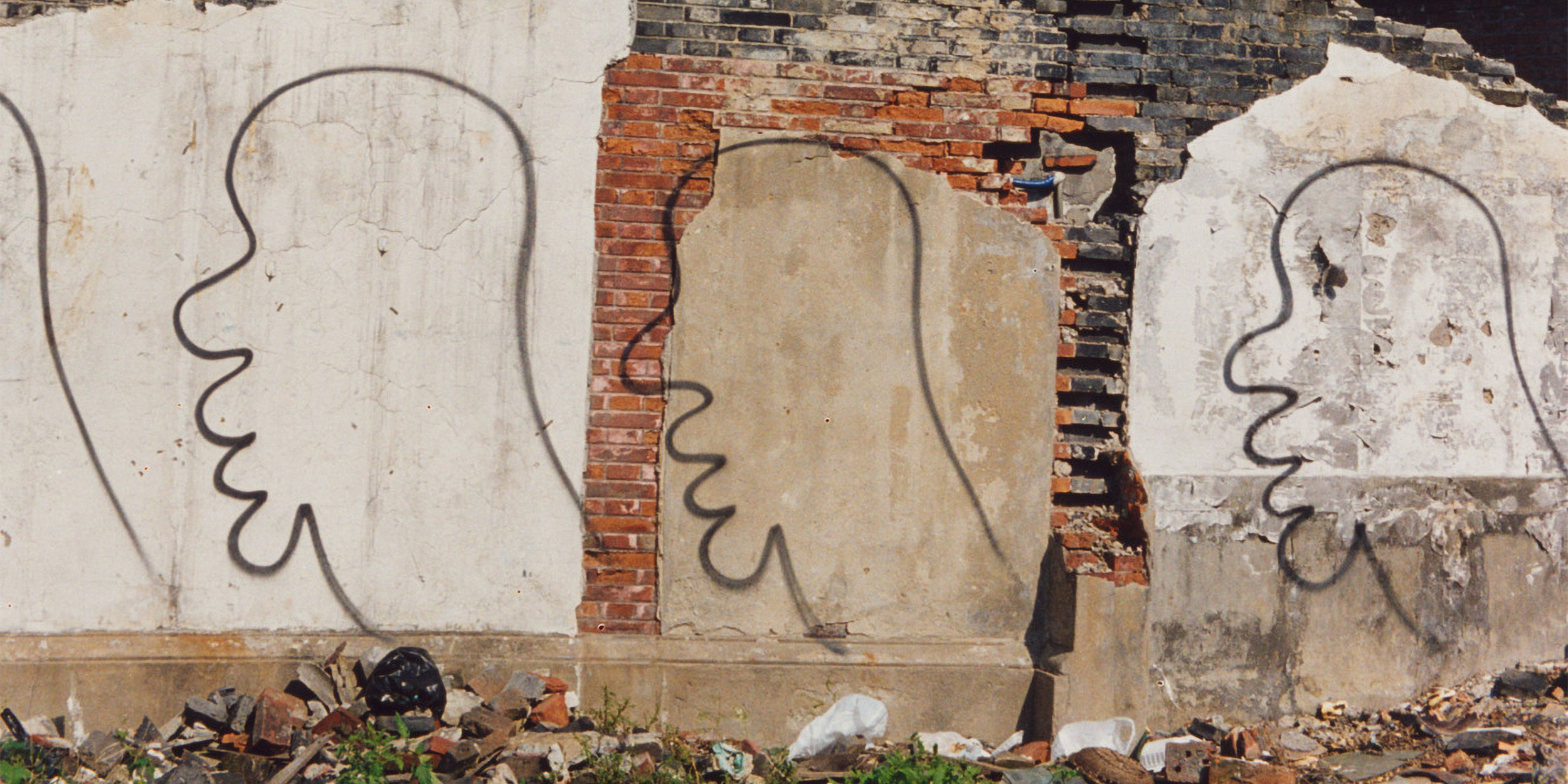
Few contemporary artists understood the relationship between urban life and destruction earlier, or more deeply, than graffiti artist Zhang Dali. In the mid-1990s, while the global art market was only beginning to flirt with the commercial possibilities of street art, Zhang Dali was already engaged in a visceral, high-stakes conversation with the disappearing hutongs of Beijing. His Dialogue series, which featured spray-painted profiles of his own head alongside the character chai (“to demolish”), offered a masterful example of urban metabolism.
His work interrogated urban development while challenging Western anxieties about permanence and embracing the radical ephemerality of graffiti. He never attempted to preserve the walls he painted. He understood that the wrecking ball was coming. By spray-painting his profile and, in many cases, physically carving out the masonry inside the contour, he opened literal windows into the demolition. Destruction itself became a creative collaborator. In this dialectic between creation and demolition, the artwork does not exist despite the ruin; it exists because of it.
Zhang Dali also pioneered what I call the “amphibious artist,” someone capable of moving between the spontaneous realm of the street and the formal space of the gallery without compromising the integrity of the work. Crucially, he was among the first artists to confront graffiti’s institutionalization in a meaningful way. Rather than bringing rubble into the gallery, he brought the trace: the photograph. Images of graffiti had circulated since the 1970s, but they were often taken by outsiders and stripped of the work’s spirit, resembling sociological documentation more than artistic expression.
By exhibiting photographic documentation that fully captured the significance of his interventions, Zhang Dali reframed graffiti as a recorded act within the gallery space, closer to conceptual or performance art. He demonstrated that the “heart” of street art lies not in the brick itself but in the trace left by a spontaneous intervention. This stands in direct opposition to the logic behind the restoration of Banksy’s Venice mural. The institutions involved want the brick without the meaning. Zhang Dali preserves the meaning without the brick.
This brings us to the present moment and to the exhibition I am curating at K-Gallery in Chengdu: “Wild Traces.” The exhibition is the practical culmination of a decade-long investigation carried out in collaboration with Pietro Rivasi, much of which has been condensed into our book “Un(Authorized)//Commissioned.”
The exhibition is a direct response to the “Banksy heist” and to broader attempts to co-opt graffiti culture and transform it into yet another instrument of pacification, this time through white cube taxidermy. Instead, “Wild Traces” asks a different question: how can we honor urban creativity without kidnapping it?
In Chengdu, a city that embodies the rapid flux of Chinese urbanism, there is a particular sensitivity to these questions. Because the city is constantly rebuilding itself, there is also an implicit cultural understanding that traces are temporary. We don’t need to cut a work off the wall in order to value it. We value it precisely because it is fleeting, a temporary mark on a changing surface.
“Wild Traces” presents two distinct strategies for institutional survival. The first is the documentation of the spontaneous act itself. Like Zhang Dali’s early photographs, RICO TXT’s images of spontaneous neon-light installations in public spaces preserve the raw energy of the intervention. They function as records of moments the city has already absorbed and moved beyond. The second is the post-graffiti path, visible in the work of artists such as Francesco Barbieri, SEVEN, GAS, Dezio, and again Zhang Dali. These artists have developed intricate studio practices that do not merely imitate street work but synthesize it. They bring the grit, textures, and architectural skeleton of the city into the gallery in ways that remain self-determined and do not depend on the theft of public walls.
The removal of Banksy’s mural in Venice reveals a broader crisis in how cities understand culture and public space. Across much of the West, urban landscapes are increasingly preserved, packaged, and sold back to tourists as spectacles, while the communities and creative energy that once gave these places meaning are gradually pushed out. Street art cannot survive if every wall must remain untouched and every spontaneous act is treated as property to be extracted and archived.
Artists such as Zhang Dali offer a different way of thinking about the city. In his work, demolition is not the opposite of creativity but part of it. A living city changes, disappears, rebuilds itself, and leaves traces behind. The task is therefore not to freeze urban life in place, but to preserve the spirit that makes a city feel alive in the first place.
(Header image: “2000 107A,” from the series “Dialogue and Demolition.” Courtesy of Zhang Dali via MoMA)