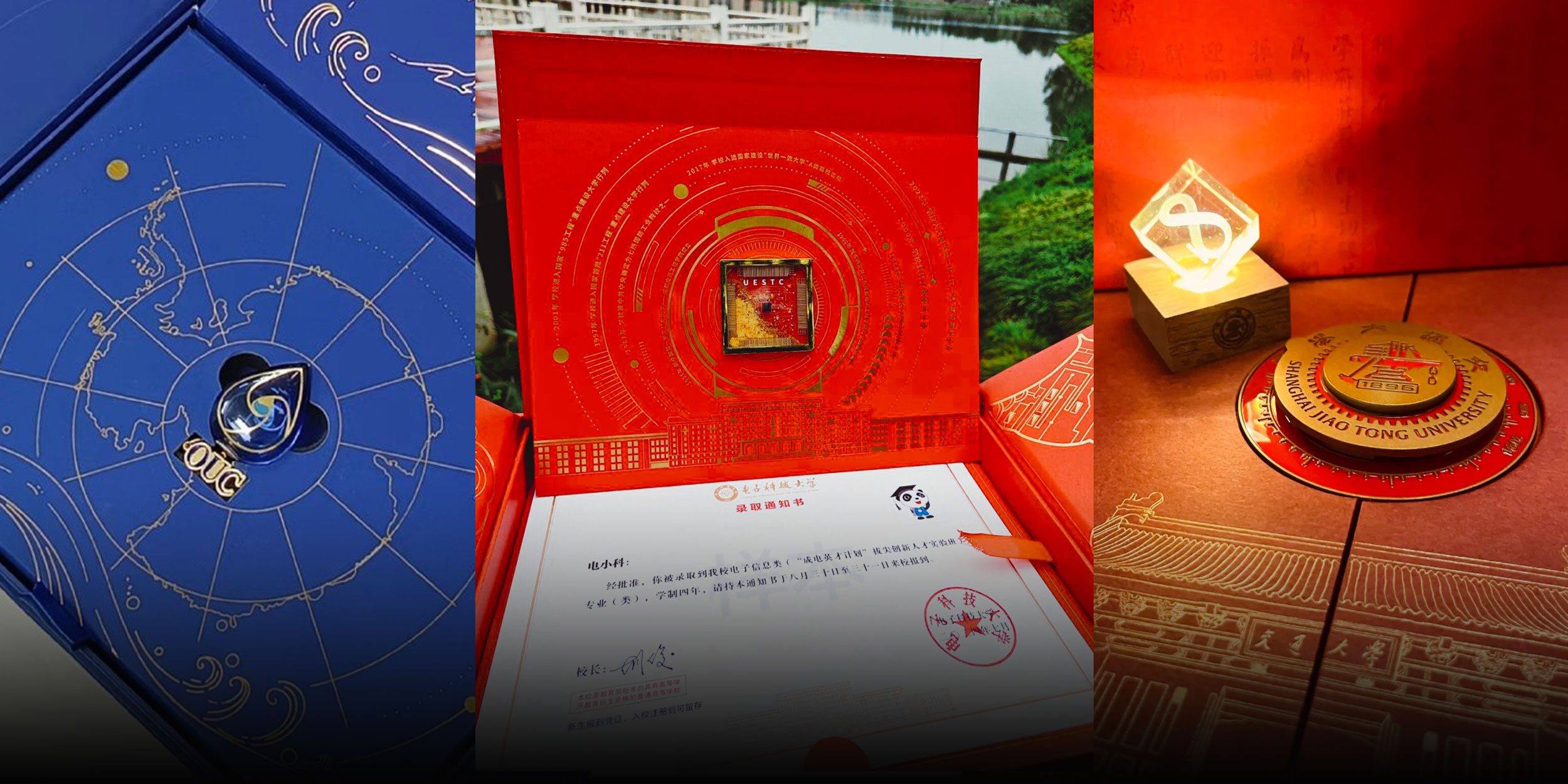
Deep-Sea Water to Microchips, China Curbs Flashy Admission Packages
From embedded microchips and 3D models to vials of water collected from nearly 11 kilometers under the ocean and ultra-thin steel letters, Chinese universities’ increasingly elaborate admission packages may soon be coming to an end.
In recent years, admission packages have become a showcase for university branding, with some packages weighing more than 1.5 kilograms and costing hundreds of thousands of yuan to produce.
On June 3rd, four days before this year’s national college entrance examination, or gaokao, China’s Ministry of Education issued a notice urging schools to return admission letters to a simple “one-page format” and curb what it described as “extravagant” welcome packages for students.
The notice is part of a broader push that also prohibits universities and high schools from promoting “top scorers,” “high-scoring candidates,” or college admission rates in any form.
State news agency Xinhua argued that increasingly elaborate admission packages are often “flashy but impractical,” with the original purpose of an admission letter — notifying students of their acceptance — overshadowed by elaborate packaging and marketing.
On social media, some users argue the packages carry commemorative and educational value for students, while critics say their extravagance is wasteful and fuels unhealthy competition among universities.
For instance, Shanghai Jiao Tong University spent 1.1 million yuan ($153,000) on the design and production of its 2025 admission package and related merchandise. The package, which cost about 212 yuan per incoming student, included an AI-powered bookmark, a crystal ornament, an hourglass, a school badge, and a letter from the university president.
Universities have also experimented with increasingly creative designs. Tsinghua University in Beijing included a paper-made 3D model of its iconic gate. The University of Science and Technology Beijing used steel just 0.07 millimeters thick, sharp enough to cut food, for its admission letters.
And while the University of Electronic Science and Technology of China included a handmade silicon chip embedded in the admission package, some universities incorporated local culture. Sun Yat-sen University included Pu’er tea from counties it supports through rural assistance programs and Zhejiang Sci-Tech University embroidered students’ names in Suzhou embroidery.
The elaborate designs have also fueled a secondary market. Vials of Antarctic seawater included in Ocean University of China’s so-called “most romantic admission letter” were reportedly listed for up to 5,000 yuan on resale platforms last year.
Online, the packages remain popular among students and collectors. Photos of “limited-edition” admission letters have attracted thousands of likes, and related topics have garnered more than 6.5 million views on the microblogging platform Weibo.
For Yun Yan, a postgraduate student admitted to Renmin University of China last year, the appeal of the package began long before it arrived. “While preparing for the exam, you imagine countless times what it would feel like to finally get admitted, to hold the package in your hands and to share it on your social media,” she said.
Her package contained a large gift box, a book lamp, a metal bookmark and a book. “There are plenty of areas where costs can be cut. There’s no need to cut back on the part that gives people the strongest sense of ceremony and value.”
Editor: Apurva.
(Header image: Screenshots show university admission packages containing deep-sea water, a silicon chip and a night light. From Weibo)