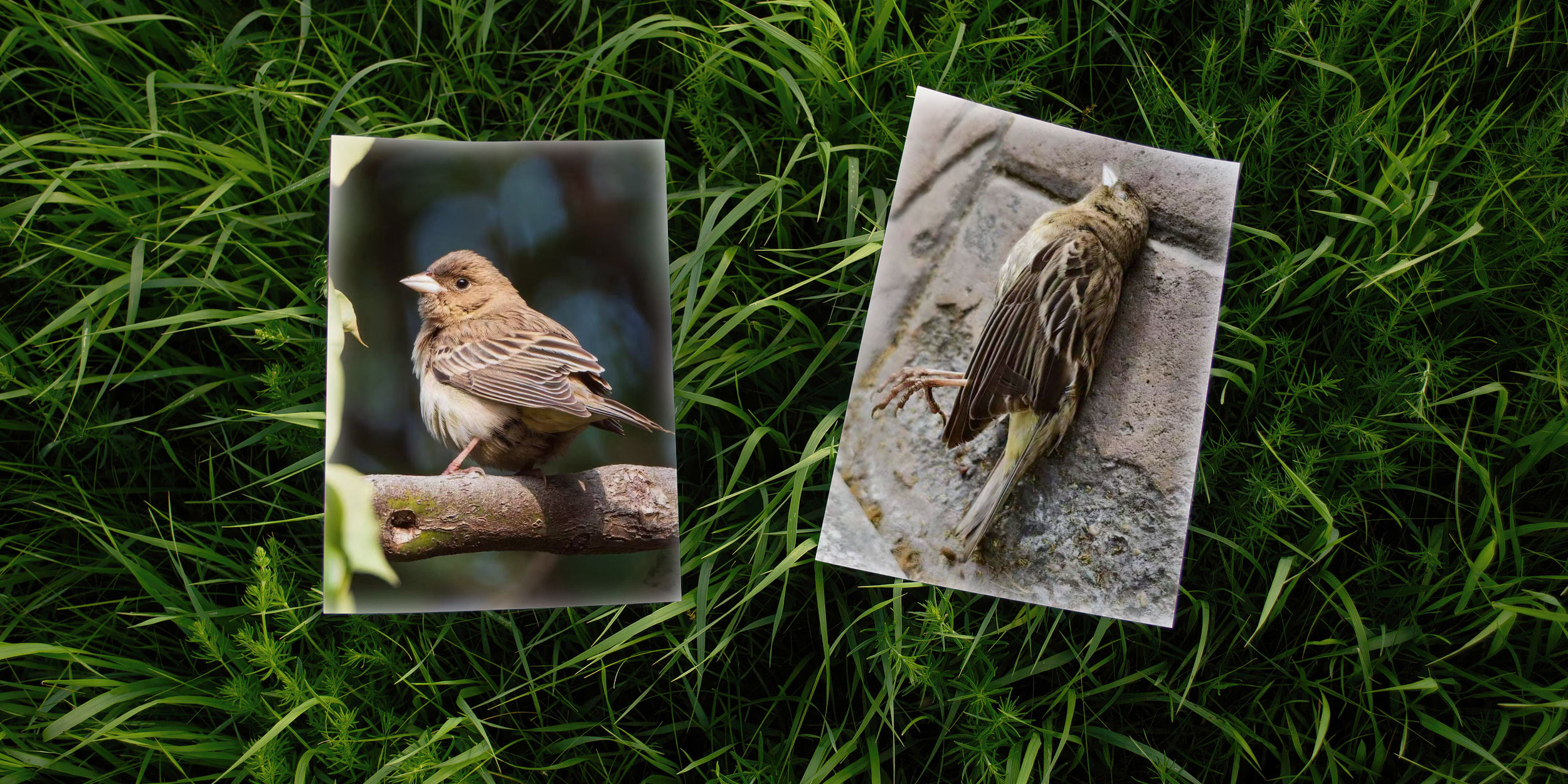
Lost Bird Becomes a Shanghai Celebrity — Then a Cautionary Tale
For weeks it was the talk of Shanghai’s birdwatching community: a black-headed bunting that had somehow strayed from its migration route from Europe to South Asia only to wind up in the city’s Century Park.
And now it was dead.
Around 7:30 on the morning of April 16, wildlife enthusiast Xie Xiang discovered the bird laying motionless on the steps outside the Da Fugui restaurant, part of a large, glass-walled building close to the park’s Plum Blossom Garden. Its legs were stiff, its eyes tightly shut, its feathers ruffled.
Xie crouched down and took some photos, then wrapped the body in tissue paper before carefully placing it in his backpack.
It’s impossible to know why this bunting came to Shanghai, but we know what killed it. An examination by a taxidermist at Fudan University’s Zujia Biological Museum in Shanghai revealed a bruise under the skin on the bird’s head, indicating that it almost certainly died after flying into the glass curtain window.
“The bird had brought us so much joy,” says Hu Yuxuan, a 20-something birdwatcher who learned about the death from Xie. “A bird that was already lost somehow found its way here, only to die.”
Amid the large-scale greening efforts of major cities like Shanghai, the incident has once again thrown a spotlight on the sometimes fatal collision between nature and urban design.
Survival instinct
Sitting at a crossroads in the East Asian-Australasian and West Pacific flyways, Shanghai’s skies are filled with migrating birds every spring and fall. By the end of last year, the city had recorded 543 wild avian species, with about 970,000 bird occurrences — the documented presence of a specific species at a particular location and time — logged in 2024, the highest in a decade.
Vagrant birds are not uncommon, especially in Century Park, a vast green space in the city’s eastern Pudong New Area that features a two-hectare island sanctuary off-limits to humans, as well as an abundance of food sources. At 10 p.m., the park also dims its lights to protect the wildlife.
He Xin, a researcher at the Shanghai Natural History Museum, explains that vagrancy can be caused by birds being thrown off course mid-migration by bad weather, accidentally transported to unfamiliar territory while resting or taking shelter on a vessel, or the illegal wildlife trade.
However, black-headed buntings are extremely rare in Shanghai. Previously there had been only two confirmed sightings — in September 1958 and on Oct. 23, 2021. The one in Century Park this year was first spotted in mid-March.
Small but stocky, with a thick beak, it was often seen among a flock of sparrows. “We thought it might stay a day or two and then leave. None of us expected it to remain here so long,” Hu says.
As the bird often stole food from a dog cage in the park, some nicknamed it “Gou Sheng,” meaning “Dog Leftovers.” Others used a snapshot of it nibbling on a biscuit that looked like a cigarette dangling from its beak to create a widely shared meme, tagging it as “Bunting Bro.”
When He learned of its death, he wasn’t surprised. He’s seen many vagrant birds meet tragic ends over the years, such as in 2023 when an oil-slicked black-throated loon poisoned itself when it preened its feathers, and last year when a fairy pitta — classified as a vulnerable species — flew into a classroom window at a school in Pudong.
“Cities like Shanghai, our environment wasn’t designed with wildlife in mind,” he says. “When animals arrive, they do their best to adapt. Wild animals have remarkable resilience. That is the foundation for rebuilding biodiversity here.”
Shanghai now has more than 1,000 parks, ranging from those covering multiple hectares to tiny neighborhood “pockets,” with plans to build 1,000 more over the next decade. Yet, these are still green oases within an urban jungle filled with high-rises, glass curtain walls, and artificial lighting. Wildlife must survive in the narrow cracks.
Warning signs
After its arrival in March, the black-headed bunting was regularly spotted around the entrance to Da Fugui, which stands among tall trees not far from the park’s southernmost entrance. Xie says that, in the early morning light, the glass-walled structure becomes a giant mirror reflecting the sky and surrounding woods.
In recent years, birds striking windows has become an urgent issue for avian enthusiasts and wildlife conservationists in China.
“This migration season alone I’ve seen three or four reports of bird-window collisions in our group chat,” says Shanghai birdwatcher Lu Yuqiong, who explains that smaller species like warblers and white-eyes tend to fly in groups, meaning that one incident can involve multiple birds. “For tiny birds, such collisions can be fatal. They fly so fast and the impact is tremendous.”
News of the bunting’s death prompted a flood of calls to the city’s citizen hotline and park’s administration office demanding that bird collision deterrent stickers be placed on all large windows.
The Manner Coffee outlet on the opposite side of the building containing Da Fugui had already installed anti-collision stickers — 30-centimeter-wide blocks of white polka dots along with a line of explanatory text. However, there were none at the restaurant’s entrance.
In 2021, to raise awareness of bird-window collisions, environmental health researchers at Duke Kunshan University, in the eastern Jiangsu province, established the National Anti-Bird Collision Action Alliance. To date, more than 6,000 volunteers have recorded over 1,900 incidents in 200 cities nationwide.
Li Mengjiao, the alliance’s coordinator, explains that collisions peak during the breeding and migration seasons in spring and fall, with most incidents involving glass-walled structures up to six floors high. Birds that migrate at night are especially vulnerable, as light pollution in built-up areas can disrupt their navigation.
In the past five years, the alliance has supported partners in carrying out 39 deterrent retrofit projects in various cities. This has included working with students at Fudan, Tongji University, and the East China University of Science and Technology, as well as high schools and other institutions, to conduct extensive surveys.
At one institution, data revealed that more than a dozen birds had fatally struck one glass window in a single year. The evidence was enough to prompt immediate action from the campus administrators.
Fudan biology student Jia Yikun participated in a survey covering the Yangtze River Delta organized by the Shan Shui Conservation Center, an NGO focusing on species and ecosystem conservation. On her campus, she found the bodies of a gray-backed thrush and a White’s thrush — two commonly seen migratory species — that had died after striking windows.
“At the site where they lay, you could look up and see glass walls reflecting like mirrors,” Jia says.
According to Shanghai’s Biodiversity Conservation Strategy and Action Plan (2024–2035), city authorities are researching how to assess the impact of urban buildings and glass curtain walls on birds, and exploring bird-friendly architectural design and retrofit guidelines to reduce collisions and other ecological incidents.
However, Li says general awareness of the issue in China remains low. Few incidents attract interest outside of birdwatching circles, while the country still has no reliable estimate on how many birds are killed in collisions each year. In the United States, official data suggests the number exceeds 1 billion.
“When you first approach property managers, their reaction is often: They’re just birds,” Li says. In recent years, her team has encountered much resistance to bird-strike deterrents, with the general view being that they are “low-probability events.” Some simply complain that the stickers are unsightly and costly.
Since the bunting’s death, the Century Park administration office has confirmed that work is underway to add more anti-collision stickers to the glass-walled building.
Ecological change
While deterrents are a step toward preventing accidents, researcher He argues that the collisions reflect a wider ecological problem: environmental exploitation and the disappearance of wildlife habitats.
“Building more parks is certainly a good thing,” he says. “When park designs are closer to nature — with dense native trees, meadows, and woodlands — they benefit both people and wildlife. Many changes happen gradually. If we all work on the broader environment, the results will slowly come.”
Whenever he is invited to speak to students, He always urges school administrators to place anti-collision stickers on windows, with some principals heeding the advice and even making it into a student activity. “It’s a small thing, but many changes start with small things,” he says.
The black-headed bunting of Century Park is already gone, but many more birds are on their way.
(Due to privacy concerns, Xie Xiang is a pseudonym.)
Reported by Zhang Lingyun and Zhao Ruijia.
A version of this article originally appeared in Original (Jiefang Daily). It has been translated and edited for brevity and clarity, and is republished here with permission.
Translator: Kiong Xin Xi; editors: Wang Juyi and Hao Qibao.
(Header image: Visuals from the interviewees and VCG, reedited by Sixth Tone)