What China’s ‘Drama Girls’ Really Want
Musical theater has become one of the most talked-about art forms in China’s entertainment industry. According to the 2025 China Musical Theater Market Annual Report, the country staged nearly 19,700 performances in 2025, generating 1.81 billion yuan ($266 million) in ticket revenue and drawing over 8.18 million audience members. No other form of stage art comes close.
Yet the industry’s rapid growth has also brought growing criticism from state media. In January, People’s Daily published a commentary titled “What to Make of Musicals’ ‘Star Over Story’ Problem,” arguing that the genre had become “overly dependent on fan economics,” with some productions relying more on performer popularity than artistic quality to drive repeat attendance. China Youth Daily raised similar concerns, warning that some young audiences had brought the habits of celebrity fan culture into the theater, disrupting the ticketing market and “undermining the integrity of the art form.”
This wave of official criticism may be linked to an incident that went viral late last year: the so-called “12.08 Drama Girl Incident.” On Dec. 8, a female university student went live online to reveal that she had accumulated 80,000 yuan ($11,750) in debt from repeatedly traveling between cities to attend musicals, buying merchandise, and purchasing photography equipment. Several media outlets pointed to the story as evidence of fan culture “killing musicals with kindness.” But the incident resonated for another reason too: it tapped into long-simmering frustrations with “drama girls” (ju nü), who are often seen as irrational spenders, obsessive followers, and market disruptors.
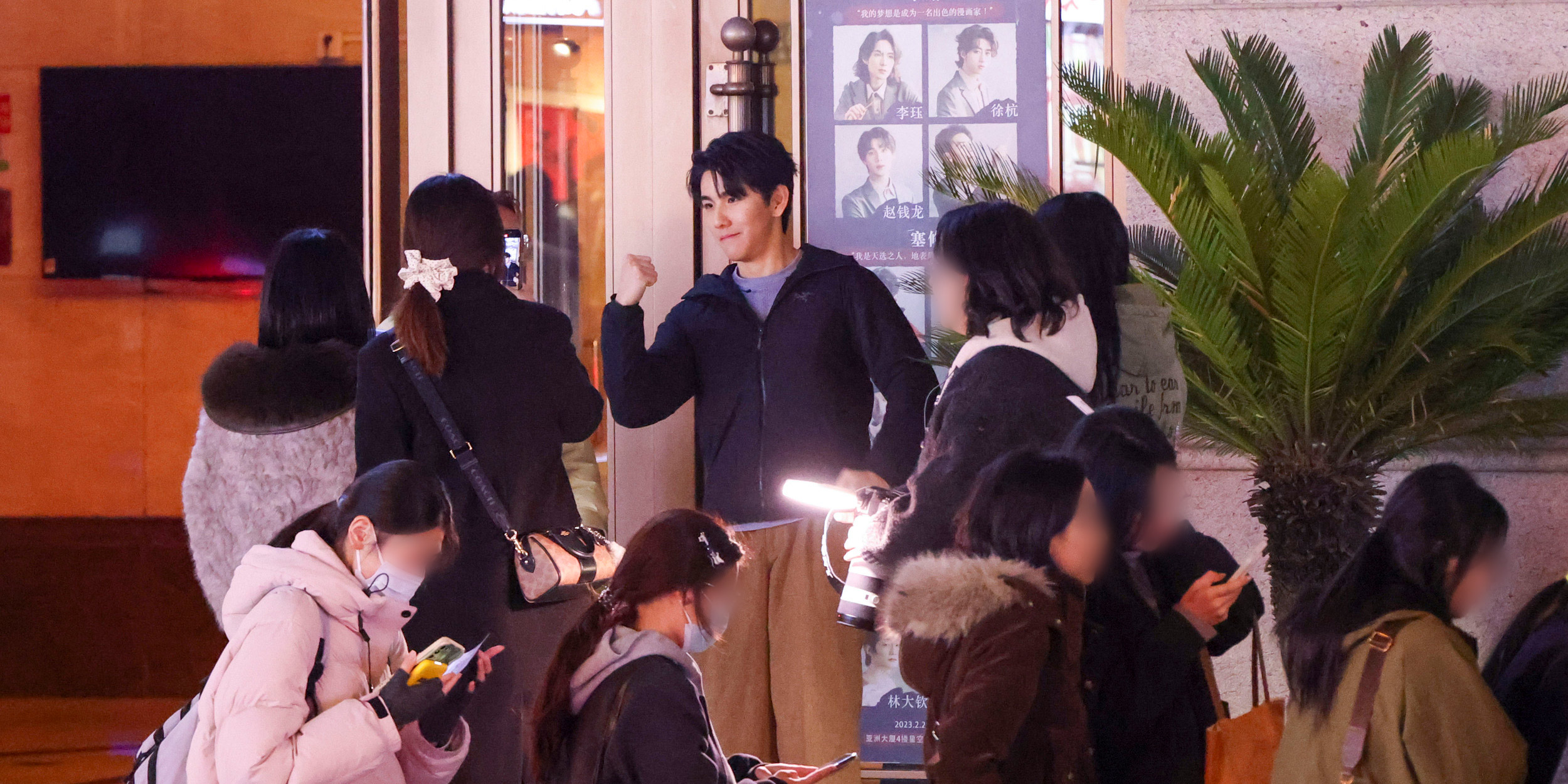
“Drama girls” is a relatively recent term for the core female audience of stage productions such as musicals and spoken drama. Since the breakout success of immersive resident musical Apollonia at Shanghai’s Asia Building in 2020, this group has become one of the main forces driving the market. Women now account for around three-quarters of musical theater audiences, and some data puts the figure as high as 88.5%. Their involvement spans the entire theater experience: competing for tickets, attending performances, buying merchandise, and taking part in post-show stage-door sessions (SD), where audiences wait to interact with the cast.
Some of the criticism directed at them is not entirely unfair. But in my view, the problem is not fan culture itself. Furthermore, to frame drama girls simply as fans misses the point.
Drama girls do share some features with what we usually think of as “fandom”: highly engaged audiences, content circulating within tight-knit communities, and a constant tension between resisting mainstream culture and being absorbed by it. But compared to previous generations of idol fans, they represent something distinctly new. What sets drama girls apart, first and foremost, is their rejection of the pack. Unlike mainstream fan culture, often active on microblogging platform Weibo, with its mass-voting campaigns, coordinated comment sections, and herd-like emotional mobilization, drama girls operate much more as individuals. They attend shows alone, join SD interactions independently, and post reviews on Xiaohongshu, known internationally as RedNote, a platform that prizes personal voice over collective action.
In one sense, this means they have slipped free from the grip of platforms and algorithms. But something has also been lost in the process. The shared purpose, emotional solidarity, and sense of belonging that come with fan communities have weakened. The feeling of being part of something larger than yourself is slowly disappearing.
And this brings us to another defining feature of drama girls: they put personal enjoyment first. Enjoyment is the point, period. Tellingly, they no longer refer to their favorite performers as “idols.” Instead, they jokingly call them “hostages” (renzhi), with fans “paying ransom” to secure their own entertainment. The phrase is playful, but it also signals something broader. Even in a culture supposedly driven by intense emotional investment, the idea of something greater than the self is quietly disappearing.
Drama girls also have a complicated relationship with seriousness itself. On Xiaohongshu, they often refer to domestic musical theater as “zgyyj” (from Zhongguo yinyueju, or “Chinese musical theater”). The deliberate use of lowercase letters instead of the more formal uppercase “ZGYYJ” signals a playful rejection of the scene’s growing seriousness, formality, and cultural self-importance. This attitude resembles what Japanese cultural critic Uno Tsunehiro has described as “decisionism”: after the collapse of large, society-wide belief systems, young people turn to small, personal values instead, anchoring their sense of self through unconditional commitment to whatever they have chosen.
At the same time, drama girls also show a hunger for something bigger than the individual. Many are drawn to stories rooted in national heritage, and strongly identify with characters who sacrifice themselves for a crumbling empire. This pull toward “quasi-grand narratives” echoes another idea, this time from Japanese cultural theorist Hiroki Azuma: intimate personal relationships bypass society as a mediating force and connect directly to huge, world-shaping events. The individual and the cosmos, with very little in between.
Then there is pleasure itself. Drama girls return repeatedly to the same production, either to maintain an emotional connection with a particular performer or to “collect” different cast combinations and emotional experiences. Much of this centers on mostly male performers who offer the right look, the right energy, and a capacity for emotional intimacy. Musical theater, combining acting, singing, and dance, is already a powerful form of emotional immersion. Intimate black-box theaters intensify the effect further, placing audiences physically close to performers and allowing emotion to spread quickly through the room.
For many drama girls, this intense atmosphere was exactly what drew them in from the beginning: an emotional, sometimes even erotic, experience hard to find anywhere else. In recent years, the broader cultural environment has only deepened this appetite for instant, feel-good consumption. A feedback loop has formed: producers churn out shows designed for fast consumption, platforms amplify spending driven by emotion, and drama girls, laughing at themselves for “paying the ransom,” continue funding the cycle.
Taken together, drama girls reflect the younger generation’s dissatisfaction with, and resistance to, an increasingly “atomized” way of life. At the same time, they also reveal the crisis of subjectivity and the moral dilemma of the digital age. They may have broken away from the collective, but not from the pressures of digital labor and consumption. Their pursuit of personal pleasure is also, in many ways, a form of self-exploitation.
Whether they reach for small, personal stories or for quasi-grand ones, both point to the same wound: a search for meaning, connection, and emotional warmth in a world that can feel increasingly isolating. Intimate black-box musicals have become a kind of offline refuge, offering face-to-face emotional experiences that offer closeness and emotional warmth against the loneliness of online life.
Yet as the German philosopher Byung-Chul Han has argued, the rich dimensions of desire, its mystery, its ritual weight, its ache toward the other, are being replaced by a single, instant hit of consumer pleasure.
The difficulties surrounding small-theater musicals today are not caused solely by drama girls. They are products of a broader cultural moment shaped by capital, technology, platforms, and cultural policy. In some sense, drama girls have simply become convenient scapegoats.
Even so, youth culture remains something alive and evolving, shaped by both individual agency and broader structural forces. The popularity of drama girls and the shows surrounding them also reveals a deeper hunger, especially among young women, for intimacy, connection, and emotional experience in a life increasingly lived online. That may be the real story behind the rise of China’s musical theater boom.
Translator: Dasha Cowley; portrait artist: Wang Zhenhao.
(Header image: An actor interacts with audience members after the show, Shanghai, Jan. 17, 2026. VCG)