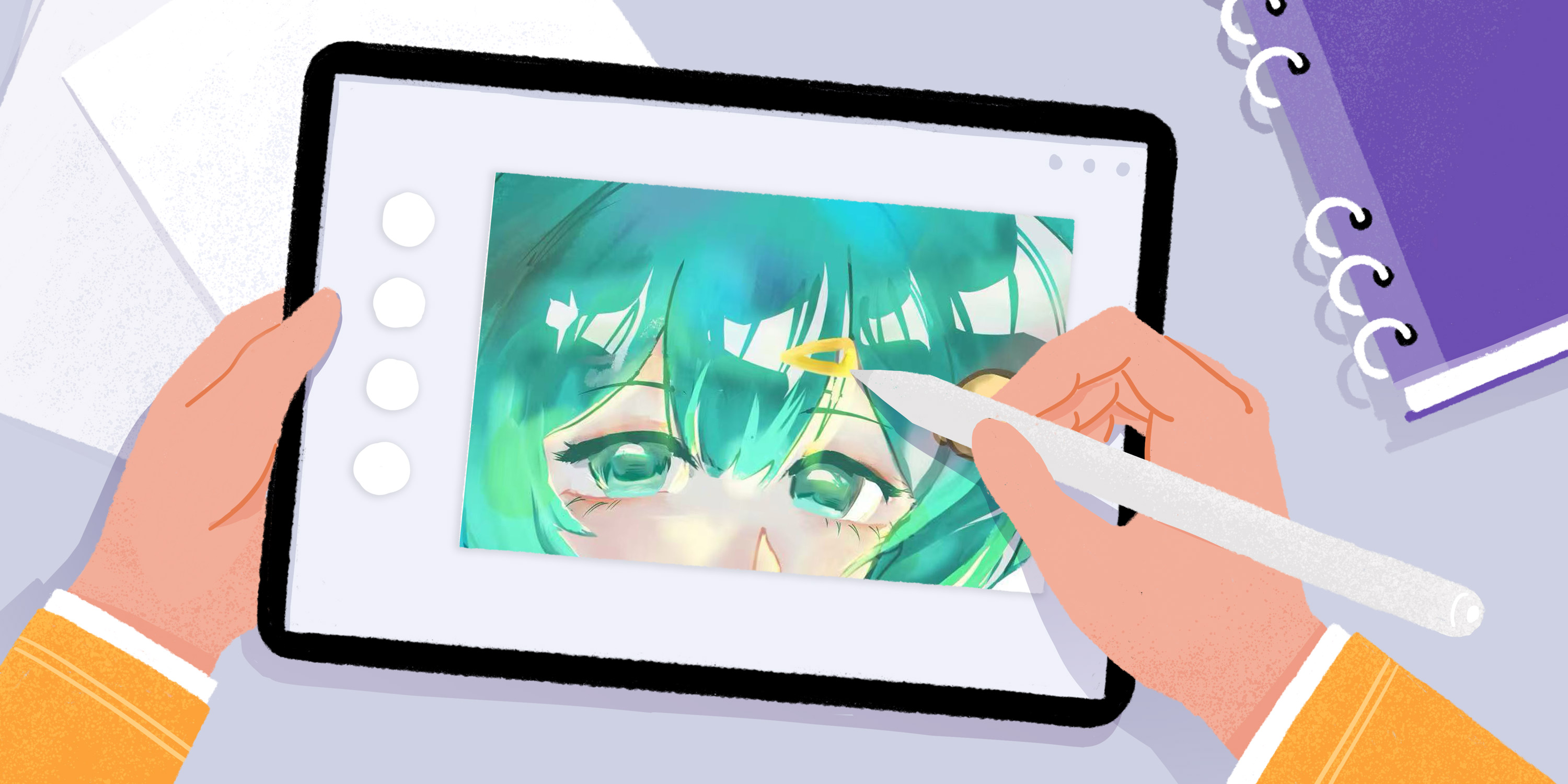
Keep Drawing Your 0.5-Yuan Masterpieces, Kid
“Mom, I made my first bucket of gold!” my 11‑year‑old daughter exclaimed.
She’d apparently signed up for a kid-friendly art‑commission app — a platform where she could showcase her artworks and offer to draw for others — and had set a rock‑bottom price for her debut of 0.50 yuan (about $0.07) per drawing. A buyer who had noticed her commissioned one, then another, ultimately paying double the total price — a whopping 2 yuan.
In the five minutes my daughter spent telling me this, a flurry of questions raced through my mind: What if it affects her schoolwork? What exactly is this app? Is it legitimate? Does it have any protections for kids? Is 0.50 yuan too low? Should I even encourage her to raise her prices? Wouldn’t introducing her to adult commercial logic too early make her lose the pure joy of drawing for its own sake?
Of course, I kept all that to myself, instead putting on my best “cool mom” face and telling my radiant daughter, “That’s fantastic! I’m so proud of you!” Then, the second she turned away, I set to researching these art‑commission platforms.
Platforms like the one my daughter used have been around for some time, so I learned. Since 2016, for instance, Mihuashi has been connecting artists with customers, as have platforms like Huajia. According to their official descriptions, the two platforms have each onboarded around 100,000 verified artists, and since then, many mainstream social media platforms like Douyin, China’s version of TikTok, and Xiaohongshu, also known as RedNote, have also developed similar art‑commission features.
On the app my daughter uses, anyone 9 or older can register, so most active users are middle schoolers or even elementary schoolers. Custom drawings are typically priced anywhere from a few to a few dozen yuan. In fact, the app feels more like a community for young fans of anime, comics, and games. The most commonly requested types of artwork are anime profile pictures, birthday cards to celebrate a friend’s or even beloved anime character’s birthday, and, most popular of all, “OC” (original character) art in which the buyer describes their OC’s appearance, personality, backstory, even their whole world, and asks the artist to bring that fictional character to life.
Naturally, as I browsed the app, my inner alarm system as to the potential dangers went into overdrive: fraud, teenagers blowing their allowances, toxic content, predators disguised as anime fans — the whole nightmare buffet. But to my surprise, as I continued, I began to notice a certain kind of anxiety I had been feeling lately disappear.
Like so many others, I have been bombarded with news of the breathtaking advances in artificial intelligence. The day before my daughter told me about her 2-yuan earnings, OpenAI released its latest image-generation model, ChatGPT Image 2.0. Such technological progress brings awe, but also fuels concern — after all, big-tech companies, driven by their desire to accumulate wealth and resources, have been using their influence to shape and amplify the narrative that AI can replace most humans. All the while, they themselves have been laying off workers in large numbers, with Meta recently claiming it would soon slash 10% of its workforce.
The art world was among the first impacted by AI. Yet from translators to designers, from programmers to actors, people are starting to worry that they might soon lose their jobs to AI. In a recently published book, “A Pre‑History of AI,” the technology writer Zhang Xiaoyu asserts that 99% of humans will be replaced by AI and become redundant. He even proposes that the 99% and the 1% sign a “civilizational contract” to peacefully coexist as preparation for the eventual contract between humanity and AI, one in which silicon becomes the continuation of carbon.
In the midst of all this noise about AI, I feel a sense of relief, even comfort, when I see the art‑commission platform my daughter frequents. What I see are drawings that are far from masterpieces; yet in those childish strokes, there is a kind of pure joy. Some creators post their “representative works” priced at 1 or 2 yuan, and I can imagine they are children just like my daughter, drawing because they love it, and tentatively sharing their work to see if anyone likes it. It’s even more interesting for commissioned OC pieces when a buyer chooses an artist and describes what they want. In those cases, what they’re really offering is appreciation and trust, and in the process of creating and revising, the artist draws on deep understanding, empathy, and patience.
Of course, I had to ask if anyone used AI to profit from their drawings, to which my daughter firmly answered, “No.” According to her, the community relies on user reporting, and if someone finds out that an artist used AI, “they’ll post about it and warn everyone else to avoid that artist.”
Also at play, I found, is today’s “abstract culture,” which deconstructs authority with parodic, nonsensical, and ironic memes. As my daughter told me with glee, an artist once drew a picture and deliberately placed the watermark of the popular Chinese chatbot Doubao on it, just for fun.
I don’t fully understand this “abstract culture,” but it appears to have an instinctive resistance to AI. What the kids want is not so much a perfect drawing as the chance to bond and make something together with people who get them. Will this inclination disappear when they grow up? Maybe. And if it does — well, that would be a shame.
We cannot live like children, but that doesn’t mean we have to live like machines, blindly pursuing efficiency, predictability, replaceability, and error-free performance to avoid making mistakes, losing control, and even love. For one thing, that’s not really possible. For another, it won’t free us from being replaced by machines, since becoming a machine would only enable a more complete replacement. When faced with something as powerful as AI, it’s worthwhile to learn about it, understand it, and try to master it, but we must also remind ourselves not to look up to it, worship it, or cower before it. In other words, we must not fall into the trap set by those who fancy themselves as the masters of the universe.
In my view, only when we take genuine pride in being human — and truly cherish the qualities that make us who we are — can we treat AI as a tool, not a threat. What are those qualities? Certainly not speed reading, precise calculation, or the rationality of “return on investment” or “results orientation.” Rather, the passion that springs from places unknown and runs deep — the urge to create, and the courage and sincerity to reach out to people we have not met yet.
Perhaps this is nothing but a feeble fantasy, but I choose to think this way. After all, fragility and delusion are themselves parts of humanity. In any case, I hope my daughter grows up in a world where AI has not replaced people. Whether she still loves drawing or not, may the fruits of her labor be appreciated by other human beings.
(Header image: Visuals from the author and VCG, reedited by Sixth Tone)