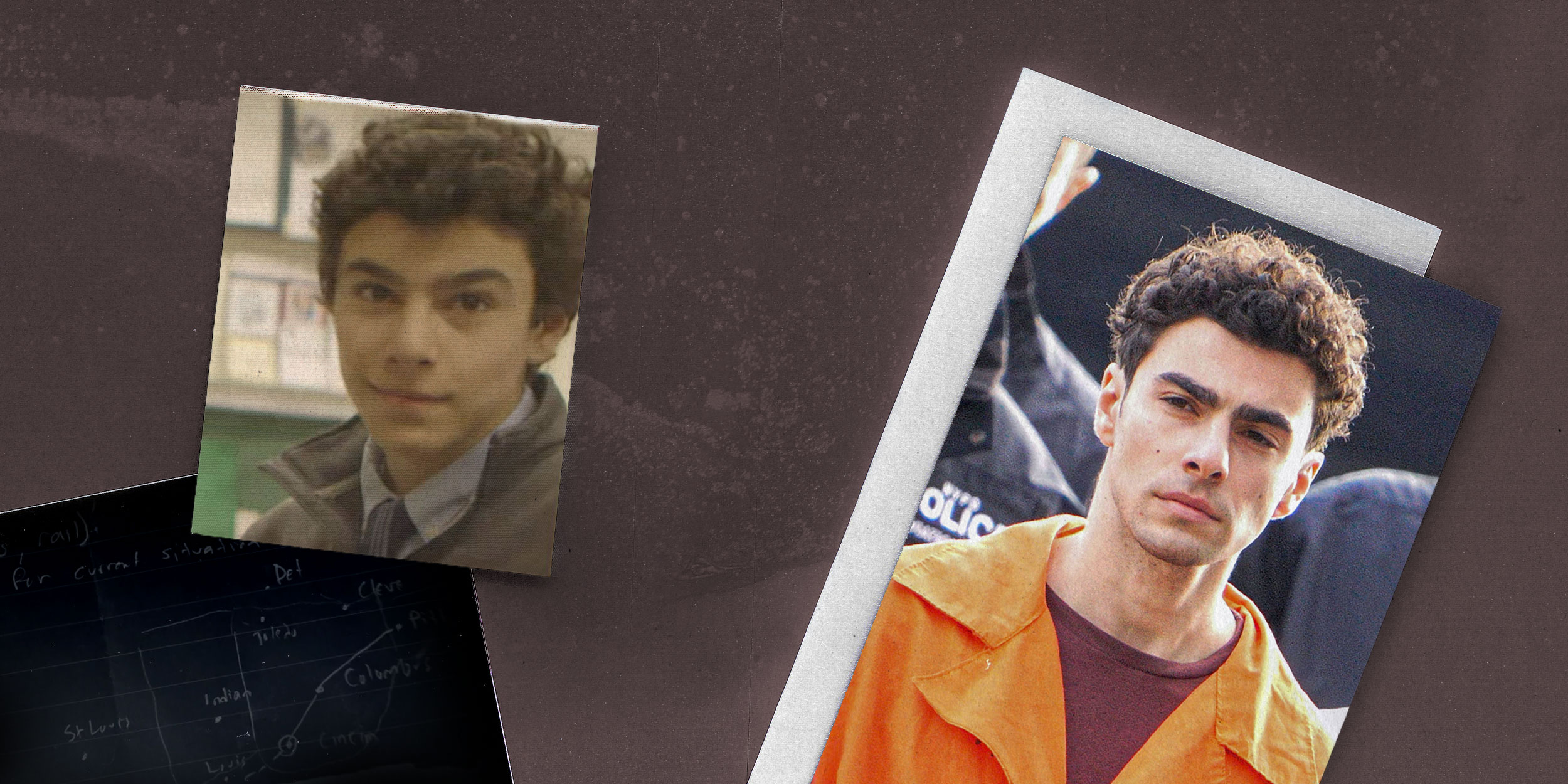
Boy in the Frame: The Chinese Filmmaker Who Captured Luigi Mangione
“Do you remember Luigi?”
Filmmaker Wang Yang was sitting in a café in Xi’an, capital of China’s northwestern Shaanxi province, when his friend suddenly slid her phone across the table. On the screen was the mugshot of a young man.
“It’s the boy who showed you around his school’s robotics lab,” she says, referring to a trip Wang made to the United States in 2014 to film a documentary.
The mugshot was of Luigi Mangione, the prime suspect in the murder of Brian Robert Thompson, CEO of the health insurance company UnitedHealthcare, in New York City on Dec. 4, 2024.
Wang froze. Of course he remembered Mangione. He was among several 16-year-old boys he had filmed at Gilman School, a private institution in Baltimore, Maryland, as part of “Youth Dream,” an unfinished project exploring the educational experiences of students from China and the U.S.
Mangione, 28, is now being held at a federal prison in New York awaiting trial for second-degree murder. He was arrested in a McDonald’s restaurant in Altoona, Pennsylvania, five days after the shooting. Police say that he was carrying a 3D-printed handgun, a silencer, a fake ID, and a three-page handwritten manifesto that contained the line, “These parasites simply had it coming.”
Although Mangione had been only a peripheral character in Wang’s documentary, the 41-year-old filmmaker remembered his strong presence on campus and on screen, prompting him to revisit the footage from the school as soon as he returned home from the café.
Here, Wang shares his recollections of Mangione, “Youth Dream,” and the brief intersection he fostered in the lives of boys from different worlds.
Like a ghost
When I met Luigi in 2014, I was documenting the lives of two boys from very different backgrounds: One was a Chinese-American boy, James, the son of the friend whom I met with at the café; the other was Maisheng, a 16-year-old from the mountains of Huining County, in China’s northwestern Gansu province.
I was staying with James’ family in Baltimore while I worked on the documentary. Each day, I followed him and his classmates to school to capture their daily lives.
It was only when I rewatched the old footage that I realized Luigi was a constant, silent presence in the frame — almost like a ghost. He seemed to be everywhere: in the lab, on the robotics team, in the cafeteria, always lingering in the periphery of my shots. James and Luigi had been inseparable back then.
In one shot, a lanky Luigi in typical prep school attire — dress shirt, tie, and dark gray top — leans over a workbench, his gaze fixed on a half-assembled robotic car as he adjusts a metal component. Later, speaking to the camera, he explains his algorithms with clear, untroubled eyes.
When I learned that Luigi had allegedly used a 3D printer to make a gun and silencer, chills ran down my spine. Had that same quiet focus and concentration become the tools for a meticulously planned assassination?
Looking back, I feel there was a measured distance in the way Luigi interacted with others. The robotics course was open-ended: the teacher mostly stood to the side answering questions, while students split into groups to program and assemble robots. In the footage, Luigi gives an impression of maturity — when some classmates start fooling around, he stands and offers a few words of guidance to steer them back on track.
He didn’t push himself into the center of the frame or appear to deliberately seek attention, but if you spent time in that classroom, you could sense he had influence. In his robotics class, he was a leader. He spoke softly, but with an authority that seemed to come from some kind of certainty.
Of course, that had to do with his wealthy, privileged upbringing. Luigi’s family owned a prominent real estate portfolio, including two Maryland country clubs. I later learned that he had graduated as the class valedictorian.
But he wasn’t the main subject of my film, so I never focused on him specifically. Did I notice anything unusual about him? No, I really didn’t. He appeared to be an ordinary teenager, albeit exceptionally composed and talented.
School swap
The idea for “Youth Dream” came from a feature-length documentary I made in 2010, “China Gate,” which followed students at Huining No. 1 High School in Gansu. In this rural county, education is not for personal interest or self-fulfillment — it is a way out of poverty.
After the film screened at international festivals, I received an email from James, who said he’d been moved by the stories of these teenagers on the other side of the world. He was keen to learn more and even expressed a wish to work as a volunteer teacher in Huining.
I realized that if U.S. students really did come to Huining, it would be an incredible filming opportunity, offering a new angle to what I’d captured in “China Gate.” With that project, I understood perfectly why those kids pushed themselves so hard, because I came out of that system.
Eventually, James and two of his classmates from Gilman School made the trip in July 2014, and I picked them up at the airport. James impressed me as a simple, good-natured youth who always said what was on his mind in a thoughtful, well-mannered way.
During their two-week stay in Huining, the trio woke at 5 a.m. to join the Chinese high school students for morning exercises. They were stunned to see all the kids carrying their English and Chinese textbooks onto the sports field to keep studying — learning had never looked like this to them.
The pace of classes, dormitory life, being constantly swamped with questions — I could see that the American teenagers were uncomfortable, but they made a genuine effort to adapt.
However, I increasingly felt that the story wasn’t complete this way. Was there also a way to have a Huining student go to the U.S.?
Maisheng was not the type of student to bury himself in test papers and recite school slogans, but he was open with his emotions and vulnerabilities. For a documentary, this is essential. He also exemplified the survival logic of all young people in Huining, believing that “knowledge can change your fate.”
We secured Maisheng a U.S. visa, but as he prepared to leave, he grew extremely nervous. He had never flown on an airplane or even ridden a high-speed train. I reassured him that the people in Baltimore were waiting to take care of him.
Gilman School is a typical American private school. I remember its red brick buildings nestled among green trees, with lawns trimmed as neatly as a golf course. Inside its walls were professional athletics coaches, Latin classes, robotics labs — stepping stones to Ivy League universities. Outside were the city’s notorious drug problems and slums.
Classes ended at 3 p.m., with a lot of time devoted to sports. While auditing a math class, Maisheng was shocked to see nearly every student had a calculator. That was a no-no in his own school, where problems had to be worked out on paper and he would still score A-plus.
At the start of his monthlong visit, Maisheng felt that American education was easy — but he soon changed his mind. For example, James had grueling fencing classes each day on top of heavy course assignments.
I also took our Chinese student to public schools in the local area, where he witnessed chaos and poverty. Toward the end of our filming trip, we visited Washington, D.C., where he practiced tai chi at the foot of Capitol Hill.
Friends reunited
After reading more about the allegations against Luigi and rewatching my footage, I began to reflect on elite education in the U.S.
In Huining, students were fighting for survival. At Gilman, the students were fighting for excellence — and Luigi was a standout. Perhaps the education he received in essence made him a more efficient and elegant predator.
Maisheng achieved good grades and attended a maritime college in northern China before settling in Lanzhou, the Gansu capital, to work in sales. I’ve thought about asking him what impact his U.S. experience had on him, but somehow could never bring myself to do it.
James’ life has followed a more standard elite trajectory. He went on to graduate school at the prestigious Massachusetts Institute of Technology and now works in quantitative trading.
His parents were highly accomplished forensic pathologists in China before immigrating to the U.S., where they had to redo medical school and adapt to a completely new social environment. Many immigrant families are like this — the older generations shatter their lives and rebuild them from scratch so that the next generation can move forward.
When I was filming in 2014, James’ father had not yet obtained his full U.S. medical license, but the family had found its footing, and when I saw them again this year I could sense that they had climbed the class ladder. They had bought a new home and settled into a stable life.
When I met up with James in Xi’an in February, we discussed many things: his work, artificial intelligence, his parents’ health, and how the Chinese city has changed. When the conversation turned to Luigi, I could feel him wanting to avoid the subject. He had seen Luigi several times after university, the last time being in early 2023. During that meeting, James recalled sensing something different about his old friend — he seemed angrier. He wouldn’t elaborate further.
After the 2024 shooting, many media outlets tracked James down to seek an interview, but he refused. I can understand why. There are many questions that even those closest to a person can’t necessarily answer.
Seeking answers
Looking back, I feel that “Youth Dream” was not merely a comparison between different education systems, but what became of these three intersecting lives.
In conventional terms, James looks to be the model of success: a stable income, moving along a clear path. But what if someone follows a path and accomplishes everything they are supposed to — then what? A path can provide security, order, and a dependable future, but is that enough to answer all of a person’s questions about life? Success can solve practical problems, but it may not solve existential ones.
What concerns me is not who climbed higher or who came closest to the “correct answer,” but whether these young men grew into complete human beings, finding peace with themselves and the world.
While filming “Youth Dream,” I had a disagreement with a producer over the direction of the project. He asked me, “Do you still believe documentaries can change society?” I said I did. But now I understand more clearly that believing doesn’t mean you should expect immediate results. It can take many years to see a shift in how people think or see the world — and that change can be very subtle.
When I revisit that footage from the U.S., I feel as though those vivacious young men are standing before me once again — boys who genuinely loved this world and once longed for a better future.
(Due to privacy concerns, James and Maisheng are pseudonyms.)
As told to reporter Li Ruiyi.
A version of this article originally appeared in Fir Record. It has been translated and edited for brevity and clarity, and is republished here with permission.
Translator: Carrie Davies; editors: Wang Juyi and Hao Qibao.
(Header image: Visuals from Wang Yang, VCG, and the New York County District Attorney’s Office, reedited by Sixth Tone)