The Rage, Love, and Loneliness Behind China’s Toxic Sports Fandom
One summer morning in 2022, table tennis fan Yin Xiaowen opened her phone to scroll through her socials and found a war raging among rival supporters. She soon charged right in.
Yin’s favorite player — the former world No. 1 Liu Shiwen — had come under fierce attack from fans of her China national squad teammates, Chen Meng and Wang Manyu, with many posts mocking Liu for the elbow injury that forced her to withdraw from the women’s singles event at the 2020 Tokyo Olympics.
When one netizen expressed hope that Liu would repeat her injury, Yin hit the roof. “That was just unbelievably shameless,” says the 35-year-old real estate agent.
As soon as Yin returned home from work that night, she unleashed a torrent of content on China’s X-like platform Weibo — posting her own thoughts and liking and commenting on posts from fellow boosters for Liu, ultimately sharing about 60 updates, all with the hashtag #ChenFansShouldApologizeToLiu.
This type of response — known as tu guangchang, or “homepage massacre” — is designed to dominate discussion on the platform, drowning out all opposition voices until they simply give up.
Around 2 a.m., as the conflict raged on, fans switched tactics to la biao, or “pulling stats,” aiming to prove their argument with skewed spreadsheets comparing Liu’s win record and championship titles with those of Chen and Wang.
“First, you boast about how incredible your idol is, then you mock the other side for being weak,” explains Yin, who realized only in hindsight how caught up she’d become in the conflict. “I was completely unlike myself.” It was the early hours of the next morning by the time she finally went to bed, once her rival supporters had mostly been silenced.
Emotionally charged feuds among sports and esports fans have become common in China, with Weibo a key battleground for female supporters, while men tend to use the sports forum Hupu to air their grievances. In the past decade, the atmosphere around elite table tennis has grown especially acrimonious.
To address the problem, the nation’s top sports and cyberspace authorities this year began closing down online groups that promoted toxic fan behavior, such as coordinating personal attacks on high-profile competitors.
However, arguments still erupt almost daily over even the smallest issues — a match result, team selection, or when fans perceive coaches and even TV sports commentators as showing favoritism.
“Athletes who reach the absolute top tier usually only have two or three true rivals,” explains Lu Jingyan, a 27-year-old fan of the now-retired Olympic table tennis champion Ding Ning. “The competitive dynamics are extremely clear-cut, which fuels toxic feuding among rival fandoms.”
In the eyes of diehard supporters, every action should help their idol reach new heights — whether it’s desperately playing down any excitement online before a big match to “save up good karma,” or shouting themselves hoarse courtside, refusing to yield the aural battlefield to the opposing fans for even a moment.
Some even adopt the ru zhui approach, effectively “support through bullying,” which involves showering their idol with criticism and insults — on and offline — as an expression of tough love. The 22-year-old Chinese gymnast Ou Yushan came under such relentless harassment from her own supporters during the 2024 Paris Olympics that she decided to quit Weibo entirely.
Cliques don’t click
China’s General Administration of Sport and the Cyberspace Administration of China jointly began dismantling major Weibo fan circles for dozens of elite table tennis players in February as part of a nationwide cleanup campaign.
However, research suggests the move might not be enough to address the underlying catalyst for online conflicts: the subtle hierarchy created by increasingly fragmented fan identities.
In the wake of the clampdown, smaller table tennis fan communities have reemerged on Weibo, with many diehard followers choosing to stick with the platform rather than switch to the lifestyle app Xiaohongshu, aka RedNote, or Douyin, the Chinese version of TikTok, which are largely seen to be dominated by so-called “shippers.”
Shippers are a subgroup focused more on supporting or imagining romantic pairings among athletes. For example, one of the most talked-about — yet fictional — pairings today is between Olympic mixed doubles partners Sun Yingsha and Wang Chuqin, known by the collective nickname “Shatou.”
Another group is solo stans, who focus on the personal growth of one specific athlete. “They consider themselves superior to shippers, who they feel overanalyze details and invade people’s privacy,” explains Li Benben, a graduate student in the eastern Zhejiang province who has been researching China’s sports fan culture.
Li cites the 2025 WTT Champions event in Yokohama, Japan, where Sun and Wang both placed second in their respective categories. Shippers framed the result online as Sun deliberately throwing the championship to keep her partner company on the podium, which prompted anger from solo stans, many of whom slammed the shippers for “turning elite sports into an intolerable soap opera.”
Echo chamber
Dance teacher Miao Shiyue became immersed in the Shatou narrative after the pair won gold at the Paris Games two years ago. She soon began watching short, romanticized fan videos as well as closely following the pair’s match results and engaging in online forums.
Whenever posts linking Wang Chuqin to other women appear on her social feed, the 29-year-old instantly blocks them to prevent the algorithm from recommending similar content. What fascinates her, she says, is the idea of two elite performers bringing out the best in each other.
As a teenager, Miao attended a top dance school and was considered a standout student, training at least 14 hours a day. Yet while her peers have gone on to appear on TV in the annual Spring Festival Gala and in large-scale stage productions, she is still waiting for her big break.
Now living alone in Beijing, she has found fandom to be a source of emotional sustenance and has filled her home with products endorsed by Sun and Wang, seeing it as a way to support the duo and their sponsors. On most days, she teaches until around 9 p.m. and heads home to browse social media for Shatou-related content before bedtime.
After interviewing nearly 20 Sun-supporting solo stans for a research paper, Yang Anqi, a graduate student at Guangdong University of Foreign Studies, observed that most choose what to believe about their idol and his or her opponents, and simply filter out the rest — strategically curating their media environment to avoid certain feeds and categorizing channels according to affiliation. One interviewee told Yang, “I’ve deliberately built a bubble around myself.”
Studies by Li, Yang, and other academics also suggest that super-fans often project aspects of themselves onto online narratives involving athletes and other celebrities.
When Liu Shiwen and her mixed doubles partner Xu Xin lost their gold-medal match at the Tokyo Olympics, Yin remembers feeling “truly heartbroken,” especially with rumors that the player was considering retirement. However, Liu came back strong the next year, winning the mixed doubles championship at the 2025 National Games. This naturally fed into Yin’s narrative that her idol will always thrive against the odds.
With her family pressuring her to marry and her company facing mounting debts, Yin says she has drawn strength from Liu’s story. In particular, she recalls a China national team training session in 2018 — a low point in the player’s career — when Liu was pictured standing alone, watching on as the coaches focused their energies on her teammates. “Even under those circumstances, she endured,” Yin says.
Guilty pleasure
In her fourth year as a Ph.D. student, Sun Qingyuan had to contend with her doctoral advisor’s resignation while rushing to meet the deadline for her dissertation. The anxiety was keeping her awake at night — until she discovered shipper culture, which had a surprisingly relaxing effect.
Admittedly, the first Shatou video she came across left her cold. It simply showed Wang Chuqin sitting on a table during training while watching Sun Yingsha walk by. “I didn’t see any romance,” she recalls.
But after reading several comments online, she revisited the footage and felt she could also see some chemistry between the players. “They are close in age, equally matched in skill, and have been teammates for so long,” she says. “Whether in major tournaments or in their sense of responsibility toward their country, they complement each other perfectly.”
She soon began investing her time, money, and emotional energy into the narrative, following every detail of their lives. She set an alarm to rush-order limited-edition KFC meals endorsed by Sun Yingsha, buying three at a time, and even traveled from her home in the eastern Shandong province to the Beijing headquarters of the General Administration of Sport to “check in” as part of a Shatou-related online trend.
It was only after the government crackdown launched in February that she realized she had “fallen so deep” into this super-fan culture.
Yin says she first noticed her own “irrational behavior” when a colleague pointed out that her Weibo feed consisted entirely of news about Liu. While deleting her posts, she started to reflect on the toxicity of fan culture, and concluded that “public opinion is a weapon.”
By comparison, Miao appears more comfortable with her level of fandom, although as the owner of a popular dance blog with tens of thousands of followers, she keeps her obsession with Shatou a closely kept secret. She never publicly posts about the players and stores any related content in private folders.
Zhao Xin, a doctoral student at the Shanghai University of Sport who published a paper on fan culture this year, recalls that before 2016, discussions about sportsmen and women in China generally focused on their performance, win or lose. Now, even a baseless claim — such as an accusation that a player threw a match — can quickly spark an online war of words.
However, a super-fan’s passion also has the power to open doors.
Ding Ning super-fan Lu highlights the story of a graduate from the Communication University of China who began livestreaming and commentating on gymnastics competitions in his spare time, gaining tens of thousands of fans for his broadcasting abilities and in-depth understanding of the scoring system. He was eventually hired by leading sports streaming platform Migu as a full-time commentator.
“When your passion runs deep enough, and you’re willing to devote yourself to it, sometimes it really can become a way of fulfilling your potential,” Lu says.
(Due to privacy concerns, all interviewees’ names except Zhao Xin and Yang Anqi are pseudonyms.)
Reported by Xu Qiaoli.
A version of this article originally appeared in White Night Workshop. It has been translated and edited for brevity and clarity, and is republished here with permission.
Translator: Chen Yue; editors: Wang Juyi and Hao Qibao.
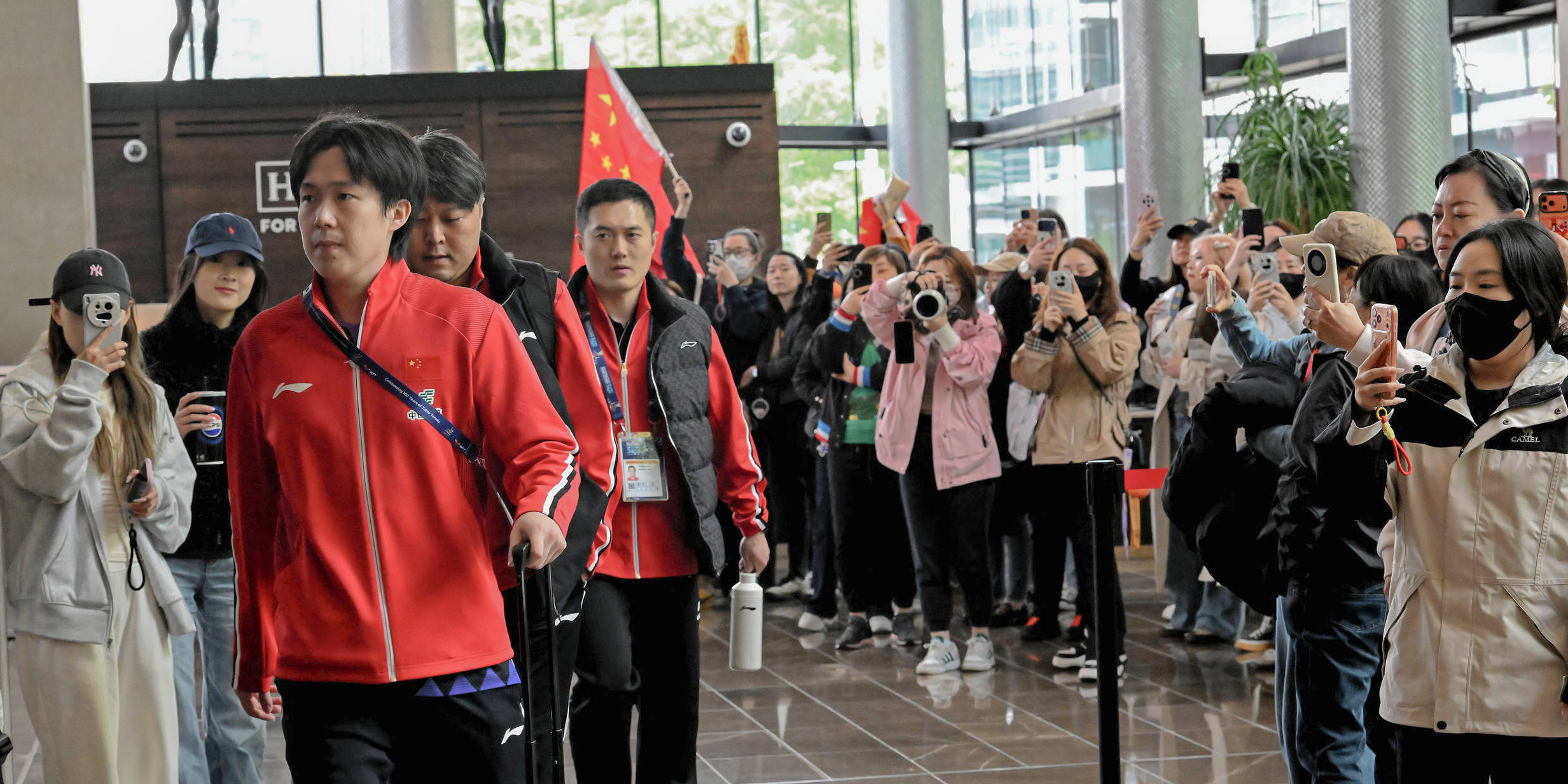
(Header image: Wang Chuqin (third from left, in red) surrounded by fans in a hotel lobby during the World Team Championships in London, U.K., May 2026. VCG)