The Dream of the ’90s Is Alive on the Chinese Internet
Close your eyes.
Now, picture life at the turn of the millennium. What do you see?
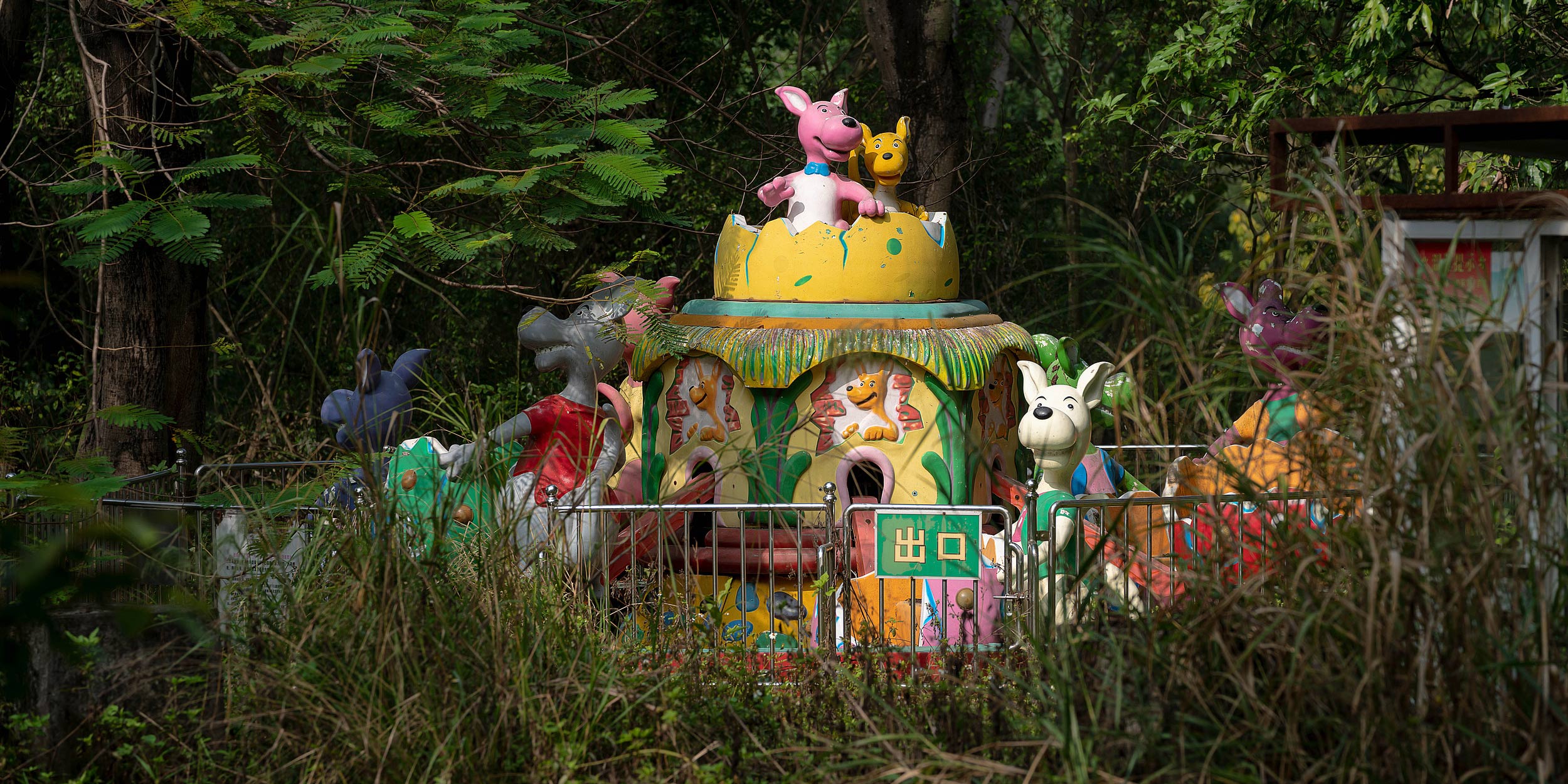
If you’re Chinese, your mind might jump to flickering low-resolution CRT televisions, futuristic yet dilapidated skyscrapers with blue windows and mottled tile façades, or maybe a colorful slide on an abandoned playground. The images would feel like real memories but for one thing: their eerie emptiness. Instead, they are examples of what’s known as “Chinese dreamcore” — a spinoff of the dreamcore aesthetic that has captured the imaginations of Chinese social media users over the past half-decade.
Grounded in nostalgic depictions of small-town China at the turn of the millennium, they can feel like transmissions from an alternate reality — or glimpses of a childhood suspended in time.
That feeling of suspension is crucial to their appeal. Today’s young Chinese grew up in a period of unprecedented change, including rapid urbanization and globalization that brought real wealth and opportunity, but also severed much of rural and small-town China from their homes, their parents and grandparents, and their ways of life.
Chinese dreamcore has resonated so widely — from short videos and social media to comics, novels, music, and even major motion pictures — in part because it offers this generation a chance to relive the past, and to imagine a different path: one that is perhaps more chaotic and less wealthy but also where life is simpler and concepts like “involution” are only a distant concern. After all, who wouldn’t want to escape the pressures of everyday life for a while, even if only in a dream?
Going back
Although early examples of the dreamcore aesthetic can be traced back to the 2010s, the term didn’t become widespread until May 2019, when an anonymous internet user posted a photograph of an empty, carpeted room on a thread dedicated to the paranormal on 4chan, the controversial imageboard website.
Now known as “The Backrooms,” the photo is a perfect example of a concept essential to dreamcore: the liminal space. These spaces can be found anywhere, from an empty parking lot or public square to a hospital stairwell. Existing in an ambiguous transitional state, they give off a feeling of the eerie or surreal, or what Sigmund Freud might have termed the “unheimliche,” the uncanny.
Liminal spaces have spawned a number of related aesthetics and terms, including “weirdcore,” “oldcore,” “poolcore,” and “traumacore.” But the best-known is probably dreamcore, which eschews horror elements in favor of a kind of eerie nostalgia.
In 2020, dreamcore aesthetics exploded across social media platforms such as TikTok. Many of these works were influenced by the visual imagery of late-Cold War American suburbia, including lawns, shopping malls, and parking lots. Creators also integrated turn-of-the-millennium computer aesthetics, adopting a retro computer-generated visual style that combined elements such as grass, blue skies, white clouds, rainbows, colorful flowers, detached houses, floating buildings, text written in MS Paint, and the iconic “eye” motif.
Over the years, these visuals have permeated pop culture, making appearances in the Apple TV series “Severance,” NewJeans music videos, and offbeat video games like the 2025 walking simulator Dreamcore.
The eye motif and imagery of American suburbia found in most Western dreamcore are not particularly relatable to Chinese audiences, which explains why some of the most popular examples on TikTok have not circulated widely on the country’s social media platforms. But that hasn’t stopped Chinese creators from grasping and exploiting dreamcore’s underlying logic: the evocation and reconfiguration of memory.
In March 2020, the musician ChenYueLong released a five-track EP titled “2020.” The EP’s second song, “Nop,” became an early anthem of the Chinese dreamcore movement. Produced using electric piano and synthesizers, it evokes feelings of sadness, freedom, tranquility, and solitude — then amplifies them with samples of children at play.
The sound struck a chord with many young listeners, transporting them back to their childhoods — that is, China at the turn of the millennium. In the comments on streaming platforms, listeners recalled their years living in old apartment buildings constructed during the planned-economy era, long summer vacations free from the pressures of educational competition, and the simple, whimsical playgrounds where they hung out with their friends.
Crossing over
ChenYueLong is far from the only Chinese artist playing on millennial nostalgia. Movies such as “Journey to the West” and “Escape From the 21st Century” also evoke audiences’ memories of early-2000s culture, such as print media and alien fever. Games, too, have embraced nostalgic dreamcore aesthetics. In December 2024, a walking simulator called There Exists Nobody was released on Steam, allowing a new generation to explore China’s millennium-era city streets.
Although the media differ, the setting is almost always the same: a town around the year 2000, one filled with old-style buildings, décor, and playground equipment, but almost no people. One of the most common titles used by Chinese dreamcore creators on social media nods at this: “You can go back, but there’s no one there anymore.”
In this “past” world, life is slower and more monotonous, but the emptiness is not off-putting or creepy like in “The Backrooms.” Instead, the atmosphere is infused with the comfort and warmth of childhood. The highest praise for a Chinese dreamcore work might be: “That’s exactly how my home looked when I was a kid!”
Closer examination reveals the underlying fantasy. Many depictions of “millennium-era China” in fact incorporate elements of Chinese architecture, décor, and commodities from the 1960s to the late 2000s. Their visuals are a composite of different eras and even different places.
Take the game A Perfect Day, for instance. Although technically set on the last day of 1999, elements of the story would not be out of place in the 1980s. This is because the millennium itself was a time of transition in China. It was the short-lived culmination of the country’s rapid development from the 1960s to the 2000s, with the urban landscape that those decades produced quickly being swallowed up during China’s post-2008 construction boom.
A Perfect Day was released in 2022. Its primary audience has only vague memories of 1999. But they see their own lives — fast-paced and filled with stress at home, at school, at work —and long for a past that feels “slow and monotonous, yet peaceful.” The fact that China at the turn of the millennium was in a state of near-constant motion is irrelevant. For the children of that period, it was a succession of lazy afternoons playing with their friends.
This explains a key difference between the original dreamcore and its Chinese counterpart. In the former, the focus is on liminal spaces and objects; there is a complete absence of people, and the intention is one of disorientation and confusion. Chinese dreamcore, although similarly depopulated, attempts to reconstruct a shared imaginative space. Its goal is not to leave the audience feeling alone. Rather, it is to reconnect them with their peers just out of frame by immersing everyone in the same dream.
That’s also why so much of Chinese dreamcore is preoccupied with searching for examples of this imagined past in the real world. Uneven development means pockets of the pre-2008 urban landscape persist in overlooked corners and abandoned neighborhoods. Perhaps if enough of them can be found, it might be possible to recreate life as it was 25 years ago.
Of course, this is just another dream. In “The Medium is the Massage,” the Canadian philosopher Marshall McLuhan writes: “We look at the present through a rear-view mirror. We march backward into the future.” When people feel unable to choose their own path, the past becomes a refuge — and no time is safer than childhood. So we grasp at its reflection, even as it recedes further and further into the distance.
Translator: David Ball; portrait artist: Wang Zhenhao.
(Header image: An abandoned playground in Dongguan, Guangdong province. 500px/VCG)