‘Unbelievably Accurate’: The Niche Dating Apps Sweeping China’s Colleges
Wang Nini, a 24-year-old doctoral student in Shanghai, hated the idea of online dating. Swiping for hours, matching with people based on just a few profile pictures, it all felt “too random,” she said.
But that changed in March, when she stumbled across a new platform called SJTU Date. It was the exact opposite of a typical dating app: hyperlocal and highly exclusive.
Only students at her college, Shanghai Jiao Tong University, could sign up. And instead of swiping, users were paired based on a lengthy questionnaire that quizzed them on everything from their bedtimes to their life goals.
Intrigued, Wang signed up — and the results astounded her. Within a week, she had received her first match — a male student in the engineering department — and the fit felt “unbelievably accurate,” she said.
The pair exchanged emails, then messages on the social app WeChat, and met in person later the same day. They quickly realized their goals “aligned perfectly,” Wang said. They shared the same emotional needs, the same relationship goals, and similar visions of an ideal partner.
Nearly two months later, they still see each other almost every day, and feel “extremely comfortable” in each other’s company, she added.
Wang is far from alone. Niche matching platforms like SJTU Date are rapidly taking off on campuses across China as time-starved students seek an antidote to the exhausting — and often toxic — experience of traditional online dating.
China has a range of dating apps, but the dominant players remain swipe-based platforms such as Tinder-like Momo and Tantan. They also feature the same problems Tinder users in other countries will be familiar with: from poor-quality matches and chats that go nowhere to scammers, fake accounts, and abusive users.
“Campus dating apps” like SJTU Date aim to fix these problems by taking a radically different approach. Often created by small groups of students, they deliberately have high barriers to entry: outsiders cannot join, and every member must create a detailed profile — sometimes answering as many as 50 questions.
The platforms appear to have struck a chord with Chinese students, who struggle with grueling workloads and relentless competition even as undergraduates and often describe having little time for socializing, let alone dating.
Many students say the apps’ main attraction lies in their “efficiency”: too busy to play the field, they often aim to find a high-quality partner without expending too much effort. The best way to do that, the idea goes, is to drastically shrink the dating pool to include only their immediate peers.
That logic has led a host of platforms to gain traction. Within a week of its March 10 launch, SJTU Date had gained more than 6,000 users. Shortly after, two similar platforms — FDU Date and Solmate — were launched by students at Fudan University, another top college in Shanghai.
The trend has continued to gain momentum. SJTU Date has since rebranded as CampusDate and expanded to students at six other Chinese universities. Signups have now surpassed 17,000.
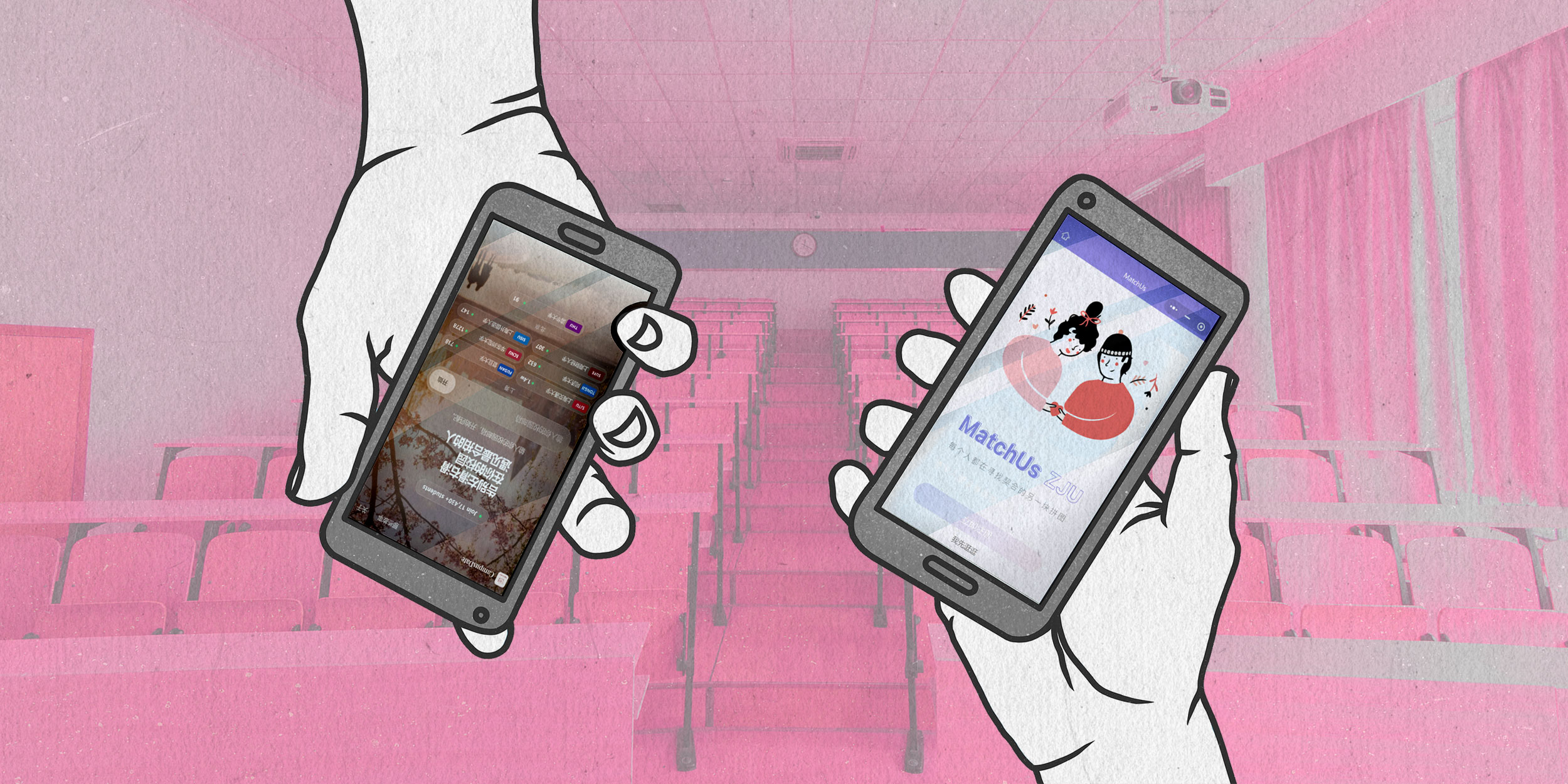
Other platforms have quietly been growing for a while, including MatchUs — a dating platform created in 2021 by Zhejiang University, in the eastern city of Hangzhou, which has since expanded to serve several universities and claims to have matched more than 56,000 students.
“Campus dating apps” appear to be particularly popular at China’s elite universities, where students face the toughest workloads and attitudes towards love tend to be quite conservative, according to Du Shichao, an assistant professor of sociology at Fudan University.
For Du, the rise of these apps reflects the broader issue of students’ horizons narrowing in an era when many rarely leave campus.
“People’s social spheres are increasingly confined to campus, internships, libraries, and labs,” Du said. “The chances for spontaneous, romantic encounters are dwindling, and so are the opportunities to meet new people.”
Shifting attitudes towards relationships and marriage are accelerating the trend. For Du, the apps mirror a growing “homophily” — a tendency to date people from similar backgrounds — in Chinese society.
“Students at top universities treat ‘securing safety in advance’ as a hedge against uncertainty,” he said, noting that today’s young people often consider dating someone from a different educational background or income level as too risky.
Recent surveys suggest that China’s students feel pressure to find a compatible life partner quickly. A 2024 study found that students are keen to get married and have children. But they value “autonomous choice” and are worried about potential conflicts with their partners over issues like careers.
In a 2026 poll by the Beijing-based MyCOS Institute, meanwhile, only 6.7% of college students said they wanted to stay single permanently. More than 40% believed 26 to 28 was the ideal age to get married, and more than 70% reported already feeling pressure from their families to tie the knot.
Many students believe they’re more likely to find the right match among their classmates, who tend to share similar backgrounds, values, and aspirations. But Du said this kind of “filter first, meet later” mentality could have downsides.
As students get used to screening out anyone who doesn’t fit their ideal of a perfect partner, they may become less willing to deal with the inevitable complications that come with a real relationship, he warned.
“In the past, both sides might take 50 steps forward to embrace each other, but now, at the first sign of conflict, people blame the matching mechanism and give up too quickly,” Du said.
There is also a deeper worry: a sense that students are being trained to treat love as another box to check, yet another exam to ace. According to Du, students are often overly focused on finding a partner with good “key performance indicators,” such as a high grade point average.
“When young people become accustomed to managing their lives with KPI-driven thinking and market logic, emotions that originally belonged to the realm of romance or aesthetics are transformed into quantifiable, optimizable projects,” he said.
On campus, though, the buzz around the platforms is palpable. CampusDate — the platform that Wang uses — has an unusual model: rather than letting users pair up on their own, it assigns users a new match every Tuesday at 9 p.m.
The weekly “drops” help build anticipation, turning the platform into a campus talking point. But for Wang, the platform’s main advantages remain its efficiency and relatively large user base.
“Once you’re matched, you can just start chatting and meet up,” she said.
Yet, some of the old pitfalls of online dating still apply. Wang has noticed that many users add each other on WeChat after being matched, but never actually message each other, possibly due to a lack of chemistry.
Tang Zhaoyi, a 22-year-old Fudan University student, has had a similar experience. He joined Solmate after his roommate suggested they sign up together. He was curious and open to meeting someone with a matching personality or interests.
Like Wang, Tang had never used mainstream dating apps, which he felt targeted an older crowd. He prefers university platforms, where “everyone is on the same level,” he said.
Tang disagrees with the claim that platforms like Solmate, which also require users to fill out detailed profiles, reduce people to labels. For him, it just helps users avoid wasting time.
“Some issues might get masked by other good qualities when you first meet someone, but over time, those issues can slowly become bigger,” he said. “It’s better to make your deal-breakers or boundaries clear upfront.”
So far, Tang has matched with two people on the platform. Both were “easy to chat with,” but neither led to a connection, he said. In April, his first match told him she was already talking to another student, who was more focused on starting a romantic relationship.
For Fang Tuo, the Fudan business student who created Solmate, this is how the platform is supposed to work. He originally launched the project in February, but gave it a major overhaul the following month after being inspired by the success of SJTU Date.
Solmate now follows a similar design. There are weekly “date drops,” with users only matched if they have a compatibility score above 80 out of 100. To reduce failed interactions, users must manually opt in to each matching round.
“Initially, users were automatically enrolled in every round, but some forgot to turn (the function) off and wouldn’t reply to emails after being matched, which hurt the experience for those genuinely looking to connect,” Fang explained.
Once matched, users will get a notification email rather than a direct message — a slower-paced format that Fang feels helps users forge deeper connections. The changes appear to have paid off: Solmate’s user base has now grown to over 1,500.
For some students, the platforms have already led to lasting relationships. Wang Shiqi — who isn’t related to Wang Nini — is a 20-year-old junior at Zhejiang University who started using MatchUs in 2024.
She first heard about it via the college’s internal forum, where students often discussed the platform’s monthly matching rounds, she recalled. She was soon paired with a male student in the same school — engineering — but in a different program.
They chatted online for a day, met the next, and became a couple after about two months. They have now been together for well over a year. Without MatchUs, Wang said they likely never would have crossed paths, as neither is part of many on-campus clubs.
The platform is particularly useful for students in male-dominated programs such as engineering, who often struggle to meet potential partners in real life, according to Wang. But that gender imbalance follows them onto MatchUs too — Wang’s boyfriend joined 11 rounds over two years before finally being matched with her.
The relationship has brought Wang a lot of joy. She and her boyfriend have plenty of shared interests, such as sports, and she appreciates the fact that they live on the same campus, which allows them to see each other almost every day.
With so many classes to juggle, Wang said managing a relationship took some effort, describing it as sometimes feeling like she’s “added an extra course” to her already busy schedule. But it’s one she is glad to have signed up for.
“This ‘course’ makes me very happy,” she said. “It gives me a fixed routine every day, and it makes me feel that I have something new to look forward to the next.”
(Header image: Visuals from VCG, CampusDate, and MatchUs, reedited by Sixth Tone)