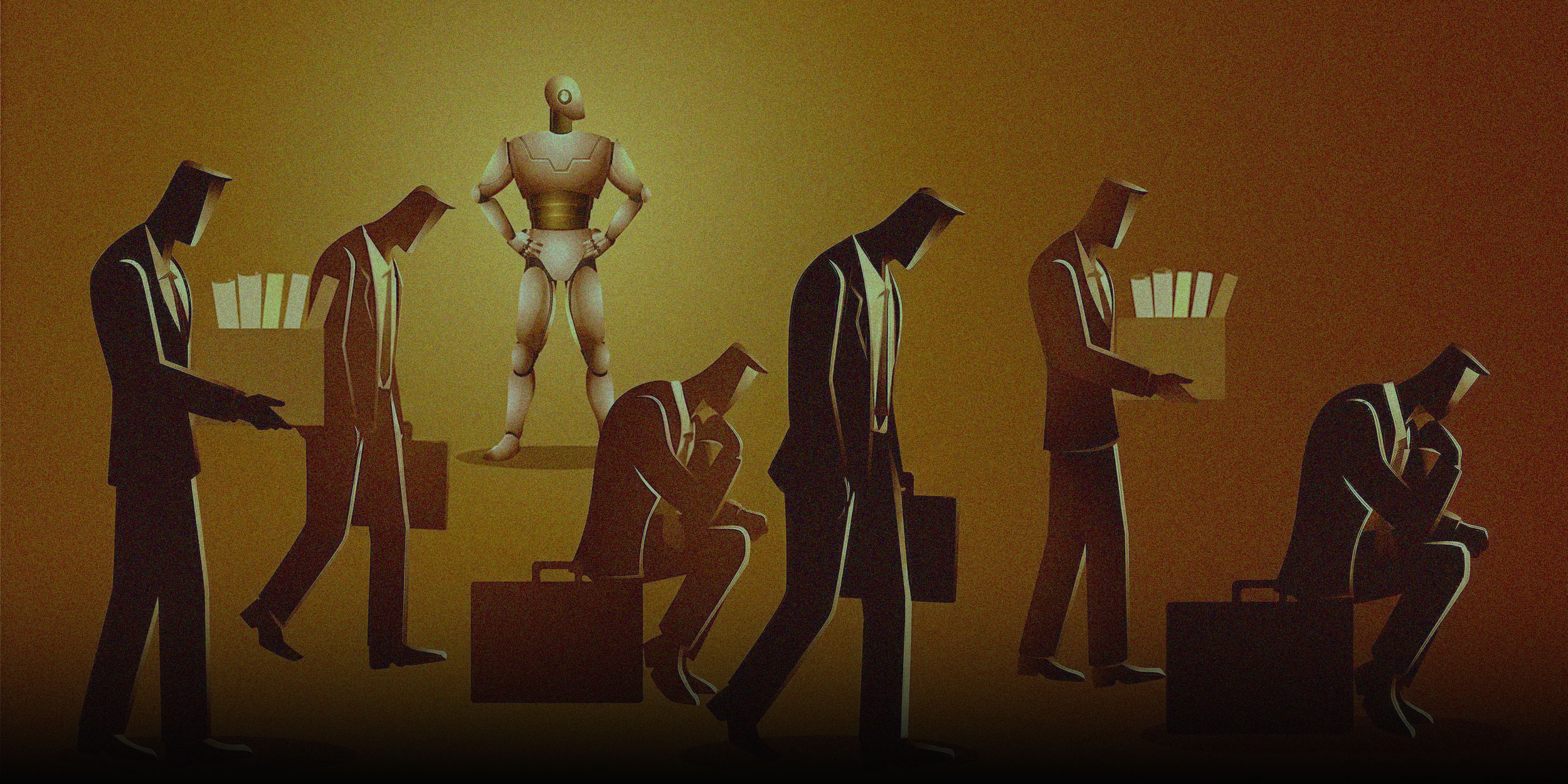
AI Took His Job. A Chinese Court Awarded Him $38,000.
Scared AI will replace your job? A Chinese court is on your side.
In a ruling released at the end of last month as part of a series of AI-related cases, the Hangzhou Intermediate People’s Court in eastern China’s Zhejiang province ordered a fintech company to pay a former worker more than 260,000 yuan (roughly $38,000) in compensation after it replaced his role with AI.
The employee, surnamed Zhou, had worked as a quality inspection supervisor for an AI model at the company, where his role was to review, evaluate, and ensure accuracy in the model’s user interaction responses.
In early 2025, amid the domestic AI frenzy sparked by the introduction of the Hangzhou-developed large language model DeepSeek, the company proposed reassigning Zhou to a lower-level operational role and reducing his monthly salary from 25,000 yuan to 15,000 yuan. When Zhou rejected the terms, the company terminated his employment contract.
Later, during arbitration proceedings, Zhou learned that the company’s rationale for his reassignment and salary downgrade was that his work had allegedly been rendered redundant because AI could perform his quality inspection duties.
The court ruled that the company’s actions constituted the illegal termination of Zhou’s labor contract and that it must pay compensation for unlawful dismissal and related losses.
Presiding over the case, Shi Guoqiang, judge of the fifth civil division of the Hangzhou court, said that the company did not abide by China’s Labor Contract Law, which states that employers can only terminate workers’ contracts if “a significant change in the objective circumstances upon which the employment contract was based renders the contract impossible to perform.” Shi determined that Zhou’s termination was due to AI’s cost advantage rather than factors considered “objective,” such as business cuts, poor management, or loss reduction.
Jiang Xiaotong, a lawyer at Zhejiang Yufeng Law Firm representing Zhou in the case, told Sixth Tone that she sees the ruling as a benchmark that directly refutes “AI replacement” as a catch-all justification for layoffs. “Going forward, if companies use AI as a reason to cut jobs, courts will strictly examine three points: Is there a genuinely legally significant change in objective circumstances? Was there reasonable and equitable negotiation, without substantial pay cuts or demotions? Has the company fulfilled its obligations to provide training and reassignment?” she said.
In addition to the Hangzhou case, in 2024, a court in Guangzhou, capital of the southern Guangdong province, also ruled in favor of a graphic designer at a tech company whose job was replaced by AI programs including Midjourney and Pixso AI.
AI-driven job displacement is a global concern. A 2025 study by the United Nations-affiliated International Labour Organization suggests that a quarter of jobs worldwide could be affected by generative AI. According to a white paper released by the Hangzhou Intermediate People’s Court, the city — which has recently become a hub for the AI industry — handled 12,359 labor dispute cases in 2025, up 61.68% from the year prior, with a growing number of disputes involving artificial intelligence and big data.
In a commentary on the case, state media outlet CCTV wrote, “The Hangzhou Intermediate People’s Court has provided a positive guideline: when job adjustments are indeed necessary, priority should be given to training employees, improving their skills, and internal transfers, rather than unreasonable job adjustments with significant salary reductions or direct dismissal.”
Editor: Marianne Gunnarsson.
(Header image: VCG)