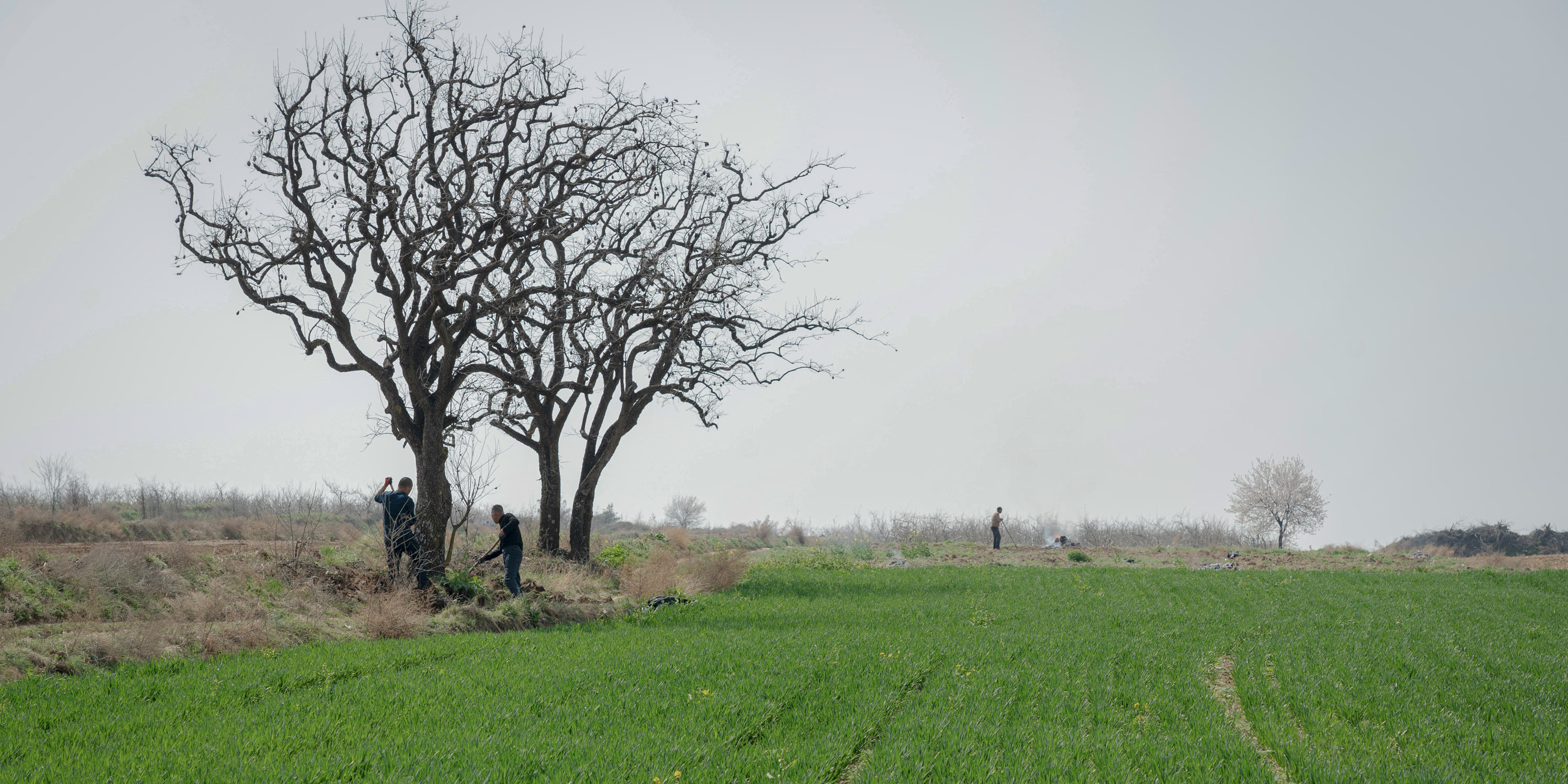
How Private Gardens Are Giving ‘Neglected’ Persimmon Trees a Fresh Start
On a cool afternoon in March, Cao Lin watches through the floor-to-ceiling window of her east-facing living room as a crane gently lowers a large persimmon tree into a hole in her city garden. For more than four decades, the tree has stood in a village 1,300 kilometers away.
Cao has been craving one of these low-maintenance, deciduous fruit trees ever since seeing a social media post about them in winter. “It’s exactly what our home has been missing,” she says. “There’s something beautiful about the sense of interaction, being able to just reach out and pick a persimmon as you walk past.”
In recent years, the trade in persimmon trees from China’s northern Loess Plateau to private courtyards in the country’s eastern cities has boomed, with some rural counties uprooting as many as 1,000 trees a year.
It is a nascent business that connects two contrasting faces of a changing China: at one end are dusty townships that working-age people have abandoned for fresh opportunities, neglecting their families’ fruit trees; at the other are affluent aesthetes looking to give these trees a new home.
Yet while urbanites revel in the trees’ ornamental charm and villagers cash in, for some the trade highlights the fading connection that those in the countryside have long had with persimmon trees.
Branching out
Over the past five years, interest in persimmon trees has surged on Chinese social media, with posts about their year-round photogenic appearance and sweet fruit receiving tens of millions of views.
To capitalize on the trend, tree nurseries began advertising specimens in short, high-quality videos, using narration to introduce the orchards or families that have tended to them for generations, all set to sentimental background music.
As more buyers emerged, a solid industry chain took shape: dealers scout for trees in the remote valleys of the northwestern Shaanxi province and neighboring Shanxi province, negotiate with locals, and handle excavation and shipping, while nurseries act as middlemen, helping with storage, trimming, and marketing.
Trees purchased from villagers for as little as 500 yuan ($75) are now being resold to middle-class consumers for tens of thousands of yuan — even hundreds of thousands if the specimen is nearing 100 years old.
Cao, who runs a craft furniture company with her husband in Nantong, in the eastern Jiangsu province, spent just under 20,000 yuan on her tree, with the cost of shipping it 18 hours from Shaanxi on a 13-meter semi-trailer running to 4,000 yuan alone. She had requested a tree with a sturdy trunk, a diameter at breast height (DBH) of 30 centimeters, and a height of no more than five meters.
Seeing it finally standing in her 200-square-meter, classical Chinese garden, Cao breathes a sigh of satisfaction. It will take time for the tree to bed in, but it has already taken root in her heart.
Falling leaves
Around the same time Cao was welcoming her garden centerpiece, a persimmon tree that had stood for some 80 years was being uprooted in a quiet corner of Xianyang, in Shaanxi.
Persimmons were once a major source of income for families in the city’s Liquan County, but many trees were abandoned in the fields after farmers began switching to growing apples in the 1960s. An exodus of young people to the cities also means there’s almost no one left to look after them — some villages today have fewer than 100 residents, most of whom are elderly, sick, or disabled.
Although the county still holds an annual persimmon festival, for a long time the locals viewed their trees as worthless: mere landmarks for giving directions, or obstacles that blocked the road and dropped fruit, leaving a sticky mess. But when they heard that tree dealers from out of town were offering to pay for good specimens, they got excited.
Zhao Shangwu, who is in his late 50s, knows Liquan like the back of his hand after spending a decade riding from village to village as a fruit buyer. When dealer Sun Xing first visited his field, Zhao’s persimmon trees didn’t leave an impression, but his social skills did.
Sun decided to hire Zhao as his local agent, tasking him with finding marketable trees, verifying ownership, and helping mediate negotiations with farmers over prices.
In this industry, securing a quick deal is essential. Not only is the competition rapidly intensifying, but the period in which a persimmon tree can be transplanted is short — from when its leaves fall in early winter to when new shoots sprout in spring. Outside that, uprooting it would be fatal.
In March, Sun and Zhao spent day and night driving around Liquan, searching for “premium specimens” and knocking on doors. Sun had landed seven clients who all requested trees within three days.
In one village, the pair spotted a copse of persimmon trees surrounded by neat rows of low-growing crops. Each tree stood about two stories high, and some had trunks so thick that a person would struggle to wrap their arms around them. It was Zhao’s job to convince their owners to sell.
“Buying trees is just like buying fruit,” he says, explaining how he lowballs easygoing farmers and sweetens the pot for stubborn holdouts. Zhao can earn up to 100 yuan on each deal, although he concedes that sometimes it’s better to just walk away: “Money can’t buy what’s not for sale.”
And even when a sale is agreed, other villagers might still object. Once, Sun reached a deal to dig up a mighty persimmon tree from land in front of an old temple. However, just when his crew was about to start digging, a group of elderly residents formed a human wall around the trunk and refused to budge. In the end, the tree remained where it was.
The 80-year-old specimen uprooted in March was among four trees that Sun had purchased for a total of 2,000 yuan from Li San, a 50-something villager who now lives in a nearby town. The dealer estimated that each tree would fetch at least 3,000 yuan on the market.
One of them — which boasted a DBH over 40 centimeters, a dense and flourishing crown, and had produced more than 300 kilograms of fruit the previous fall — was especially valuable for its physical characteristics, according to Sun. Clinging to the eroded edge of a terraced field, it had grown a wide root flare, an adaptation he planned to promote as an auspicious sign of “solid foundations and enduring success.”
Sun’s team of diggers — all retired construction workers from the next county over — were on site at 6:30 the next morning. It took them three hours to excavate the tree’s root tendrils, several of which were “as thick as a man’s calf.” The tree’s hemispherical root system radiated an estimated 3 meters down and out, releasing a crisp, slightly bitter scent as it was cut.
Moments before the tree was extracted, Li’s wife, Wen Peipei, arrived to paste a red scroll on its trunk. The paper bore an inscription notifying the tree spirit to move on before being disturbed or trapped.
According to local custom, families should set off firecrackers, burn incense, and kowtow to a tree before it is moved. Villagers believe that offending the inhabiting spirit can bring misfortune. “Honestly, it’s all superstition,” says Wen — but still, her family can’t afford any more bad luck.
Originally, Li had no desire to sell his persimmon trees, and had turned down offers just a few months earlier. Although in a neglected state, the oldest trees had been planted by his grandfather, while several others he’d placed with his own hands as a teenager. Selling their fruit had once brought his family about 2,000 yuan of additional income.
However, Li was forced to change his mind after falling from a high ladder while working at a building materials factory. He required four steel pins to stabilize the bones in his left leg and now walks with a permanent limp. In 2025, his apple orchard was also hit by a hailstorm, reducing the harvest by 10% and leaving the surviving fruit scarred and unsellable.
When Wen had finished kowtowing to the tree, the workers wrapped the trunk and sawed through the last two lateral roots. The crane’s steel cable pulled tight until the taproot snapped with a sharp crack. Suspended in midair, the crown looked like a burst of fireworks.
Long routes
To prepare a tree for transport, it must first be shaped to fit on the back of a flatbed truck or semi-trailer. Only about 1 meter of soil and fine roots is kept around the base. The root ball is tightly bound with rope and wrapped in a layer of shade netting to prevent moisture loss, while the crown is typically pruned to a diameter of under 4 meters.
Through this process, a mature tree with thousands of branches is transformed into a cylindrical bundle only slightly larger than an average-sized man.
To save on shipping costs, nurseries try to load up as many trees as possible. But navigating up to 7 tons of persimmon trees along narrow ravines is no easy task, and accidents are common. Rolling down dirt roads, semi-trailers often damage crops, snag power lines, and crush water pumps. Sun says he’s grown used to paying villagers for repairs.
Liquan has an especially complex landscape, full of steep earthen slopes and fields divided by ravines hundreds of meters deep and with sheer cliffsides. The locals were happily surprised when new level roads suddenly began being built, paid for by dealers and nurseries to facilitate the tree trade.
Yet, while many gravel roads are now paved, people feel it’s unlikely to draw younger people back to the area. “If we don’t sell the trees, who will inherit and look after them?” asks one elderly villager. Others express that with every small change, the county’s ancient connection to the persimmon tree is diminishing.
Li had no idea where his trees would end up, but he guessed the buyers must be wealthy urbanites. “Go enjoy a better life over there,” he says, patting the trunk of one tree, as if bidding farewell to an old friend.
He has no plans to sell his family’s three remaining persimmon trees. “Maybe I can no longer climb the trees to pick the fruit every year, but my children can,” he adds.
Turning a new leaf
In Nantong, Cao reaches out to touch her new tree’s weathered bark. It’s hard and warm, just as she had imagined. Formed over decades on the Loess Plateau, its layers of intersecting grooves and cracks resemble what the dealers call “dragon scales.”
Her gardener waters the tree and lays a thick layer of enriched soil around the root ball, and in a few days an arborist will stop by to treat it with pesticide, something most village farmers wouldn’t ever consider doing.
Looking up, Cao marvels at the branches — “so gnarled, yet so full of life” — and remarks how peaceful and grounded the tree makes her feel. “Seeing it lying on that long trailer, it looked so tiny and fragile,” she says. “Now it lives in my courtyard, like a grand elder quietly watching over us younger ones.”
(Due to privacy concerns, all names are pseudonyms.)
Reported by Cong Zhixiang and Yin Shiqi.
A version of this article originally appeared in The Beijing News. It has been translated and edited for brevity and clarity, and is republished here with permission.
Translator: Carrie Davies; editors: Wang Juyi and Hao Qibao.
(Header image: Workers dig up an old persimmon tree, Liquan County, Shaanxi province, March 2026. Cong Zhixiang/The Beijing News)