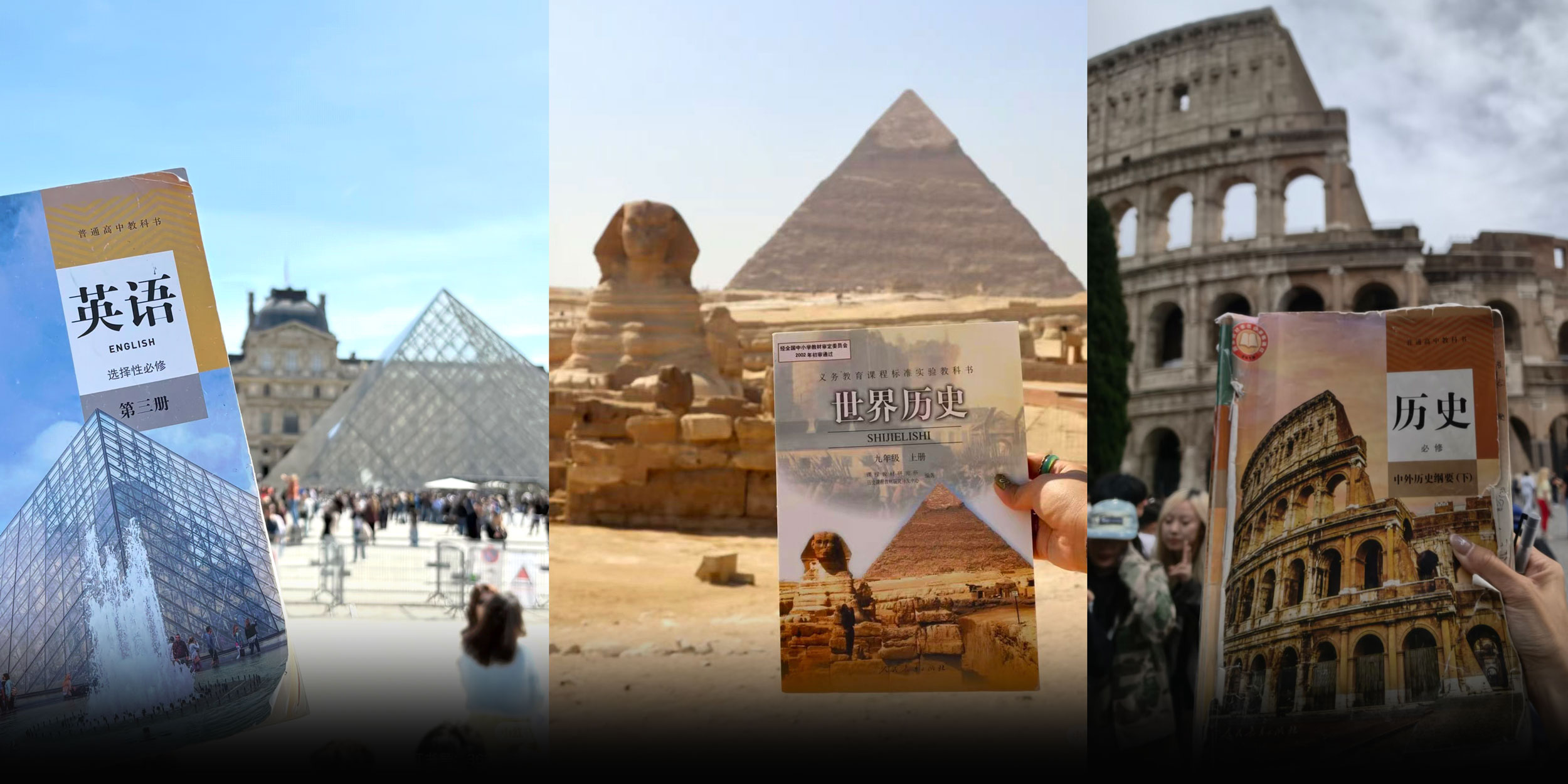
Chinese Tourists Leave Textbooks at Monuments for Others to Find
Chinese tourists are leaving high school textbooks at global landmarks such as Big Ben, the Colosseum, and the Pyramids of Giza, in a viral “treasure hunt” that some say they find meaningful, due to seeing the images within their textbooks “come to life.”
The trend, known online as keben jieli, or “textbook relay,” first began last November, when Chinese travelers to Egypt started posting pictures of the cover of a common junior high school history textbook, featuring the pyramids and the Sphinx, in the exact location of the textbook’s initial photo on social media.
Others soon began hiding textbooks behind trash bins or inside gaps between stones for others to find, sometimes with a pen for them to leave notes. The trend remains viral today, with the hashtag “travel with textbooks” having since drawn over 26 million views on lifestyle platform Xiaohongshu, also known as RedNote.
In March, several Chinese students in the UK continued the trend by hiding copies of their English textbook near Big Ben — a landmark featured on the covers. Visitors who located the books through Xiaohongshu posts have since written messages inside them, including wishes for family health and “world peace.”
“Hope everyone who learns about the world through books can see it in person,” read one note in a textbook placed near Big Ben.
“Some say you should go higher and farther, but you can also just explore,” wrote another.
One visitor reported finding seven textbooks hidden around Big Ben, including under lamp posts, behind a telephone booth, near a discarded bicycle, and behind light boxes along the River Thames.
In Italy, a Chinese student hid a history textbook near the Colosseum ticket office. In France, an English textbook featuring the Louvre Museum was placed in the bushes across from the museum.
One participant who left a textbook at the Louvre Museum told domestic media she recalled the landmark from her high school textbook, and seeing the image “come to life” felt like her education had come full circle.
The trend has spread as social media platforms and even Chinese embassies promoted the activity. In London, a Chinese restaurant near Big Ben placed a box of textbooks at a check-in point, offering free drinks to participants, while a hotpot outlet sent its panda mascot to pose with the books.
Beyond the textbook treasure hunt, “travel with textbooks” has become a broader tourism trend within China in the past few years, with state media promoting trips to sites featured in school materials and travel agencies launching textbook-themed routes. At the former residence of the Tang dynasty (618–907) poet Du Fu in the southwestern Sichuan province, for instance, visitors who memorize all 83 poems from a collection of classical poems about the province receive lifetime free admission.
Editor: Marianne Gunnarsson.
(Header image: Photos under the hashtag “travel with textbooks.” From Xiaohongshu)