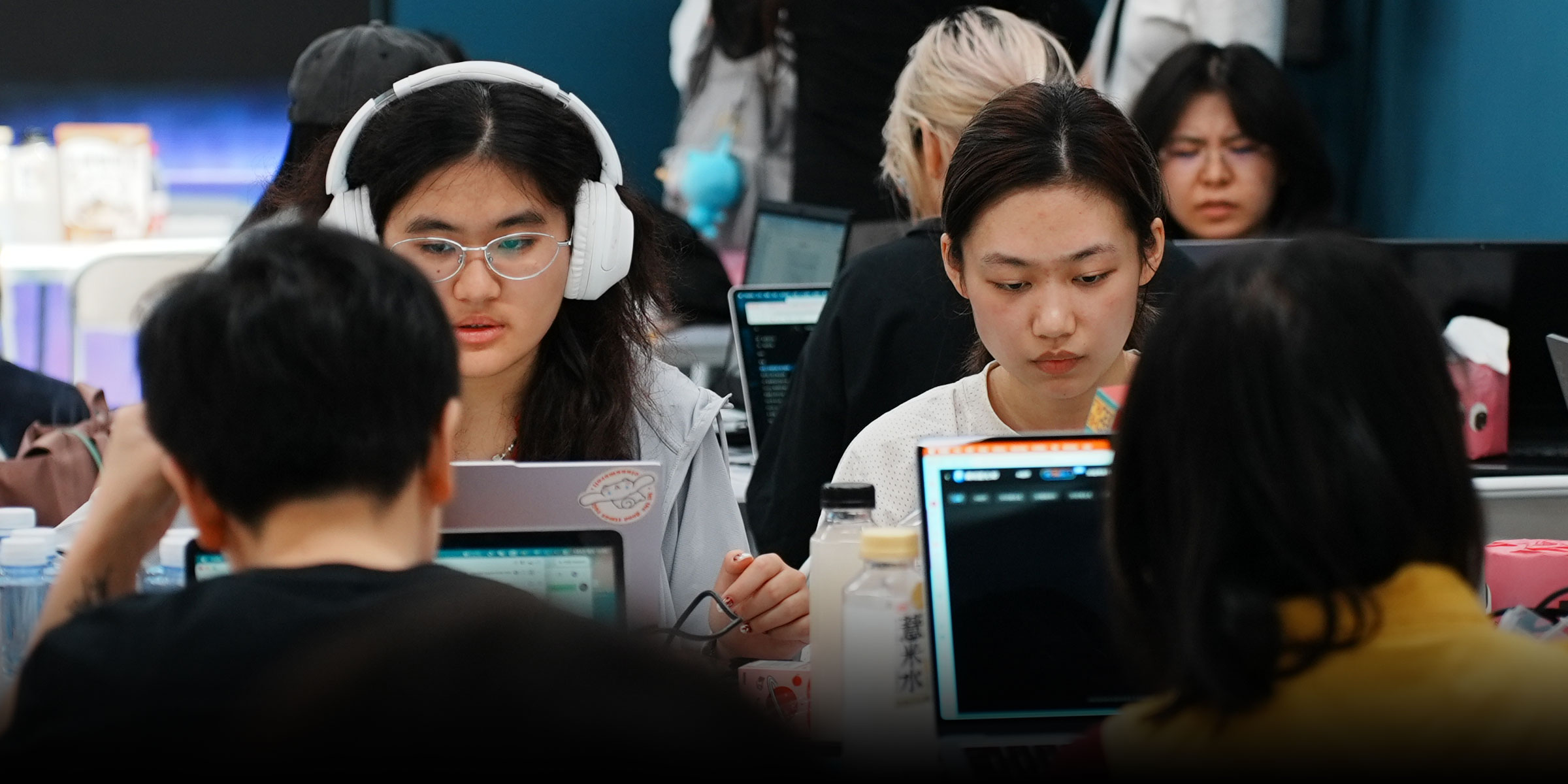
In China, a Women’s Hackathon Series Opens the Door to Tech
“I didn’t mean to offend. Women like you are just too sensitive.”
Moments later, fluorescent green text flashed across the lens of a pair of smart glasses: “Sexist stereotype detected: True. Suggested response: Everyone’s emotions are unique. Sensitivity is not a weakness, and everyone deserves respect.”
“It works!” shouted the team.
Their project, presented on April 6 at She Code Lab, China’s first women-focused hackathon series, involved programming smart glasses to analyze conversations to help women identify sexism and harassment. Called “SheSense,” the glasses also offer suggested responses and can record dialogue.
The marathon-style coding competition asked strangers to form teams of two to five people and develop a product within 48 hours. Of the total 161 contestants from 400 applicants who participated, around 90% were women.
Since late 2025, She Code Lab’s organizers — now a group of around a dozen women from diverse fields — have staged three hackathons: in Shanghai, Beijing, and the southern tech hub of Shenzhen, aiming to encourage more female creators in a tech world long dominated by men. According to a 2023 report by Chinese recruitment platform Lagou, women accounted for just 26% of newly registered programmers in the country.
China has seen a growing number of coding groups and training programs for women. In 2017, Beijing-based computer skills school Coding Garden launched a free online coding course for girls. Coding Witch, one of the hackathon’s two organizing teams, has gained 90,000 followers on lifestyle platform Xiaohongshu, also known as RedNote, since its founding in 2025, and has become a prominent women-in-tech community. And some local branches of state-backed women’s federations have opened free shared maker spaces for female entrepreneurs.
“Women make up half the world, but less than half of all products incorporate women’s perspectives,” 23-year-old organizer Peng Jing, an IT student at a Beijing university and a member of another organizing team, She Nicest, told Sixth Tone. “We want to encourage more women to step into the role of creators and builders, rather than simply users and consumers.”
From everyday experience
For 25-year-old Liu Mi, a hardware engineer at a Shenzhen tech company, the idea for the SheSense glasses came from personal experiences in a male-dominated workplace. Once, a male colleague praised a circuit board she had designed by saying, “Did you really make this? You draw so well. I couldn’t do that when I started.”
Uncomfortable with his words at the time but not knowing why, Liu later realized her discomfort stemmed from her coworker’s implicit assumption that a young woman should not be that good at technical work.
“He probably didn’t mean harm, and it wasn’t an obvious prejudice,” Liu said. “That kind of discomfort is hard to explain.”
Her teammate Cao Yuan, 26, who studies robotics and AI in Germany, recalled a more direct instance of sexism: her high school physics teacher told students that girls were weaker at engineering than boys.
“I believed the teacher at the time,” Cao said. “When I struggled with hard questions, I assumed it was because I lacked ability, not because the problem itself was difficult.”
Putting these experiences together, 23-year-old team leader Zhou Xuan, who also works in the AI industry, proposed building smart glasses to help women recognize sexist language in real time.
After surviving on just three hours of sleep a night during the hackathon, the team delivered a successful final demo. They now hope to work with glasses manufacturers to bring the product to market.
Other hackathon participants have drawn from their own experiences as daughters. Last year, 33-year-old Shanghai investor Helen He read an essay collection by Japanese writer Hiromi Ito chronicling her experience with menopause. She realized that her mother’s urinary leakage could be a symptom of menopause, as was the author’s case, rather than a result of childbirth.
“We know far too little about menopause, and it is often stigmatized as an illness rather than understood as something every woman goes through,” He told Sixth Tone.
She would go on to form a team at the Shanghai hackathon with a woman whose mother was also going through menopause. Her mother was diagnosed with rectal cancer last year, but because cancer patients often cannot undergo hormone therapy, her hot flashes became especially difficult to manage. She said she wanted to “at least do something so my mother could sleep at night.”
At the hackathon, the team built a smart pillow for women experiencing menopausal hot flashes. Using AI to predict changes in body temperature, the device cools automatically before symptoms begin. The project won first prize.
He is now working to commercialize the idea. Another teammate introduced her to a hardware manufacturer, while a hackathon vlog He later posted on social media also drew interest from another manufacturer. The team plans to launch an app to track hot flashes soon, followed by a smart pillow priced below 500 yuan ($70).
A niche market
Peng still remembers the phone call from fellow organizer Ni Zhen in July 2025. Ni had just finished attending a large mainstream hackathon, where male judges dismissed a product she designed for mothers.
“They said such products for women were ‘too niche and too small’ to commercialize,” said Ni. “But I saw it as a specialized product with 700 million potential users.”
Ni knew she was onto something. On the call, she asked Peng, “Why not build a hackathon led by women?”
Peng was lying in bed, watching tree shadows sway across the window above her, adding to the dreamlike image of founding their own hackathon. By the time the call ended, they had decided to make that dream real.
In the months that followed, Peng and Ni from She Nicest joined forces with Coding Witch to organize a 50-person software hackathon in Shanghai — the first of the She Code Lab series — in December 2025, circulating flyers for the event on Xiaohongshu and messaging app WeChat. To their surprise, more than 200 people signed up.
There are now around a dozen core organizers, all women from different backgrounds — students, journalists, programmers, and international school teachers. Some specialize in technical mentoring, others in logistics.
So far, the group’s hackathons and affiliated free beginner-friendly workshops have drawn more than 3,000 sign-ups and produced over 200 projects.
The organizers are now planning another women-led hackathon with more than 1,000 participants in July 2026. “With every event, we want to break another ceiling,” Peng said.
At the first Shanghai event, participants were asked to build under the theme “technology that benefits women.” Winning projects included tools for managing menopausal hot flashes, an injury-prevention tool for female athletes, and apps that help users locate nearby women’s shelters.
Later events in Beijing and Shenzhen removed the women-only theme restriction. Roughly half of the final projects still focused on women’s issues, while the rest covered broader ideas such as restaurant marketing, music, art, and accessibility for disabled users.
Participants who had previously attended mixed-gender hackathons told Sixth Tone the atmosphere at She Code Lab felt different because most of the contestants, judges, and organizers were women, creating a sense of “mutual understanding.”
At the Shenzhen demo day, one of the loudest rounds of applause went to a wearable device designed to track and manage premenstrual syndrome, or PMS, symptoms. When judges suggested the smart glasses project from Zhou’s team could also be used to collect evidence in sexual harassment cases, the room broke into applause again.
Breaking the ceiling
Organizers say they soon realized why supportive spaces like this were needed.
At She Code Lab’s Beijing event in January 2026, despite repeated encouragement, only one team signed up for the “Engineering and Systems” track, which emphasized working on real-world technical solutions involving algorithms and hardware. Instead, most chose the “Ideas and Projects” track, which focused more on product storytelling and case scenarios.
“There were many strong participants,” Peng said. “But many of them lacked confidence. Society often tells girls they are good at the humanities and boys are good at science, so many women feel they need to rank first before they can claim they’re good at tech.”
Jiang Xuning, one of the organizers and a computer science teacher at a Shanghai international school, told Sixth Tone that many female students in the teaching workshops affiliated with the hackathon were hesitant to ask questions or were afraid of failing.
But Jiang added that vibe coding — an AI-assisted way of building software with natural-language prompts — has significantly lowered the barrier to entry for women in tech, allowing beginners to build products much faster.
At the Shanghai hackathon, He, the Shanghai investor, learned how simple vibe coding could be. Later, she would use it to build AI tools for meeting notes and marketing at her own company.
“AI was moving so fast, but I used to feel all I could do was watch,” He said. “Hackathons gave me a chance to join the wave.”
He said she especially enjoyed the process of finding a team to compete in the hackathon, as people came together to solve problems without regard for background or credentials.
“We left our social labels behind,” He said. “It didn’t matter what school or company you came from. If we believed in the same idea, we could work together.”
As for Jiang, organizing events helped reconcile their feelings about gender, education, and where they fit in — facets that confused them growing up.
“I used to feel that communicating with girls was becoming harder in school, while talking with boys felt easier,” Jiang said. “Or I thought it might be simpler not to think about whether I was a girl at all.”
But during the hackathons, Jiang watched participants grow. Some who joined beginner workshops later became tech content creators, while some projects went on to win awards elsewhere.
Jiang also met women leaders from across industries. “They were always out there, scattered in different fields, maybe feeling isolated too,” they said. “Now they’re gathering. We can finally see who to learn from.”
“I’m no longer pessimistic, and I’ve started to rethink my own ability to take action,” Jiang said. “It proved that just a small group of us could build something incredibly useful. And by making such a large and diverse community of female creators visible, we’re already challenging stereotypes from the outside world.”
Editor: Marianne Gunnarsson.
(Header image: Attendees at the She Code Lab hackathon in Shenzhen, Guangdong province. Courtesy of She Code Lab)