Shenzhen’s Food Delivery Aunties Get a Policy Upgrade
Southern China’s tech hub of Shenzhen is piloting an official “relay delivery” system to improve security and incomes for its “last-mile runners” — usually older women informally contracted to carry delivery orders from riders to customers in tall buildings.
The pilot first began in November in the city’s Huaqiangbei Subdistrict, coordinated by Shenzhen’s social work authorities with delivery platform Taobao Flash. This month, food delivery giant Meituan introduced a similar relay service in the same location.
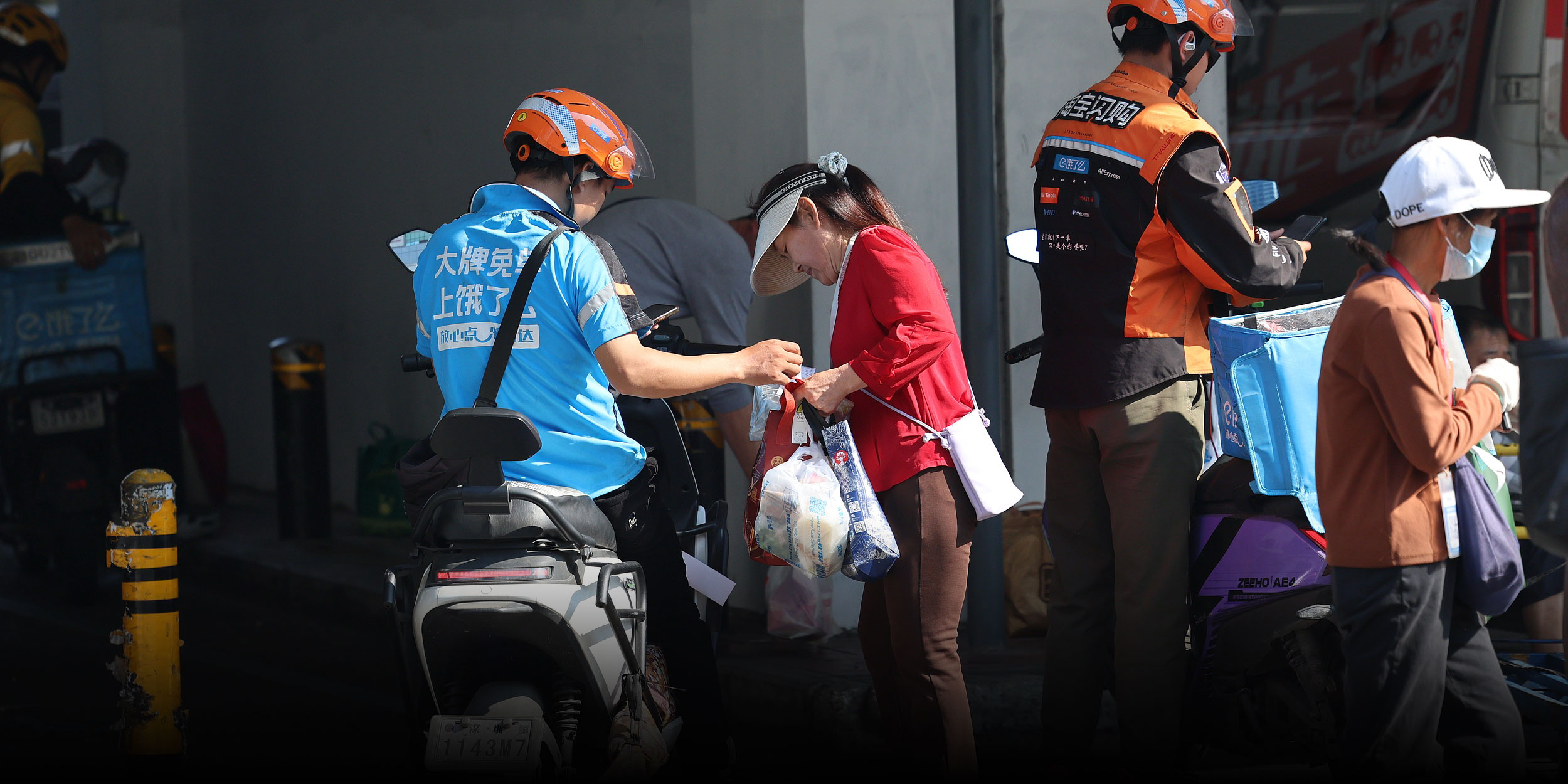
“Last-mile runners,” or paolou dama, provide a niche service in Shenzhen, where certain properties forbid food-delivery riders from parking their scooters outside. The policy, combined with strictly monitored delivery times and the sheer size of buildings, has left riders with no choice but to find others to finalize the delivery of their orders. But runners often face disputes over deliveries, low pay, and lack of insurance, while drivers bear responsibility when runners misplace orders.
The idea for the pilot system emerged in 2025, when local authorities launched a monthslong survey of building runners, finding that runners sought more stable incomes, safety protections, and a clearer system for dispatching orders.
At relay stations outside buildings, riders now drop off and scan orders before moving on. Orders are then arranged by floor and assigned to building runners who check in by scanning a QR code and select orders based on their physical ability, as crowded elevators mean runners often have to climb many flights of stairs. Each run pays approximately 1.5 yuan ($0.2).
The new model also demands the platform purchase accident insurance for runners, with a total coverage of up to 650,000 yuan ($95,000). A Meituan staff member told Sixth Tone that delivery incentives and subsidies will also be allocated to drivers and riders in the pilot area, but did not specify the amount.
“There are many locations in the food delivery service that are difficult to pick up or deliver to,” a staff member from Taobao Flash told Sixth Tone. “These locations may be enclosed or semi-enclosed, located on high floors, span large areas, or be subject to strict property management.”
Before the pilot’s launch, most riders in Huaqiangbei would pay a runner a fee out of their own pocket to carry orders up to customers. “The relay delivery method is popular because the time saved brings more orders and lower risks, and many riders’ monthly income has actually increased,” the staff member said.
Ao Xiulian, 56, has been running the same building complex every weekday for three years as a part-time supplement to her housekeeping job. She told Sixth Tone that before the pilot, arguments and fights among runners were common as income depended on who could grab orders first.
“As soon as a rider arrived, seven or eight people would rush them,” she said. “Building runners fought over orders, and some even ended up at the police station,” adding that she often struggled to get orders because she presents as gentle.
Ao said she used to complete 40 to 50 orders daily. Now her orders have doubled, bringing her monthly earnings to around 2,000 yuan — double what she made before. “Since the delivery relay station started, things have become much more stable,” she said.
“(Runners and riders) are part of this community too,” Zhang Mingbao, an official representing the Huaqiangbei Subdistrict and who introduced the pilot, told Sixth Tone. “We felt there should be a way to make this work safer and more orderly.”
According to Zhang, since the pilot’s launch, not only have fights stopped, but a complete order-tracking chain has also been established, allowing riders, runners, and customers to see the status of their orders.
“Before, if food spilled or someone got hurt, (runners and riders) bore the cost themselves,” Zhang said. “Now the platform can provide insurance and absorb some of that risk.”
So far, around 50 registered runners have joined the Huaqiangbei pilot, according to local authorities, with plans to add more service points and extend the model across the subdistrict.
“This isn’t just about delivery efficiency,” Zhang said. “It’s also an experiment in how cities can include informal workers rather than leave them outside the system.”
Editor: Marianne Gunnarsson.
(Header image: A runner takes a delivery from a rider in Shenzhen, Guangdong province, Jan. 17, 2026. VCG)