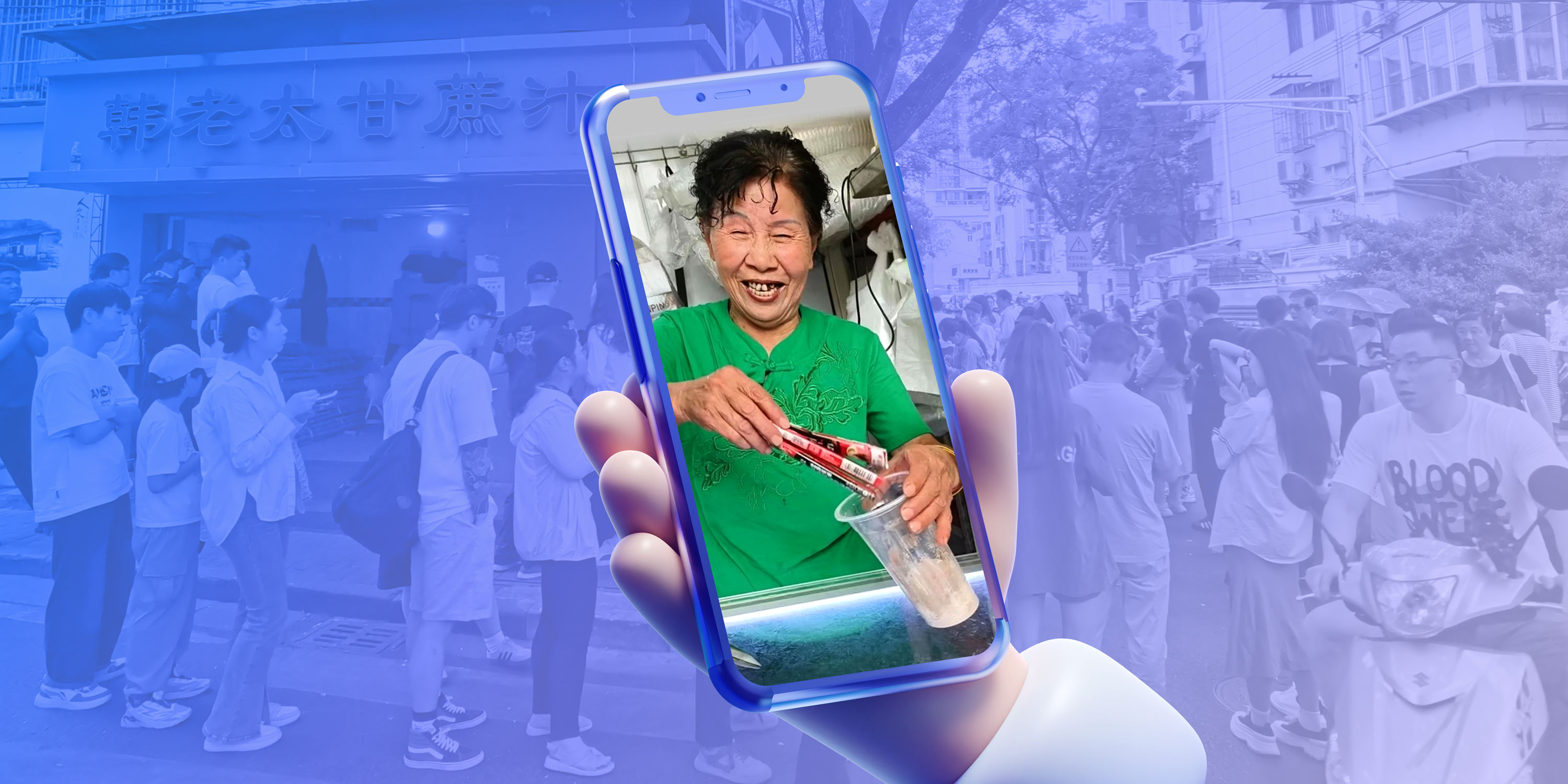
Instant Karma: No Regrets for ‘Coffee Gran’ Who Stirred Media Frenzy
Editor’s note: In the age of the attention economy, social media has the power to change lives by propelling any ordinary Joe to celebrity status in an instant. But what happens when that 15 minutes of fame ends?
Sixth Tone is republishing five stories from “After the Spotlight Fades,” a 10-part series by The Paper that revisits people and places in China whose fortunes were transformed — sometimes only briefly — by viral fame.
“When you’re trending, you earn more money — and when you’re not, life is more comfortable. Good health is the most important thing.”
After seeing both sides of the coin, Han Suzhen knows which she prefers.
The 74-year-old shot to fame in May 2024 when a tourist’s short video about her “hand-brewed instant coffee” went viral, sending countless customers flocking to her small alleyway store, Granny Han’s Sugarcane Juice, in downtown Nanjing, capital of the eastern Jiangsu province.
It is perhaps not immediately clear why the post grabbed people’s attention, but nostalgia no doubt played a part. In the video, Han slices open three sachets of Nescafé instant coffee with large iron scissors, empties the contents into a cup, and pours hot water from a “retro” red flask. For this, she charges 10 yuan ($1.50).
Soon after, Han was selling 1,000 cups a day, with fans coming from as far away as China’s southwestern megacity of Chongqing, the northern Inner Mongolia Autonomous Region, and the northwestern Xinjiang Uyghur Autonomous Region. Even celebrities and social media influencers from overseas, such as the Malaysian pop singer Michael Wong, stopped by to take photos with her.
“The line would sometimes stretch more than 50 meters,” says the owner of a nearby barbecue stall.
Then, Han’s instant fame disappeared almost as fast. Today there are far fewer selfie-shooting visitors, and sales have dropped back to about 100 cups a day at best — sometimes it’s only two or three.
Her shop still bears the memories, though. Dotted on the walls of her 10-square-meter space are photos of Han posing with film and television stars and at red-carpet events in an elegant qipao dress, as well as a red velvet banner sent by Nescafé.
But there are also parts she’d like to forget — not least the rumors and accusations online that called into question her character and authenticity.
Easy come, easy go
At the peak of Han’s fame, Nescafé featured her on a livestream and promised a lifetime supply of free coffee, while one of Nanjing’s biggest tourist attractions asked her to be a brand ambassador. Many companies also offered her free products including flasks, milk, an air conditioner, and a television.
“Someone gave me a hot water dispenser — there were just too many customers, and I couldn’t boil water fast enough,” she says. “In the end, the water boiler was the only thing I kept. I politely declined everything else.”
Yet, there were those who believed it was all a stunt. Some claimed online that Han had a professional content team behind her to drive traffic, while others suggested she had raked in millions of yuan in just 20 days.
This left Han upset and frustrated. “I’m just an elderly lady. Where would I get a team?” she says, explaining that her nephew had helped her set up an account on Douyin, the Chinese version of TikTok, because someone had started impersonating her online. “I do have a personal account where I post videos of my everyday life and occasionally livestream.”
And the rumors about her income? “I sell sugarcane juice and coffee — how could I possibly make that much?” she scoffs. “I did earn a few hundred thousand, but it was all from hard work.”
Within two months of the video going viral, the crowds outside Han’s store had already begun to thin. By the National Day holiday in the fall, things had returned to normal.
“I wasn’t disappointed. Why would I feel disappointed?” she says. “For me, going viral was like pennies from heaven. As a woman in my 70s, running my little shop, to suddenly become famous nationwide and receive the attention from so many people — what more could I ask for? I think my life has been truly worthwhile.”
She always knew the hype would eventually cool down. “If I’m not trending anymore, then I just sell a bit less,” Han says. “As long as I make enough to cover my costs and put food on the table, that’s fine. And honestly, if it had stayed that busy, my body wouldn’t have been able to take it — I would have collapsed sooner or later.”
“At the peak, I went three days without a proper meal and lost almost three kilograms,” she adds. “Once, I almost fainted at work. I was working myself to death — that’s no good.”
And it wasn’t just Han who was running off her feet. Ah Fu says his mutton soup restaurant, which is next door to Granny Han’s Sugarcane Juice, was packed every day with tourists and content creators. He had to set up more tables outside to accommodate the crowds.
Now, the trend-followers are gone and the regular neighborhood clientele has returned. “Those good days are over,” sighs the owner of another food business in the alleyway.
The good life
Fame ultimately brought Han less freedom. At one point, she’d arrive at work in the morning to find lines of young people from out of town — cameras poised — waiting for her to roll open the shutters to her tiny shop. Now, she can have a lie-in on chilly days, or grab a leisurely breakfast nearby before opening.
At 9 p.m., she closes up and hops onto her electric scooter for the three-minute ride back home. She no longer has to detour through side alleys to shake off the influencers who once trailed her like paparazzi. Life has returned to what it was: steady, orderly, unhurried.
One day in January this year, just after 10 a.m., Han had just taken her first order: two cups of sugarcane juice. She slipped a disposable plastic glove over her right hand and stuffed some sugarcane into a juicer, leaning instinctively to the left to catch the juice in a plastic cup. The machine crunched and gurgled before expelling the spent sugarcane pulp into a large blue trash can via a tin chute. After sealing the cup, she handed it to the customer, a local school boy. “He’s grown up drinking my sugarcane juice,” she says.
Later, a young man in his 20s from Wuxi, a city about a two-hour drive from Nanjing, ordered a cup of sugarcane juice and politely asked if he could take a photo with Han. A young teacher from Changchun, capital of the northeastern Jilin province, also snapped a photo in front of the shop’s sign and posted it on social media with the caption, “Met an internet celebrity auntie — she’s super nice!”
By the end of the day, Han had sold over 100 cups of sugarcane juice, but only two or three cups of coffee. “The day before yesterday, I sold over 100 cups of coffee, and even more sugarcane juice. Today’s a bit slow, but it doesn’t really matter how much I sell,” she says.
Every morning, Han sprays her permed curls, applies face cream, and swipes on lipstick before heading out. When people meet her, her carefully put-together appearance leaves a strong impression. Some say she resembles the Korean actress Na Moon-hee, but Han waves this off with a laugh, insisting, “She’s a star. I’m just an ordinary old lady. There’s no comparing us.”
Born in Nanjing in 1951, Han moved to the countryside in the early 1970s before returning to the city to work as a purchasing agent at a department store, a job that required traveling across the country.
“Back then, I loved wearing qipao with a pair of 5-centimeter heels and a little blazer. In summer, I’d carry a parasol. I turned heads everywhere I went,” Han says with pride.
After China launched its “reform and opening-up” policy in 1978, coffee became fashionable among urban youth, and a friend gave Han a Nescafé instant coffee set. “That was considered a classy gift at the time,” she recalls. To make it last, she allowed herself only one cup every two days.
But she was soon hooked, and would enjoy a coffee whenever she had free time. When single-serve Nescafé sachets became available, she would empty two into a mug, pour in hot water, and stir with a spoon, savoring the aroma.
Han opened her sugarcane juice shop after she retired in 1992. Before starting each day, she would pack a few instant coffee sachets in her bag so she could brew a cup at work, sometimes leaving them on the counter. Eventually, customers began asking about them — and some wanted to buy them.
She’d been running the shop for several years when she decided to add coffee to the menu. “I was just selling coffee on the side — who would have thought my coffee would go viral?” she says. Even before smartphones, she often had lines of customers waiting for her sugarcane juice. “I’ve been selling it for decades, and business has always been good. Sometimes the daily revenue is 5,000 or 6,000 yuan.”
Han’s husband was a few years older than her. She remembers him as a patient, good-tempered, and caring man. Every night when she came home from work, he would have a cup of coffee ready for her — she found that she was unable to sleep without it. When her husband passed away due to illness in 2022, her instant coffee ritual became a form of emotional solace.
Today, back in her shop, this Nanjing native seems content with her lot. She has no interest in expanding into livestream marketing — she has no idea how algorithms work — or in opening a chain of outlets. “I’ll just keep doing what I’ve always done,” she says. “As long as my health holds up, this little shop will stay open.”
Reported by Qiu Haihong.
A version of this article originally appeared in The Paper. It has been translated and edited for brevity and clarity, and is republished here with permission.
Translator: Carrie Davies; editors: Wang Juyi and Hao Qibao.
(Header image: Visuals from Modern Express and VCG, reedited by Sixth Tone)