When Shakespeare Meets Shanxi Opera
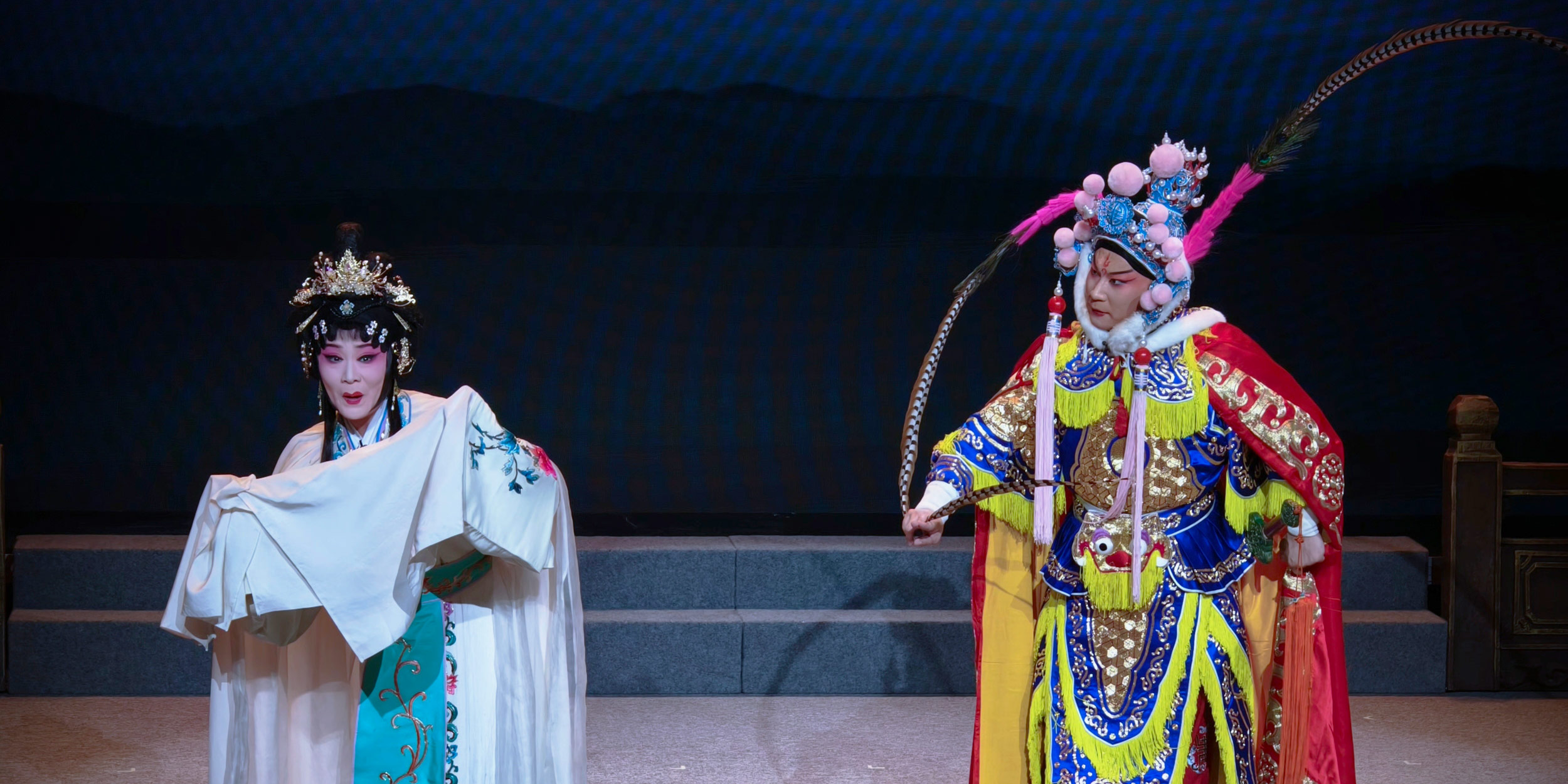
At the performance’s climax, the general, played in a wusheng role — the martial male type in Chinese opera — enters his wife’s bedroom. The flags on his back and the pheasant-tail feathers on his helmet sway with anger as he confronts her about her alleged promiscuity and infidelity. His wife, played as a huadan — the vivacious young female role — responds with a sequence of stylized movements that express shock and grievance. Finally, the general pulls out the white scarf that once symbolized their love and, in agony, strangles her.
These traditional Chinese opera performers are, in fact, staging a scene from “Othello” by William Shakespeare, a storyline that may already feel familiar. This Pu opera — a traditional form of operatic drama from Linfen and Yuncheng cities in the northern Shanxi province — is even titled “Othello: Suspicion.”
While traditional Chinese opera rarely adapts foreign classics, it is not unheard of in “small-theater opera.” The term is difficult to define precisely, but it has been developing in China for more than a quarter-century. It is generally understood as an experimental platform where creators rework traditional material through a contemporary lens.
In theory, the space for experimentation is open, since there are no fixed norms or established models to follow. In practice, however, small theater opera often relies on creative adaptations or reinterpreting existing stories. This usually means taking a story or character that audiences already recognize and retelling it from a contemporary perspective. These reinterpretations tend to fall into several categories: adaptations of novels, reworkings of traditional stories, new biographies of historical figures, and cross-cultural adaptations of foreign classics, such as the one above.
When it comes to cross-cultural adaptations of foreign classics, the Peking opera master Wu Hsing-kuo from Taiwan is widely seen as both a pioneer and a leading figure. His adaptations of Shakespeare, including “Kingdom of Desire” (“Macbeth”), “Lear is Here” (“King Lear”), and “Caesar” (“Julius Caesar”), are often cited as successful examples.
Wu does not simply retell Shakespeare’s stories or rely on fashionable formal experiments. In the 80-minute one-man performance “Lear is Here,” for example, he plays more than a dozen roles. What the audience sees is not just the story of King Lear, but also the physical and emotional strain of a Peking opera actor using his entire body and skill to confront, fracture, and reconstruct a Western classic. At the end of the play, when Wu sheds all his roles and faces the audience as himself, he asks, “Who am I?” The question no longer belongs only to King Lear. It emerges from Wu’s own shifting between roles and extends outward to the audience, where it resonates as a more general uncertainty about identity in a globalized world. Wu Hsing-kuo’s practice suggests that the key to cross-cultural adaptation lies not in whose story is borrowed, but in whether the work’s internal logic can be made to work within a new cultural and historical context. Judged by this standard, the Pu opera mentioned above reveals clear weaknesses in its cultural translation.
“Othello: Suspicion” retains the full narrative framework of Shakespeare’s original, even pushing the starting point further back in time. Shakespeare’s original opens after Othello and Desdemona have already eloped secretly against her father’s wishes, while in the Pu opera version, Luosai (Othello) and Bai Wuxia (Desdemona) have yet to declare their feelings. That said, the entire opera lasts only 90 minutes, making it almost impossible to cover the full arc from courtship to murder.
More importantly, Shakespeare builds this tragedy on a specific social and historical context. In “Othello,” the protagonist’s anxiety is rooted in his position as a Moor within a relatively stable society structured by racial and cultural hierarchy, where his outsider status leaves him vulnerable to doubt and manipulation. Iago’s influence works precisely because it feeds into this existing insecurity, making the final act feel psychologically credible, even if tragic.
The Pu opera version shifts the story to the Sixteen Kingdoms period (304–439), a setting marked by political fragmentation and fluid relations between Hu and Han groups, but it does not develop a comparable psychological or social foundation. In such a context, a Hu general would be unlikely to experience the same kind of sustained exclusion. Without that underlying tension, Luosai’s suspicion and the murder that follows feel less like a tragic inevitability shaped by circumstance and more like a personal failing.
If the playwright had engaged more closely with the historical context, it might have been possible to create a different rationale for Luosai’s suspicion. The Sixteen Kingdoms period was marked by rapid political change, where a ruler one day might become a prisoner the next. “Loyalty” was a gamble that could easily fail.
In the opera, Gu Yige (Iago) utters a line that hints at this reality: “Who does not want to go wherever prospects are brightest?” In such a world, trust becomes a luxury. If the playwright had developed this idea further, Luosai’s suspicion might have come from a different psychological source, not the racial inferiority of “a barbarian marrying the daughter of a prime minister” but the mindset of someone forced to remain constantly alert in a volatile world, someone who no longer believes that anything, including love, is secure. In that sense, his suspicion would not simply be a mistake, but a response shaped by experience. It would be both a survival instinct and the force that destroys his happiness. The tragedy and absurdity could then emerge naturally from the historical setting itself, rather than relying on Shakespeare’s framework. As it stands, the setting offers a general sense of chaos but little psychological depth.
Using a familiar story like “Othello” gives the playwright an advantage: less time is needed to explain the plot, leaving more room for reinterpretation. But in cross-cultural adaptation, this can also become a shortcut. Because the audience already “knows” the story, the writer may not fully rethink how its characters, motivations, and emotional logic translate into the new cultural and historical setting. Instead, these harder questions are left unresolved, while the focus shifts to performance elements. As a result, the adaptation risks avoiding the most demanding part of the work: making the story feel convincing in its new form.
Small-theater opera needs to address these harder questions. The issue is not whether to borrow from Shakespeare, but what the story becomes in a new context. Why retell it now, and what is actually being added? At its best, as in Wu Hsing-kuo’s work, adaptation does not rely on familiarity but reshapes it into something that feels both contemporary and relevant to audiences. This is the standard that cross-cultural adaptations should aim to achieve.
Translator: David Ball.
(Header image: A stage photo of the Pu Opera “Othello: Suspicion,” Shanghai, Jan. 28, 2026. VCG)