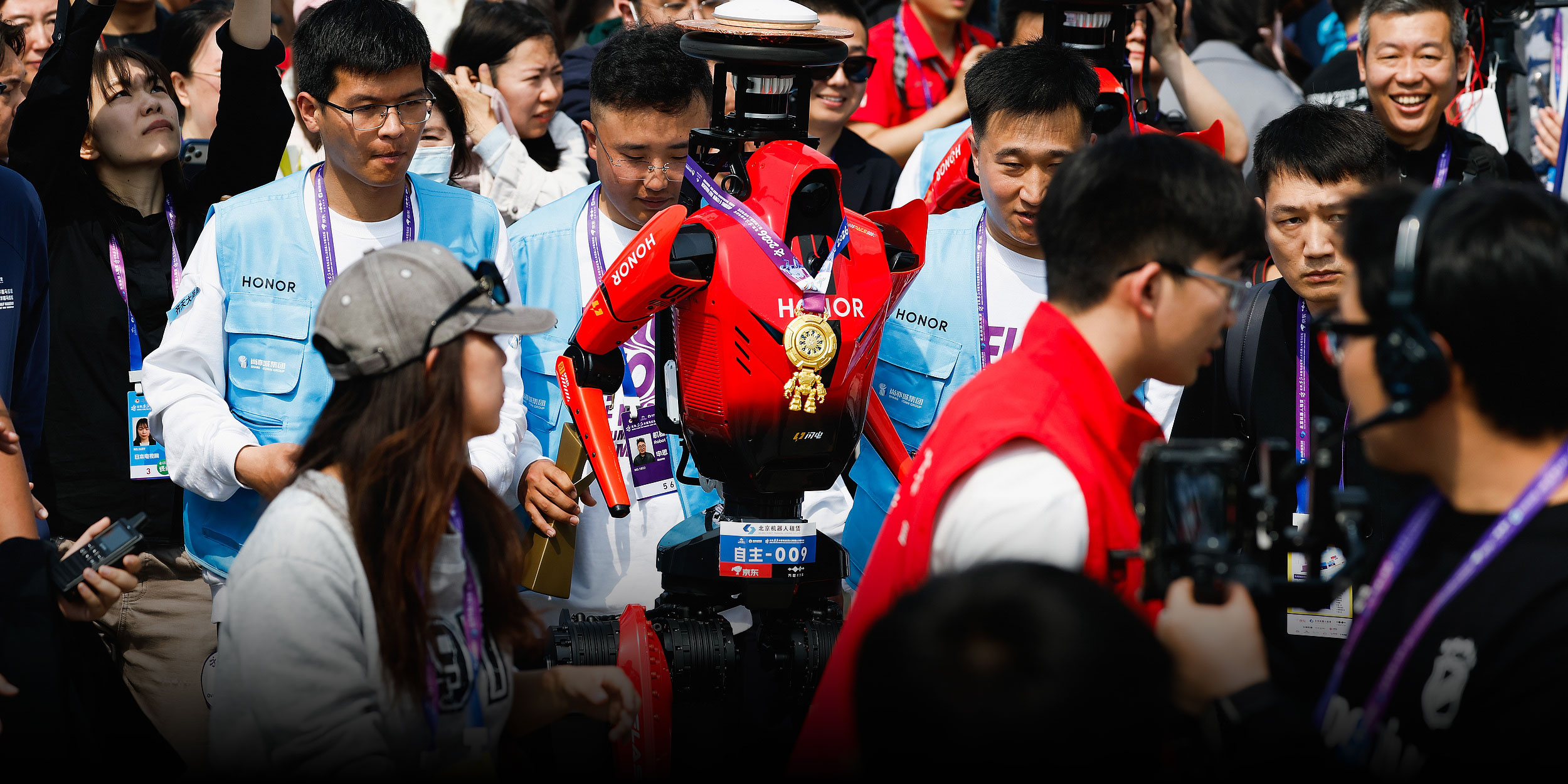
Chinese Robot Runner Beats Men’s Half-Marathon World Record
Robots as tall as adults and wearing gym shoes, child-sized robots with antennae, and robots consisting of a human head on two legs, but no torso. This was the scene during the 2026 Beijing E-Town Humanoid Robot Half-Marathon on Sunday, as robots of various shapes and sizes ran through the streets of Beijing — and even more crashed into bushes and roadside barriers.
The race’s winner, a robot named “Lightning,” completed the 21.0975-kilometer course with a time of 50 minutes and 26 seconds, breaking the men’s half-marathon world record of 57:20 set by Ugandan athlete Jacob Kiplimo in March. The second and third-place robot finishers also beat the world record.
Now in its second year, the race brought together more than 100 international teams, 300 humanoid robots, and roughly 12,000 human runners on a shared course, with separate lanes for human and robot competitors.
Of the 102 robots registered to compete, 47 completed the course — an improvement on last year’s six. Teams could choose between two participation methods: autonomous navigation or remote control, which factored into scoring, with autonomous navigation favored. This year, 18 teams used autonomous navigation and 29 teams applied remote control.
This year’s top six robots were all designed by teams under smartphone manufacturer Honor, headquartered in the southern tech hub of Shenzhen. The company entered the embodied AI sector less than one year ago.
This year’s champion has legs measuring 95 centimeters — designed to simulate the stride of professional human runners — bringing its total height to 169 centimeters. According to Du Xiaodi, Test Development Engineer at Honor, it also uses the same cooling technology as in smartphones to prevent overheating.
Speaking to domestic media, Yan Bin, chief architect of Honor’s New Industry Incubation Project, described how Honor’s teams equipped their robots with specialized joints to make them run faster. “To achieve the requisite step frequency, sufficient power must be supplied to move the robot’s legs … equivalent to the power output of a high-performance car.”
Yang Xinying, founder of the Xintuo Center for Embodied AI Research and Development, told domestic media that getting the robots to run as fast as humans, if not faster, put high requirements on researching and developing robotic joints, and that the progress achieved in making the joints smaller and more flexible holds potential for the field of robots in service of humans generally.
Yan said that the top three robot finishers were identical in structure or algorithm, and differed only in their starting positions and pre-race strategies.
“Lighting only needed a battery change at the 10.6-kilometer mark,” Yan said. “We are very satisfied; it met our expectations.”
“A significant proportion of this year’s humanoid robots relied on autonomous navigation technology, including the top three finishers,” Zhang Xiaolin, director of the Institute of Bionic Vision and Brain-Inspired Intelligence at Shanghai University, told Sixth Tone. “Consequently, as autonomous driving technology continues to advance, the capabilities of humanoid robots are also improving substantially.”
“Though these types of robots were purpose-built for running a marathon, so all unnecessary equipment was stripped away, compared to humans, there is still a gap — but even so, it represents a very significant step forward,” Zhang said.
Editor: Marianne Gunnarsson.
(Header image: Honor’s “Lighting” humanoid robot is surrounded by spectators after winning first place in the world’s second robot half-marathon in Beijing, April 19, 2026. VCG)