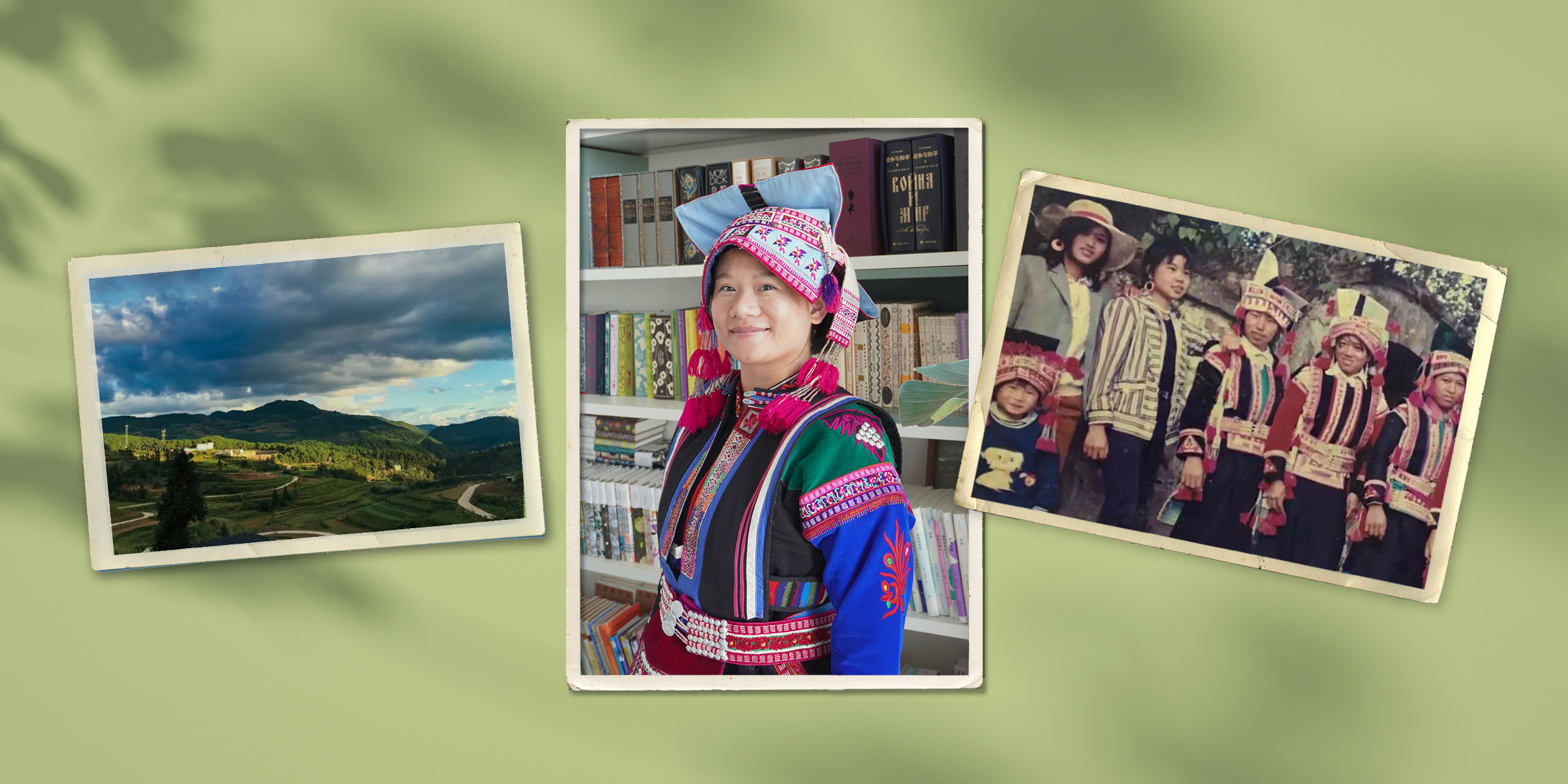
The Room Within: A Yi Childhood Among Animals in Yunnan
Editor’s note: Zha Shiyire is a Chinese writer and pre-veterinary science student based in the United States. Born in 1990 in the southwestern Yunnan province, she is a member of the Yi ethnic group. She spent her early childhood in a “zhaizi” — a traditional stockaded village — before attending a Han-majority primary school.
In August 2025, she published her debut essay collection, “I Grew Up in a Zhaizi,” a vivid recount of her open-souled upbringing in a remote, natural environment and her later efforts to adapt to modern society and mainstream Han culture. The book weaves together personal joys and struggles, sentiments, and memories, while portraying the evolving lives and perspectives of her mother, sister, and other female relatives in the Yi community. The book was named a 2025 Top 10 Book on Chinese review site Douban and recommended by numerous Chinese media outlets.
Below is an excerpt of the book’s preface, “The Room Within.”
A long time ago, I was chatting with a friend who taught at a university in Beijing. He said, “You know, people like you are a real minority. People like me make up the majority of this country. It’s just that there aren’t too many people like me around you, so you’ve come to mistakenly believe that you’re one of the majority.”
We had been talking about childhood. I asked him, “Have you ever seen hundreds or even thousands of damselflies flying together?” He hadn’t. I asked him many other things like that, but he hadn’t experienced any of them either. Later, our conversation drifted to more common topics, like jiwa, or “chicken blood parenting,” the national will, and the rules of society. What we said were things others had already said, so there wasn’t much need to elaborate. But somewhere in that conversation, I had a realization: I had always envied elites like him, and I was genuinely curious about the life experiences of someone who had done everything right since childhood. What I hadn’t considered was that anyone might be curious about the life experiences of a wild, feral childhood — like mine.
I also understood something else: there is a part of my inner world that I can’t directly share with others, a place they have no way of entering. Only I know it exists, and I’ve been drawing energy from it ever since.
I’ve spent many days wondering how that room was built — what constitutes the deepest part of myself that might never be able to empathize with another person. Today, talking with my dad, I seem to have found a little bit of the root: first, a childhood full of direct contact with nature and animals; second, my father’s innate sense of romance.
I am, without exaggeration, a child of animals. All kinds of domesticated and wild creatures directly participated in — and sometimes intervened in — my growing up.
In the seven years before entering a Han school, I spent almost every hour of every day alongside animals. There were no concepts of bacteria or microorganisms in rural areas, especially in the rural ethnic minority communities. If I close my eyes now, I can vividly feel, almost without trying, the warmth and texture of my dog — a huge dog — holding me in its arms as we napped together on the cobblestones outside our house after lunch while the adults went to work. A summer breeze gently blew the damp hair on my forehead; cicadas and birds chirped; somewhere behind the house, a small canal murmured. I would usually wake up at around two in the afternoon to find my dog vigorously licking my hair and the sweat on my face. I felt itchy from its licks, and I’d burst into laughter from the tickle. Then we’d run wildly together to play, or help adults in the fields. Whenever I grew tired and wanted to lie down again, its embrace was waiting. It had been there when my mom gave birth to me at home, watching me arrive, then watching me walk, taking me in, from infancy until its death at 13.
We napped in so many places together: on field ridges, in the mountains and forests, in the attic, on cobblestones, and on haystacks during rain. The textures of these places are imprinted in me so deeply that I don’t need to call them up intentionally. That feeling grew alongside my genes.
At the time, being a child in that world, there were almost no rules. Apart from basic values and morality, parents had neither the time nor any established traditions to prescribe what their children should or shouldn’t do. The teachers in Yi schools were not full time; they might teach a class in the morning, maybe Mandarin, and then everyone worked together in the afternoon.
After entering a Han school, I began to understand what a collective was and what a wealth gap looked like. I was exposed to many ideas, learned to follow rules, and learned to conceal a part of myself in order to move forward more smoothly.
But seven years of feral living cannot be changed overnight. After starting school, although my health deteriorated, my nature hadn’t changed much. I made mistakes often.
Once, after a fight with a classmate and a scolding from an adult, I felt so stifled that I went to the stable and rode out on a horse. We galloped to a distant hill. It was dusk, and I lay down on the horse’s back and let it wander wherever it chose. It walked very slowly, and I gripped its neck, gently stroked its mane, and confided all my grievances to it. My tears rolled down its hair. Its body heat spread throughout my thin chest and belly, warm and reassuring, with a sense of trust that passes between one living body and another. The scenery that day was beautiful, with mountains stretching off endlessly and wildflowers covering the slopes. Grasshoppers sprang up from the grass, and patches of green swayed slightly under a blue sky without a sound, except for the rustle of leaves. My horse and I walked and walked for a long time. I didn’t go home until nearly dark.
Horses are very gentle animals — especially toward me. When I was so small that I couldn’t mount by myself, one of them often played a devious little game with me. I was only a little higher than its knees at the time. When we stood together, it would press its lips on the top of my head, deliberately rubbing left and right. The tickling made me howl with laughter, and it would nuzzle my face, taking great pleasure. The chin and lips of a horse are very soft; you could say they feel like ... breasts? I can’t quite explain it. That kind of touch is wonderful, and I really enjoyed playing the game with it.
I’m now in my 30s, and I still love people who feel as warm as horses, and I still love having my head rubbed. It might be the preference for the tactile memories that horses bring to me.
We had a big rooster at home — a truly enormous one. When I was about 2 years old, I was shorter than it when I crouched down. It was also very friendly with children. I’d often hold onto its neck with my hands and rest my head on its back, and it wouldn’t flee. It would let me keep holding it like that until I got tired of it. The feathers running from its neck down its back were so smooth. It felt wonderful.
One day during a thunderstorm, I found myself alone with a cow on a mountain slope. The rain gradually grew heavier, and my heart went out to the cow. I draped my raincoat over its back and sheltered beneath its belly. It was a gentle cow, so I wasn’t worried at all that it might step on me. I held onto its front legs tightly and fell asleep. It didn’t move at all. When I woke up, the rain had stopped, and the sun was shining on the grass again. There was a rainbow in the distance, and the cow just looked at me softly, unmoving, not eating.
Sometimes I really went wild, sliding from its back to its head, and hanging upside down from its neck, watching the world in reverse. Sometimes I’d pinch its lower lip out of mischief, but it never got angry. I’d dangle until I couldn’t hold on anymore, then drop down with both hands braced on its horns.
As for what my father has to do with any of this, it’s probably that whenever there was any interaction between the animals and me, he never stopped me. He was strict about studying for a time, but he never opposed going wild in this regard.
So many of my memories about nature and beautiful scenes are bound up with him. Endless starry skies and waterfalls. Wild sorrel fields and white roses laid at our dog’s grave. Lying in streams watching white clouds drift. Screaming and rolling down gentle slopes, doing somersaults. Chasing a snake to keep it away from the road …
Over a long period, from high school through my early working years, our relationship went through great crises. Integrating into school and society brought us both difficulties and gains. We were each, in our own way, constantly worn down by the effort of adapting to society. But we were lucky enough to hold onto our beautiful memories, and when these tense periods passed, we became good friends again.
I’ve always believed that my father also has a room in his heart like mine. It’s because of that room that he has remained a romantic person through a difficult and humbling life.
To return to that conversation with my friend, if we follow the prevailing standards of social stratification, given my starting point, my background, and my life trajectory, my life should have been very difficult. But now I’m living far better than I ever imagined — I’m even a little worried that the people running the world might have forgotten about me. I move through life like a “software bug” surviving in the world, always burdened by a sense that I don’t deserve this luck, and that it could vanish. I doubt the solidity of what I’ve built, and wonder if I’m trapped in a well. Am I too small, too closed off, too narrow-minded? Can my “small enough” bear the world’s “large enough”? Is this peace I feel real, or will it be taken back?
As a person, I am not particularly successful. My fears are as bountiful as my joys, my hypocrisy as heavy as my sincerity, and my pride and my inferiority are wound together inside me. My losses and gains constantly reshape my heart and body, with my feelings of emptiness and fullness constantly trading places.
But on every quiet and lonely night, when I feel low and exhausted, my little room is still bright. Dogs, horses, cows, fish, wild grasses, roses, streams, mountains, and earth are all still there, vivid, in this room waiting. I lay in it, holding my dog, and we are wrapped in a gentle stillness, sleeping peacefully on the cobblestones, undisturbed.
Perhaps this is what the room is for. I must have been a very, very lucky child to have such a room.
“I Grew Up in a Zhaizi” was published in August 2025 by Shanghai Translation Publishing House. This excerpt is republished here with permission.
Translator: Matt Turner; editors: Wang Juyi and Elise Mak.
(Header image: Visuals from the author, Shanghai Translation Publishing House, and VCG, reedited by Sixth Tone)