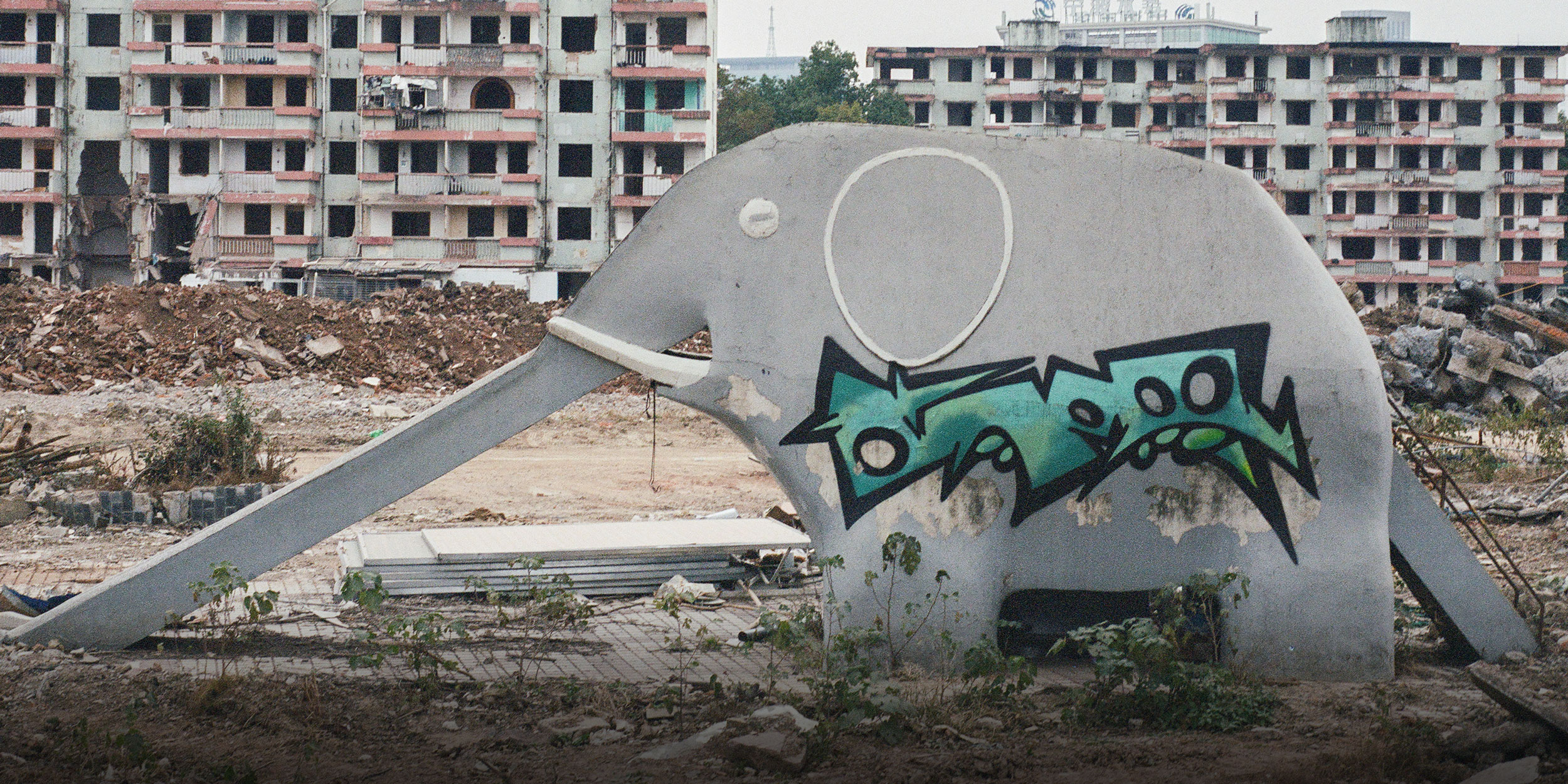
The Long Hunt for China’s Vanishing Elephant Slides
Near the Ming Xiaoling Mausoleum in Nanjing, eastern China’s Jiangsu province, an elephant-shaped playground slide stands alone in an abandoned swimming pool covered with fallen leaves. The site is known as Zixia Lake Park, but the pool is now hidden among wooded hills, without a precise address or a fixed location on any map. Visitors, drawn to the forgotten structure, rely on routes shared online to find it.
Elephant slides — relics of a bygone era that many recall playing on in childhood — are scattered across China. They rarely appear in official records or mapping systems, yet continue to be rediscovered through word of mouth and fragmented online clues — a quiet, informal practice of searching for them gradually taking shape.
As urban parks expanded rapidly in the early years of the People's Republic of China, elephant slides gradually became a familiar feature of Chinese parks. Many cities drew on Soviet models of public space design, and animal-shaped stone playground structures became common.
These slides were also once embedded in systems of collective life. Work-unit compounds — associated with railways, oil, and factories — functioned as self-contained communities with housing, schools, canteens, and small parks. As this system gradually declined, many compounds were dismantled or repurposed, leaving the slides among the few remaining physical traces.
Sun Maoyicheng, from the eastern city of Hangzhou, is one of the most persistent elephant slide documentarians. Since late 2024, she has traveled to more than 60 cities and photographed over 100 elephant slides, estimating that fewer than 200 remain nationwide. She sorts, archives, verifies leads, and plans routes to the slides, like a researcher conducting fieldwork.
The project began almost by accident. She came across a photograph of an elephant slide on social media, which brought back childhood memories of a gray terrazzo elephant slide at a local primary school, where she used to play with classmates as a kindergartener. But by the time she enrolled at the primary school, the slide had been removed. Learning that similar slides still existed elsewhere came as a surprise.
For Sun, the project also marked a shift in the way she practiced photography. Having worked for years as a newspaper photojournalist, she was accustomed to focusing on people, but found the constant interaction exhausting. The slides offered a quieter subject — one that does not require direct engagement, yet still reflects the relationship between people and their time.
Finding them is rarely straightforward. With no systematic archive, Sun relies on fragments: a post, a comment, a vague place name. She cross-checks and narrows possibilities until a location becomes plausible.
She often navigates narrow alleys, old residential compounds, ruins, and abandoned industrial sites, asking for directions along the way. At some point, an elephant slide simply appears — a moment Sun describes as similar to “clearing a level” in a video game.
Over time, she has developed a practical method: children are often the most reliable source of directions. Adults tend to say the slides have already been demolished, while children are more likely to point to places where they still exist or are still in use.
When photographing the slides, Sun sometimes slides down them herself, trying to imagine what it felt like for children who once played there.
Sun believes there are more elephant slides in southern China, with the highest concentration in Guangdong province. She has also noticed regional similarities. In Shaanxi, elephant slides are often shaped as a smooth curve with a patterned “blanket” over the back. In Henan, they tend to feel more three-dimensional, with larger, rounder heads and a stronger sense of volume. Some regions also incorporate local stylistic elements, such as designs in Yunnan province influenced by the local Dai ethnic group.
Despite these variations, the underlying design logic remains consistent: the elephant’s trunk as a slide, the back as a platform, and the limbs as supports.
Yet the slides continue to disappear. The reasons are largely practical: lack of parking space, aging infrastructure, and urban redevelopment. Some are still in use but carry visible layers of repair and alteration. Some are reconstructed but lose their original material texture. Some are converted into structural supports for signage, while others are relocated or preserved after local appeals. Others remain alone in ruins as temporary remnants.
Sun does not see their fate as something that can be determined by individual will; for her, documentation is what she can do for now. Still, each demolition leaves her with a sense of regret, particularly when she sees the sites in photographs. At the same time, she accepts it as part of urban transformation. “I think the preservation of public facilities should not rely on my sentiment alone; it should be about serving local residents.”
As her images circulated online, more people began sharing their own childhood memories of elephant slides, elevating them from mere objects to triggers of collective memory.
For Sun, this response is not simple nostalgia, but a way of thinking about belonging. In the past, people were embedded in more stable, collective systems — work units, neighborhoods, families. Today, as those structures loosen, mobility has increased, but so has the distance between people and places.
Returning to familiar places only to find them changed produces a sense of dislocation that these slides seem to embody. Once sites of play and sound, they now stand as empty forms shaped by time.
“I am just a recorder,” Sun says. “Before they disappear completely, I press the shutter and leave a trace of what once existed.”
(Header image: An elephant slide in Ningbo, Zhejiang province, built in the 1980s. It may be relocated following residents’ appeals. Courtesy of Sun Maoyicheng)