Inside the Linguistic and Cultural Rebellion of the ‘Mudan’
In the intricate choreography of the traditional Chinese calendar, the solar term guyu — or “grain rain” — marks a critical ecological threshold. Falling around April 20, it is a period when the atmosphere’s thickening humidity and warming soils are said to give life to a hundred grains.
But for the residents of Luoyang, an ancient capital in central China’s modern-day Henan province, guyu is defined by a different kind of growth: the peak blooming season of the peony, or mudan, as it is known in Chinese.
This time of year is so deeply entwined with the mudan that Song-dynasty polymath Ouyang Xiu (1007–1072) once observed that the flowers of Luoyang, “take the Grain Rain as their cue to bloom.” During this window, the city is engulfed in a riot of color so pervasive that it once moved the Tang poet Liu Yuxi (772–842) to declare that the peony alone possessed the “color to truly captivate the nation,” a spectacle capable of “stirring the entire capital.”
However, the peony had once stirred the capital for other reasons. As it stands, the mudan is an icon of Tang dynasty prosperity — in large part because it is rooted in a legendary act of botanical defiance. Folklore tells of the Tang Empress Wu Zetian (624–705), the only woman to rule China in her own right, who ordered every flower in the imperial garden to bloom at once during a winter banquet in Chang’an (now Xi’an, capital of the northwestern Shaanxi province). All obeyed except the stubborn peony. Infuriated by this perceived treason, the empress ordered the plants uprooted and banished to Luoyang.
Far from a punishment, this exile became a coronation. Over in Luoyang’s fertile loess, the mudan flourished, eventually earning the moniker huawang, or “King of Flowers.” Soon, it evolved from a mere ornamental plant into a symbol of resilience, becoming a character in the Chinese psyche — a rebel that refused to bloom on imperial command.
Despite its deep roots, the mudan’s official status in modern China remains a subject of ongoing debate. Unlike the British rose or the Japanese cherry blossom, China has no formally designated national flower.
Since the 1980s, a spirited “flower war” has simmered between the plum blossom (meihua) and mudan party, with proponents of the plum blossom pointing to its resilience in winter as a metaphor for national fortitude. Still, when the China Flower Association launched a nationwide poll in 2019, the mudan received nearly 80% of the votes. The State Council has yet to grant it official legal status, but for some, crowning the mudan is not just about aesthetics; it is about codifying a cultural identity and supporting a burgeoning domestic industry centered in Luoyang and Heze, in the eastern Shandong province.
The mudan is, after all, a springtime icon, one that refuses to be categorized in language or place. Its allure has even crossed the oceans, captivating Western horticulturists like Michael Haworth-Booth. In his 1970 work “The Moutan or Tree Peony,” Haworth-Booth noted: “In Chinese art, each month is represented by a flower, and Moutan is specifically the flower for March (the third month of the lunar calendar).”
The mudan’s rebellious legacy as a flower that refuses to fit any mold also has deep philological roots. Haworth-Booth’s use of “Moutan,” for instance, is more than an exoticism: It is a phonetic fossil. A transliteration of the Chinese mudan, the spelling carries the fingerprints of the Wade-Giles romanization system, where the “t” represented the unaspirated “d” in Pinyin. Furthermore, the first syllable, mou, likely reflects an archaic pronunciation. According to the “Guangyun,” an 11th-century rime dictionary, the first character mu, represented by mou, is listed under the mo-hou consonant-vowel combination, suggesting a vowel that differs entirely from modern Mandarin.
The spelling may have even been filtered through 19th-century French lexicography. Émile Littré’s “Dictionnaire de la langue française” recorded the “Moutan” as a pivoine ligneuse originaire de la Chine (a woody peony originating from China). Even then, its botanical classification remained in flux, reflecting the West’s struggle to categorize a plant that looked like a peony but possessed the woody structure of a shrub.
The Oxford English Dictionary has long recognized this distinction, canonizing “Moutan” as a main entry in 1933. Even so, in the OED’s hierarchy, “Moutan” remains the primary entry, complete with etymological citations, while “tree peony” (the closest translation to mudan) is relegated to a sub-entry under “tree.” This linguistic priority mirrors a biological reality: the mudan is a definitively woody specimen, not merely a garden variant.
Contemporary English often lazily collapses mudan into the generic term “peony.” But as any botanist will attest, the genus Paeonia is broad, encompassing both herbaceous (shaoyao) and woody (mudan) varieties. The Royal Horticultural Society in London maintains this distinction with characteristic rigor. In its “A-Z Encyclopedia of Garden Plants,” it lists the species as Paeonia suffruticosa — literally “shrub-like peony” — and explicitly uses “moutan” as its common name to distinguish it from its soft-stemmed herbaceous cousins.
The evolution of these names reveals a striking parallel between East and West. The Grand Chinese Dictionary (Hanyu Da Cidian) notes that in antiquity, the mudan was simply grouped under the general term for peonies (shaoyao). It was only later that it was distinguished as the “woody peony” (mu shaoyao) before mudan became its universal name. Wherever it appeared, the mudan evaded easy description or categorization.
As the Grain Rain approaches once more, the people of Luoyang prepare for the return of their king. After its 20 days of glory, the petals will fall, and as the Tang poet Bai Juyi once wrote, “the whole city will go mad with longing.”
More than this, however, the grand return of the mudan is a reminder that whether in the pages of the OED or on the streets of Luoyang, it remains a flower that refuses to be simplified — a spirit that lives on throughout time.
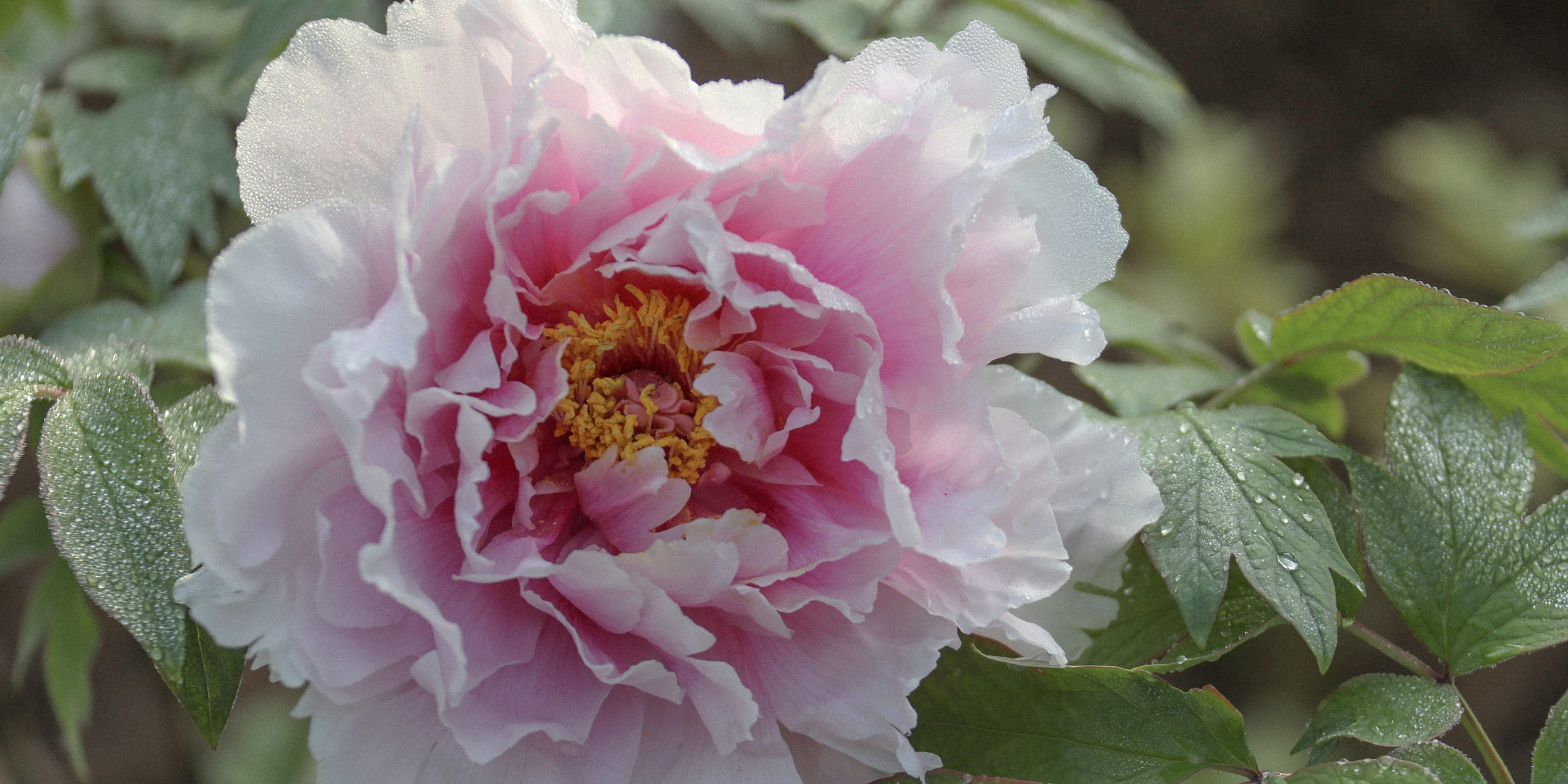
(Header image: A mudan peony in Luoyang, Henan province, 2025. Ma Huaigang/VCG)