The Pagoda Puzzle: What Can Save China’s Oldest Wooden Tower?
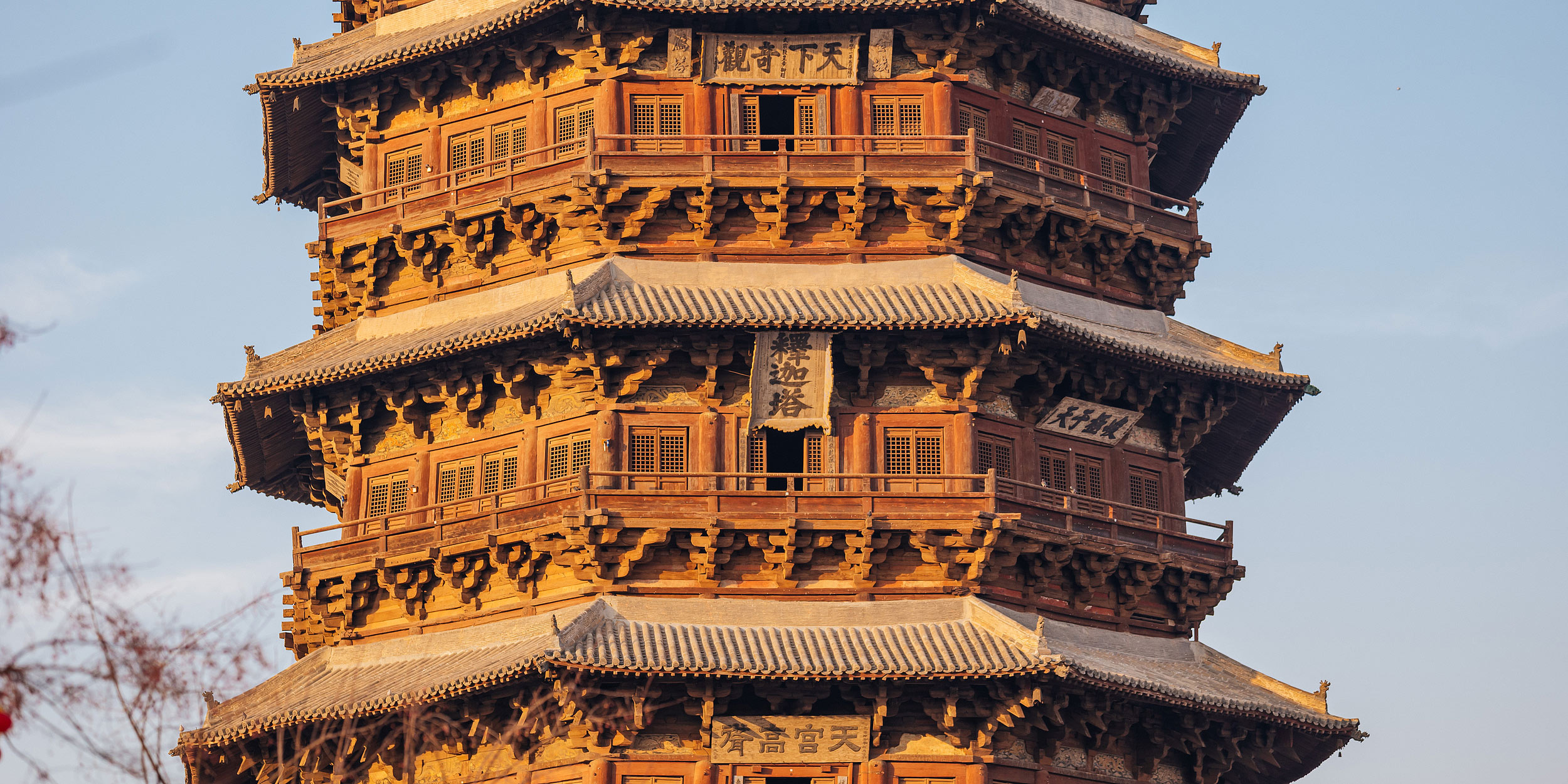
The Wooden Pagoda of Ying County, in China’s northern Shanxi province, is the tallest and oldest all-timber pagoda in the world. It has stood for nearly 1,000 years, held together solely by 80,000 mortise-and-tenon joints.
However, time has not been kind. Today this national treasure is in critical condition — and its restoration has ignited considerable debate among academics and netizens.
In March, the Chinese authorities moved to quash online rumors that the 67-meter-tall pagoda would soon be completely disassembled, insisting that monitoring and surveys are still ongoing to determine the right approach.
Here, Wang Yongxian, a former senior expert at the Shanxi Institute of Ancient Architecture Conservation, discusses the controversy surrounding the ancient pagoda’s renovation with The Paper.
The Paper: What are your thoughts on the widespread rumor that the Wooden Pagoda of Ying County could soon be completely disassembled?
Wang: I was shocked at how quickly and widely the rumor spread, but I know full well that, after years of deliberation, the pagoda’s restoration plan remains focused on close monitoring, in-depth research, and localized reinforcement. A comprehensive restoration with complete disassembly is impossible in the short term and is clearly false information.
There are a few reasons why this rumor spread so quickly. First, the public has profound affection for the pagoda; it holds a special place in the hearts of the Chinese people. Second, the pagoda’s condition is truly distressing, with noticeable tilting in its second and third floors, but the public has a limited understanding of the specialized nature of this conservation and its progress, which makes them prone to misinformation fueled by anxiety.
The information was misunderstood or taken out of context. Some have mistaken long-term research proposals for imminent action, while some influencers have amplified the problem.
I think this indicates that public awareness of cultural heritage protection is improving. Going forward, I hope authorities will release information more promptly and that research and conservation institutions will intensify public education on ancient architecture preservation.
The Paper: Authorities have said that the pagoda is undergoing “partial strengthening and stabilization.” Which sections are being targeted?
Wang: The most perilous sections — the second and third floors, which are severely tilted, with heavily leaning columns. To use a medical analogy, the pagoda is like a frail elderly person with severe osteoporosis and multiple fractures.
Partial strengthening is a temporary measure. It’s a “lifesaving, risk-controlled” approach aimed at buying time for research, slowing down the tilting, and preventing further deterioration. But it won’t fundamentally solve the problem. In the long run, if we want the pagoda to stand for another millennium, scientific rectification is essential.
The Paper: Have there been any visible changes to the structure recently?
Wang: I visited the site recently and have been monitoring its structural changes. The most dangerous parts are the load-bearing columns on the southwest side of the second and third floors.
Compared with six months ago, it’s hard to see any significant worsening in the tilting. The overall appearance seems stable. But that doesn’t mean it’s safe. The deformation is slow, continuous, and progressive. Subtle changes are imperceptible to the naked eye.
Based on my experience as a former member of the leading group for the pagoda’s restoration, the conservation roadmap is clear: stabilize the pagoda first, diagnose second, then proceed with remediation.
The Paper: From an architectural perspective, what is the most awe-inspiring aspect of the Wooden Pagoda of Ying County?
Wang: As the world’s tallest and oldest purely timber pagoda, the structure represents the pinnacle of ancient Chinese wooden architecture — it’s a true masterpiece.
Standing 67 meters tall and weighing nearly 7,400 metric tons, any attempt to completely disassemble the pagoda would be hellishly difficult. The shifting of gravitational forces, the balancing of lifting operations, and the instantaneous changes in foundation loading would be almost impossible to predict.
It is a living, colossal, and intricate mechanical maze. Every component bears down heavily on the layer below. Thousands of interlocking wooden brackets and mortise-and-tenon joints are stacked together, and many are already deformed. Disturbing or damaging one critical joint could unleash a devastating domino-like collapse.
It will be like performing open-heart surgery on a paralyzed senior patient with brittle bones. What we are trying to do here is repair a mass of wood already warped under immense pressure. The pagoda is too enormous, fragile, and complex, which is what makes it awe-inspiring and yet so confusing to us today.
The Paper: The pagoda’s restoration plan has been under discussion for nearly 30 years. What has been holding things up?
Wang: In my view, the debate isn’t due to a lack of technology, in-depth research, or restoration capabilities, but rather a reluctance to carry out extensive renovations without due consideration.
There are two core points. First, among all nationally protected heritage sites, the pagoda is the most difficult, complex, endangered, and urgently in need of rescue. However, with more than 20,000 components, a single wrong decision could result in irreversible damage.
Second, the restoration of cultural heritage sites must adhere to a highly prudent preservation philosophy. Chinese law stipulates that repairs, maintenance, and removal of immovable cultural relics must not alter the original state and must be minimal interventions to ensure authenticity and integrity. We are dealing with a millennium-old national treasure, so we cannot casually use it as an experiment. The administration has always been highly cautious; they do not make hasty decisions regarding renovations. Every proposal is subject to rigorous reviews and demonstrations, ensuring safety, reliability, and a faithful restoration, with no regrets.
In short, it’s not that we don’t want to repair the pagoda, but we can’t repair it recklessly or cause damage in the process. The current partial repair, along with in-depth research, is about finding the most sound, scientific plan to ensure we can safely preserve the pagoda for future generations.
The Paper: Does the statement in March suggest that the Chinese authorities are against completely disassembling the pagoda? What is the main disagreement between that and traditional rectification methods?
Wang: Refuting the rumor of a complete disassembly does not equate to entirely ruling out this approach — it just means it won’t be implemented at this stage. The focus remains on partial strengthening and stabilization, with long-term monitoring and research.
The divergence in the debate lies in the difference between conservative and radical preservation solutions. Those who support comprehensive restoration argue that only complete disassembly will fully halt the structural deterioration. But opponents believe that this risks disturbing the original components.
One side seeks stability; the other seeks a fundamental cure. Both concepts are undergoing scientific validation, and only the plan that best ensures the pagoda’s long-term survival will be chosen.
The Paper: Some have argued that, if the pagoda is entirely disassembled, replacing deformed original components could erase history, while keeping them would make reassembly impossible.
Wang: Any major restoration project is a gamble between safety and authenticity. The controversy surrounding the complete disassembly idea is especially acute under the legal mandate not to alter the original state and ensure minimal intervention.
First, the pagoda’s unique structure and scale make the risk of disassembling and replacing original components extremely high. It is a spatial high-rise framework, not a conventional single-beam structure. It would be extremely difficult to reset tens of thousands of rotted, cracked, and deformed components, restore the structural logic of the hidden layers, and avoid secondary damage during disassembly and reassembly.
Second, the disassembly and anatomical process would take an extraordinarily long time. Each component will require on-site documentation, numbering, and stabilization, demanding technical precision. Since the working area is very narrow, disassembly and repair might take decades or even a century. The time, labor, and financial costs would be unbearable for local authorities.
It is also difficult to comply with the rules on not altering the original state and minimal intervention. The pagoda is a composite heritage site encompassing architecture, painted sculptures, murals, inscribed plaques, and Buddhist relics. Disassembly would mean an interruption to the overall authenticity. Taking the structure apart would easily cause secondary damage. Controlling the proportion of new materials would also be a challenge. Accordingly, the pagoda may slide from a precious cultural relic to an antique-style replica, diminishing its value. Once its precious structural information is lost, it can never be recovered.
Moreover, rectifying or replacing tilted and cracked components could easily trigger a chain reaction in adjacent joints.
To put it bluntly, although the disassembly method could offer a temporary fix, it might come at the cost of historical authenticity. This approach faces severe challenges that conflict with legal principles and the core values of cultural relics, meaning it requires careful evaluation.
The Paper: You have consistently advocated for a more standard rectification approach, but how would this work?
Wang: It would involve combining traditional techniques with modern technology to achieve safe and rational rectification.
The specific measures involve first carrying out comprehensive reinforcement, then distributing the excessive loading pressures. By reducing the burden and strengthening the structure, we could slowly and incrementally straighten the tilted columns, making gradual micro adjustments while continuously monitoring and correcting. Ultimately, this would restore the pagoda’s overall structure to a relatively balanced, healthy state, while maximizing the preservation of original components and existing structures.
The objective is to ensure that the pagoda’s original fabric is preserved within the boundaries of the law and without resorting to major disassembly or invasive interventions. Through minimal intervention, the structure could be restored to an upright, safe, and stable state.
The Paper: How do you feel about the passionate public discourse over the pagoda’s future?
Wang: This pagoda has stood for a millennium, relying on the heartfelt care of generations of people. The widespread attention about its restoration is truly valuable.
I hope that when people visit, they will treat it as a 1,000-year-old elder rather than just an “trendy photo spot.” Walk around, observe those columns bearing heavy loads, and listen to the wind chimes. Amid the quiet, listen to the pagoda’s heartbeat.
Reported by Li Mei.
A version of this article originally appeared in The Paper. It has been translated and edited for brevity and clarity, and is republished here with permission.
Translator: Eunice Ouyang; editors: Wang Juyi and Hao Qibao.
(Header image: Partial view of the Wooden Pagoda of Ying County, Shanxi province, 2023. VCG)