The Earth Between Us
My grandfather died at the age of 90. If you think 90 is a good age to die, you are wrong.
For years, I resisted my grandfather’s imminent death. This resistance dominated my personal and professional efforts: I wrote about him, loaded my phones with pictures and videos of him, spent every holiday with him, and even did my graduate linguistics research on his dialect. From the stories in his dreams to the way he moved his tongue, I tried to preserve everything about him.
But the moment he died, he was taken from me.
The death came as a shock. He was recovering from surgery after a fall when the doctor declared his dire condition. My uncle rushed him home from the hospital, ignoring my pleas for further treatment. My grandfather took his last breath almost as soon as his body touched his own bed.
“Don’t drop your tears on him!” a relative standing by the bed warned me. No one explained why. I knelt next to my grandfather, wailing in shock: my Yeye died, and yet I was not allowed to cry. The rituals followed immediately. The incense was lit, the ghost money burned, the rice wine served, and his clothes changed. My uncles and male cousins busied themselves while my mother and I, lower-ranked in the patrilineal hierarchy, were asked to stand outside.
The death rituals forced a change upon me: I could no longer relate to my grandfather as an individual; we were part of a complex social hierarchy and cultural web. Yet, as I found over the next three days, the rituals also helped loosen my grip on my grandfather.
My grandmother said that, for months before he died, my grandfather asked to go home. It was one of the nonsensical things he said as his dementia worsened. “What home?” Grandma replied, “You are home!” She was referring to the apartment in the town where they’d lived for almost 70 years. But the same day he died, relatives sent him back to his childhood village.
“Despite urbanization,” the funeral officiant told me later, “those who do well enough still tend to go home after they die.”
I last stayed in my grandfather’s village six years ago. Back then, I was doing fieldwork for my linguistics research. This time, I was there as a mourner, a member of the extended family network that made up the village. Many of the people we saw, including those who conducted the funeral, were related to my grandfather and thus to me in some way.
“How did you get to know my grandfather?” I asked one of the funeral officiants.
“People talk about him,” he said. Even 70 years after he left.
More than the clan, my grandfather’s death belonged to the mountains. The first morning, we were taken to walk across the field and climb up and down hills, and then kneel next to a pond and touch our heads to the ground. The pitted concrete pressed against our knees. The sun scorched our necks. Tall white banners framed the mountain backdrop. We bowed to and away from the mountains while the funeral officiants sang to the gods about my grandfather.
The funeral tent was built on the grounds of my grandfather’s old house. The house had recently been demolished, and a big red carpet was laid on top of the house’s remains. Over the three days and nights, I formed an intimate relationship with the red carpet. For hours and hours, I knelt on it, following the funeral officiants’ singing and chanting. There were times when I wept and the tears darkened the red carpet, but more often I was overtaken by heat and exhaustion. We, in our white garments, were nothing but bodies that represented my grandfather’s descendants. My eyes couldn’t focus. I didn’t understand what was sung in the dialect. Through the shifting emotions and repeated bows, I learned one thing: My personal feelings, attachment or not, didn’t matter in that moment.
What mattered was the celebration of death through life and life through death. Consider the Qingming Festival in early April: one of the most important traditional holidays, it is a day of ancestral veneration and tomb sweeping, and also a time for spring outings, flower admiration, and kite flying. Such is the hallmark of Chinese culture.
Hundreds of relatives, family friends, and village acquaintances gathered on the remains of the old house, eating one elaborate meal after another. Even when confronted with death, meals took on the utmost importance — they rekindled old relationships, and cousins, now bigger, played together again.
Soon, the red carpet was covered by sunflower seed shells, cigarette burns, and spit. I looked at my grandfather’s coffin in the back of the funeral tent and felt such disdain toward this mess. But then I recalled when, years ago, I had accompanied my grandparents to a villager’s 70th-birthday banquet. My grandfather, like everyone else, spat sunflower seed shells on the ground. If he were here at this funeral, he’d probably do the same, right? Thinking that way, I let myself drop a sunflower seed shell onto the red carpet.
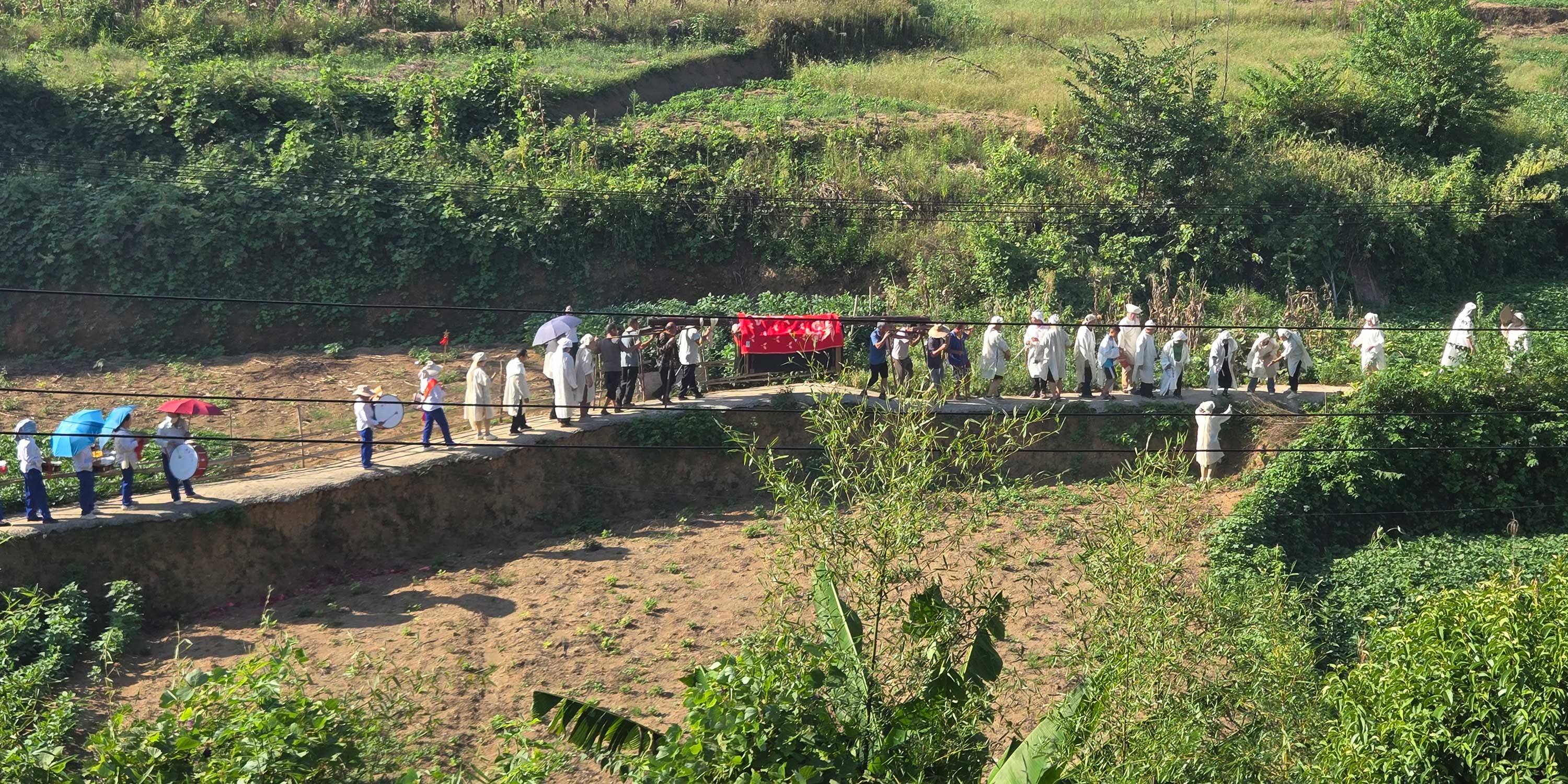
My grandfather truly returned home when we carried him through the village over a three-hour-long walk on the last day of the funeral. Our procession wound through narrow field paths, the suona and gongs resonating for miles. My elder cousin held our grandfather’s portrait. Behind him was the coffin, carried by male villagers whose sweat pelted the ground. We walked backward, facing the portrait, and bowed to the ground every few steps. A distant relative, whose new house was built next to my grandfather’s old house, held a rooster on the coffin, saying it would protect us descendants. My mother supported the coffin from the side. When we went downhill, she whispered with tears, as if still pushing my grandfather’s wheelchair, “Watch out, Baba.”
Every time a firecracker was set off, we bowed to the villagers on the side of the road. One of my uncles then offered them cigarettes and face towels. We walked, stopped, bowed, rose, walked, stopped, thus carrying out the funeral ceremony, in which our bodies mourned more than our minds.
On the last afternoon, we knelt on the red carpet as the officiants sang away the gods they’d invited. An ant crawled its way up to my nails. Weren’t we to the mountains just as the ant was to us?
As I considered the ant, I thought of how the ant was me, my grandfather, all of us who felt the weight of life and death but still went through the motions. Both the cruelty and the blessing of traditional death rituals lie in their impersonality. They remind us there’s something larger — nature, the web of relations, life itself — something both beyond and a part of us. My hand’s presence made the ant all the more moving; against the mountains, my grief found its place.
Eventually, we burned a paper house with all my grandfather's clothes. We ran around the burning house three times, on one side of us a roaring bonfire of offerings and on the other a storm of fireworks. At one point, I was forced to escape the heat and watch his clothes turn into a mound of ash from afar.
Then, we walked down the hill to a relative’s house and quenched our thirst with green-bean popsicles, the kind my grandfather loved when he was alive.
(Header image: A funeral procession in Shuangli Village, Lianyuan, Hunan province, 2025. Courtesy of the author)