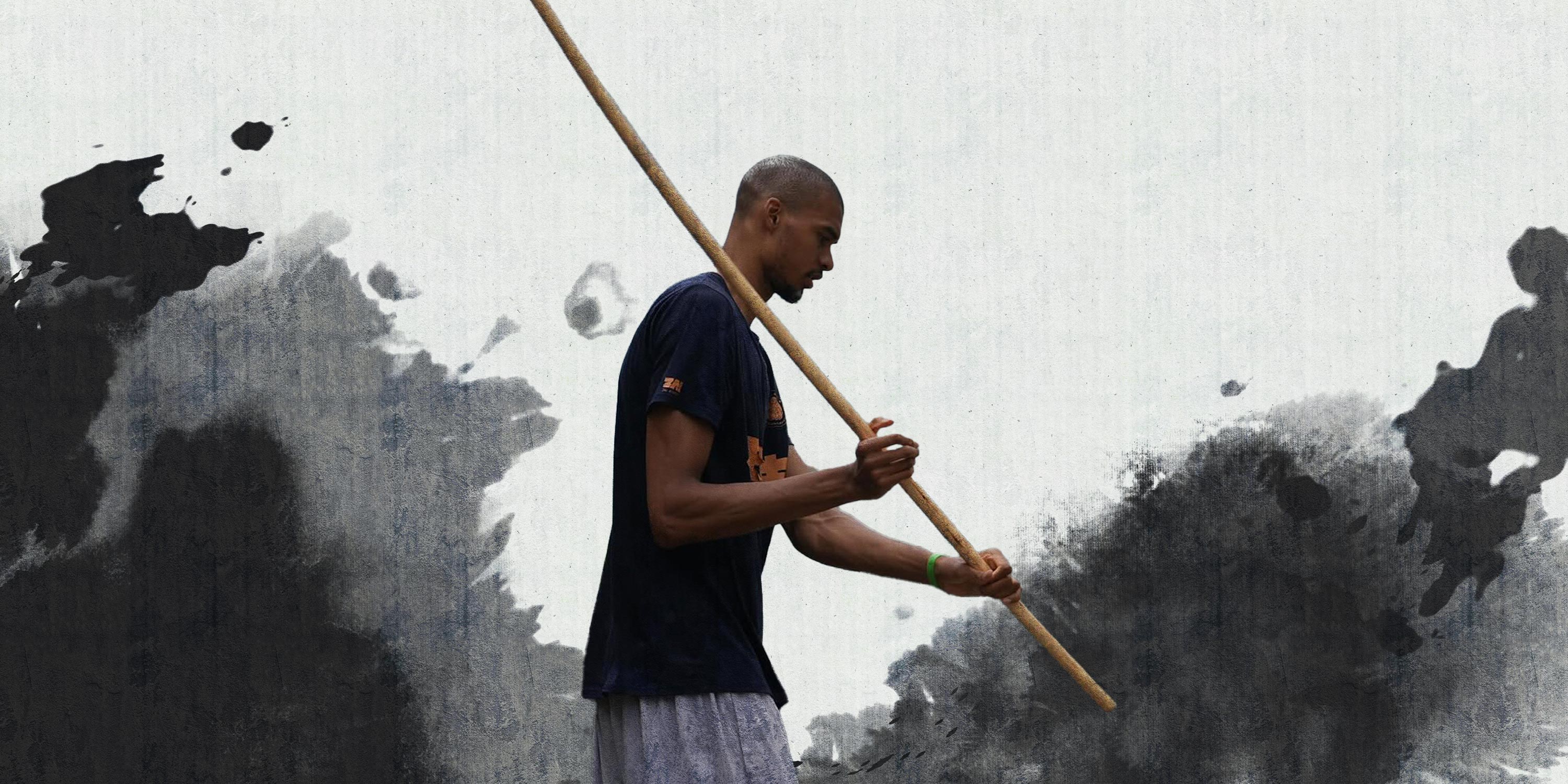
Spurs to Shaolin: Inside NBA Star Wemby’s Secret Temple Retreat
Editor’s note: French basketball star Victor “Wemby” Wembanyama — leader of the NBA’s MVP rankings in March — spent 10 days last June receiving training in martial arts and meditation at China’s much-storied Shaolin Temple on the outskirts of Zhengzhou, capital of the central Henan province. Here, his master, Yan’an, who previously taught in the United States, shares how the 21-year-old San Antonio Spurs forward adapted to the rigors of monastic life.
I received a call last April asking whether I could help arrange for Victor Wembanyama, an exceptionally talented basketball player, to study kung fu at the Shaolin Temple. Although extraordinarily gifted, his highly specialized training with the Spurs had already pushed his physical capabilities to their limits. The team wanted to explore new methods to enhance his performance.
Basketball is not a game simply about physical confrontation. The barriers that limit performance are often invisible and intangible, such as the ability to stay composed when your team is trailing, controlling your emotions at critical moments, enduring mentally over a long season, and maintaining focus when the body is near breaking point.
For this reason, Wembanyama and his coaches saw in kung fu a kind of foundation that could help address these challenges — not specific techniques, but a philosophical system centered on focus and balance.
His visit was kept strictly confidential, but hundreds of fans got wind of the news and gathered outside the temple on the day Wembanyama arrived.
Once the player had settled in, the first question he asked me was, “Do I have to shave my head to become a true kung fu practitioner?” Yes, I replied. Without hesitation, he sat down on the stone steps beside a statue and let me shave off his wavy brown hair with a razor. There was no ritual, no audience. When it was done, he touched his head and smiled. That convinced me that his intentions were completely sincere — this wasn’t just a publicity stunt, as some had speculated.
Appetite for learning
The first problem we had to solve was accommodation. The beds in the monks’ quarters are about 1.2 meters wide and usually no longer than 1.9 meters. Wembanyama stands 2.24 meters tall — he wouldn’t even have been able to straighten his legs when lying down. So we found a room with three single beds and pushed them together to create an extra-long one.
Clothing was another challenge. Even the largest training uniform fit him like a compression shirt. I had contacted a factory in advance to have something custom-made, but the finished garments were still short.
On that first evening, Wembanyama and I had a formal discussion about his training, during which he outlined three core objectives: to improve his physical coordination and control in complex conditions; to explore physical conditioning modalities beyond traditional training methods; and to enhance his mental focus and inner stability. It was evident this young man knew exactly what he wanted.
At the Shaolin Temple, Wembanyama’s day started at 4:30 a.m. Morning chanting began at 5 o’clock, when the monks would gather in the main hall. Wembanyama didn’t understand the words, but he stood solemn throughout. After, he would eat a typical breakfast of rice porridge, steamed buns, and pickled vegetables.
Meat and strong-smelling foods, such as garlic and onions, are forbidden in the temple — a Buddhist precept that has been upheld for more than 1,000 years. However, a plant-based monastic diet cannot adequately meet the nutritional needs of a professional athlete who requires a substantial daily protein intake.
In the end, Wembanyama’s team arranged for someone to purchase meat-based meals and deliver them to a spot a few kilometers from the monastery, where Wembanyama would eat them in the car. They strictly observed the rules and never consumed meat on or near the monastery grounds.
Routine change
From 7 until 11 a.m., the NBA player participated in training sessions tailored to his basketball-focused goals and unique physique. Before designing his program, I carefully studied his usual routines. They were extremely professional but also highly specialized. By contrast, Shaolin’s core philosophy emphasizes versatility. With this in mind, we came up with three key training components.
The first was movement coordination. The training ground was rugged stone slopes along a 200-meter hillside track, where we had him jump and hop uphill, sprint and do frog leaps downhill, and balance on one leg.
At 2.24 meters tall, Wembanyama’s greatest challenge is gravity. With every jump, he has to overcome not only his immense bodyweight but also balance difficulties created by his high center of gravity.
I also drew on the force-generation techniques of Shaolin kung fu to develop his ability to maintain a stable center while resisting external force. On the court, Wembanyama is often double- or even triple-teamed. Being able to shoot while losing his balance was a crucial area to work on.
Lastly, we focused on jumping from unconventional starting positions. In basketball, players often have to jump while leaning or being pushed, so I designed a variety of drills on uneven surfaces to simulate in-game contact scenarios.
Lunch was from 11 to 12 o’clock, consisting of four vegetarian dishes and a soup, served with rice or steamed buns. Meals in the temple are taken in absolute silence.
Afterward came a three-hour period for rest and free time, which Wembanyama usually spent reading. He had brought books on philosophy, psychology, and kinesiology, the study of human movement. He also often used this time to interact with the young monks, teaching them basic basketball moves and shyly practicing the foundational Shaolin techniques they taught in return.
In the afternoon, he received martial arts training, with a focus on the Shaolin 13 Fist Form, a foundational movement sequence. Though it looks simple, this routine demonstrates the core principles of force-generation and physical coordination.
Wembanyama displayed a remarkable capacity for learning. When I taught him another form, he could perform the entire sequence after watching me demonstrate just three times — most people need more than a dozen times.
The part Wembanyama struggled with most at first was evening meditation, when more than 100 monks gathered to sit cross-legged in complete silence. After his first session, he asked me, “Why do we just sit here?”
Later, I explained that meditation is a way of actively settling the mind. You must let go of everything external — your phone, social identities, unfinished tasks, even the thought “I’m meditating” — and face the present moment. Whatever feelings arise, the goal is to reach a state of inner freedom, where the mind is unhindered.
The lights went out promptly at 9 p.m. each night. Wembanyama barely touched his phone after lights-out, living in near-total disconnection from the outside world.
Enlightened in darkness
On the sixth day, Wembanyama asked me whether there was a way to “train my awareness.” So I arranged a nighttime hike to Bodhidharma Cave, in the mountains behind the Shaolin Temple.
For an average person, the climb takes one to two hours. The mountain path is steep and rugged, with no lighting at night.
Our small group set out at 9 p.m. — me, Wembanyama, his strength coach, and several Shaolin monks. Everyone turned off their flashlights and headlamps, relying only on the faint moonlight and their sense of touch to feel their way forward. The only sounds were the chirping of insects and the rhythm of our footsteps.
I felt slightly apprehensive — after all, he’s an NBA superstar; what if he slipped and got injured? But if one aspires to achieve the extraordinary, one must be willing to take on what others will not.
Climbing a mountain in darkness is an extreme form of sensory deprivation training. With our vision essentially rendered useless, one can rely only on hearing to determine direction, on touch to secure each step, and on balance to prevent falling. Only by stripping away external dependencies can one begin to perceive the world with one’s mind.
The mountain path was steep, with a sheer drop along some sections. Wembanyama walked in the middle of the group, protected by monks in front and behind. We had chosen a relatively safe route, but there were still inherent risks.
I can clearly recall the sound of his breathing — steady and deep throughout, without the slightest hint of panic. He took each step with exceptional care, meticulously feeling each foothold with his hands before committing his weight, his concentration pushed to its absolute limit.
An hour later, we reached Bodhidharma Cave. Wembanyama sat cross-legged on the flat ground and began to meditate. In that moment, I saw a completely different Victor Wembanyama — no longer the dazzling NBA superstar but a man quietly seeking inner peace.
Later, he posted a photo on Instagram of him sitting in front of the cave in the darkness, his faint outline illuminated by the moonlight. That was perhaps the happiest night of his retreat. He told me that feeling fully immersed in the moment was truly special.
This journey deepened Wembanyama’s understanding of awareness. On the court, he needs to make split-second judgments in a highly dynamic environment. He realized that the awareness cultivated in the darkness could help him better respond to various in-game scenarios.
From pool to open water
Wembanyama’s height is an unparalleled advantage in basketball, but it was an obstacle during the early stages of his martial arts training.
Standing meditation is a fundamental practice in Shaolin kung fu. It requires standing in a fixed position with the knees slightly bent for extended periods. For taller individuals, this can put immense pressure on the knees and ankles.
Flexibility training was another major challenge, with exercises including side splits, front splits, kneeling splits, and deep backbends. These are challenging for any beginner, and Wembanyama was no exception. When I helped him stretch, his expression showed obvious discomfort, but he gritted his teeth and persevered.
Beyond quickly mastering the Shaolin 13 Fist Form, he also displayed a natural talent for languages. I had arranged for a teenage monk to train alongside him. During practice, I had the monk count out in English and Wembanyama in Chinese. The monk’s English was halting, and he often got stuck at seven or mixed up the order. Wembanyama also made frequent mistakes in Chinese at first, but by the end of the retreat, he was already able to count backward from 50.
During his stay, Wembanyama almost never brought up the topic of basketball. He treated the retreat as one of the most important commitments of the year and was completely devoted. On his final morning, he packed his belongings, neatly folded his robes, and pushed the three beds back to their original positions before saying his goodbyes.
He gave me two gifts: one was a San Antonio Spurs jersey that he had worn, and the other was a pair of custom basketball shoes that he had used in training. In return, I gave him a red string bracelet with a bead engraved with the character “yong.” In Chinese culture, red symbolizes good fortune and peace, while yong represents the philosophy that “courage leads to the greatest good” — core tenets of Shaolin and indispensable qualities on the basketball court.
I like to use an analogy to explain the relationship between Shaolin and NBA training. Wembanyama’s previous program was like swimming in a pool — professional, efficient, standardized. Shaolin training is like swimming in the sea — exposed to wind, waves, hidden currents, and uncertainty.
These two systems develop different dimensions of ability. Basketball training taught him how to score a basket; Shaolin training taught him how to maintain the right physical and mental state for a range of unpredictable situations.
Now, whenever I think of Wembanyama, the image of him meditating at Bodhidharma Cave comes to mind. In that image, there is no sports star, no commercial endorsements, no millions of social media followers. There is only a young man on a mountaintop in a foreign land, searching for a state of mind that transcends sport, talent, and perhaps even the self.
As told to reporter Dong Sheng.
A version of this article originally appeared in Fir Record. It has been translated and edited for brevity and clarity, and is republished here with permission.
Translator: Carrie Davies; editors: Wang Juyi and Hao Qibao.
(Header image: Visuals from @wemby on Instagram and VCG, reedited by Sixth Tone)