Are China’s 8-Person University Dorm Rooms on Their Way Out?
China’s northeastern Heilongjiang province has moved to phase out eight-person dormitories at its universities, the latest province to do so amid a nationwide push to eliminate the once-common feature of Chinese higher education.
Announced Mar. 21, Heilongjiang will gradually eliminate all eight-person dormitories as part of its five-year social and economic development plan and expand campus construction.
The nationwide goal of eliminating eight-person dormitories and improving campus housing comes in response to rising complaints and controversies over university living conditions and housing shortages.
In early 2024, national authorities issued guidelines to address the long-standing shortage of student accommodation, encouraging universities to build four-person dormitories for undergraduates, two-person rooms for master’s students, and single rooms for doctoral candidates.
That year, the southern Guangdong province announced that new dormitories would be built according to the national guidelines, and the northern Shanxi province announced plans to eliminate eight-person dormitories in five years.
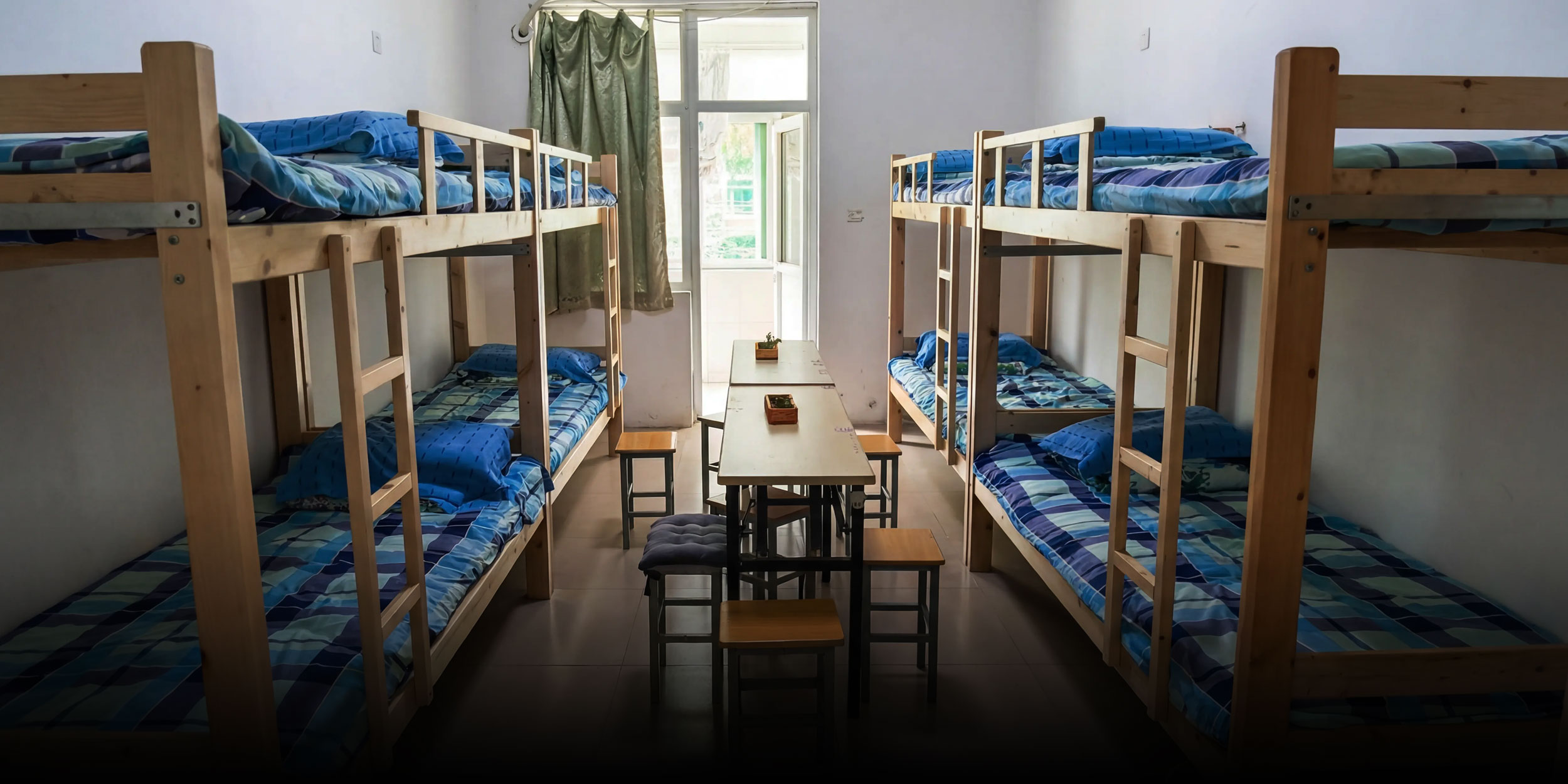
Eight-person dormitories typically contain four sets of iron bunk beds and a long shared wooden desk, often leaving little space to move around the room.
“If someone needs to use the desk, the other roommates have to return to their beds, and the person using the table has to give them some form of ‘compensation,’” one student who used to live in an eight-bed dormitory told domestic media.
Many such dormitories still rely on communal bathrooms shared by the floor or entire building. Students at one top-rated university in northeastern China were reported to have endured increasingly severe summers without air conditioning, retreating to basement tents to escape the heat, while other universities have converted four-person rooms into six and six into eight as a result of enrollment expansion, steadily shrinking already cramped spaces.
For most Chinese universities, on-campus accommodation is widely regarded as an obligation that institutions must provide at below-market prices, especially for undergraduates. However, in recent years, rising enrollment has left many universities grappling with student housing shortages and worn dormitory facilities.
“Some dormitories in city centers are too old and outdated, and even lack air conditioning,” Ding Changfa, an associate professor of economics at Xiamen University, told domestic media. “The shortage of available accommodation means some graduate students have to be excluded from consideration.”
China’s higher-education-age population is projected to peak in 2032. Ding predicts that in the future, four-person rooms could be converted into two-person or even single rooms, offering students more personalized options and further improving living conditions.
Editor: Marianne Gunnarsson.
(Header image: VCG)