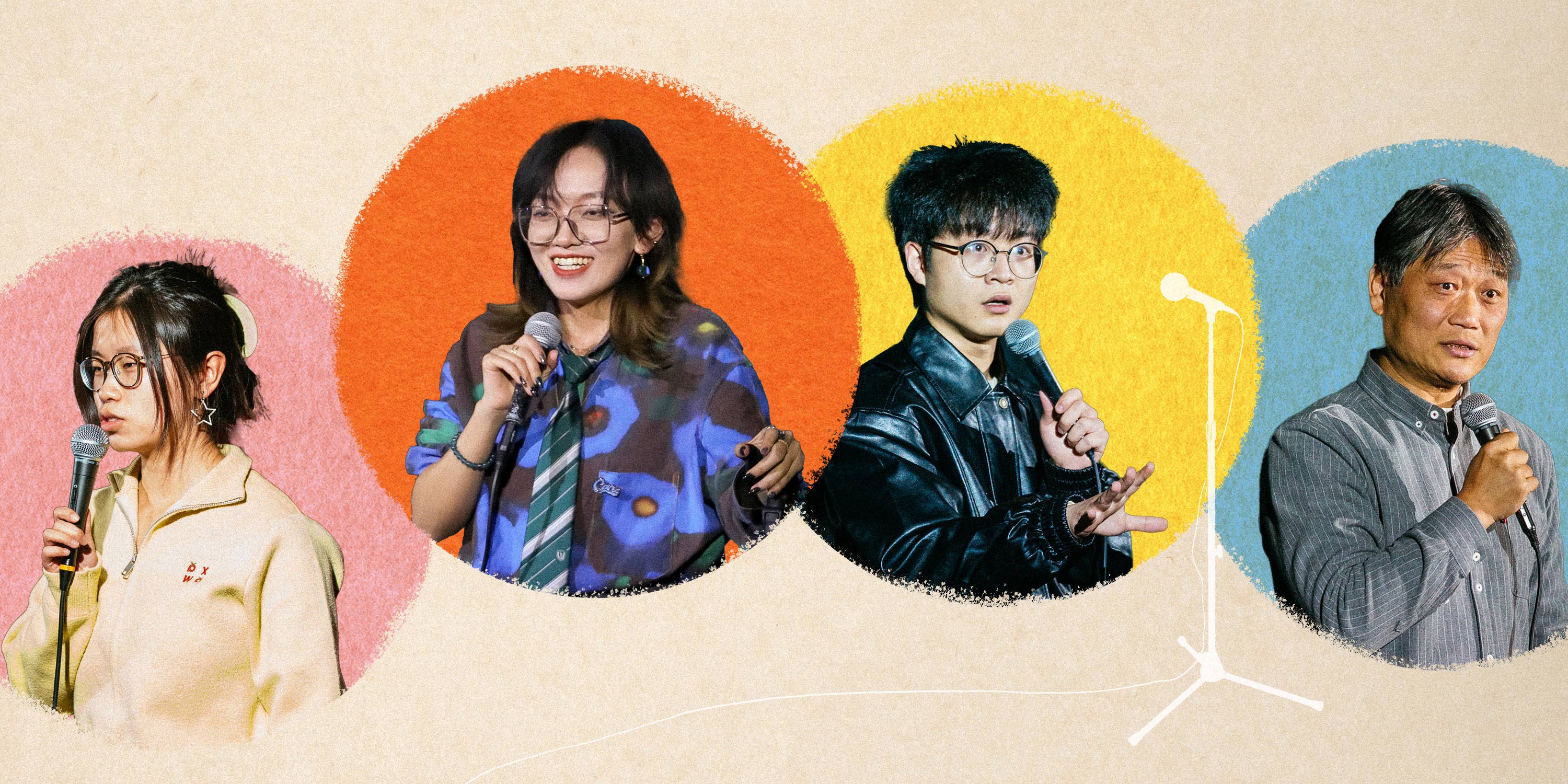
The Decade Comedy in China Grew Up, Seen From a Stage in Kunming
This story is part of Sixth Tone’s 10-year anniversary series, Ten Years in Transition.
YUNNAN, Southwest China — On a cold January afternoon in Kunming, three women from the stand-up club More Than Comedy crowd into a cramped backstage office, arguing over a joke about medical checkups.
“Medical reports should be in plain language, right?” says Gan Zhujiali, the club’s 28-year-old co-founder, leaning forward beside a space heater. “But now you read them and have no idea what they mean.”
Across from her, fellow comedian Zhu Hui, her hair dyed bright green, types rapidly on a laptop, occasionally looking up to argue back. Another performer sinks into a beanbag chair, chiming in before tapping ideas into her phone.
“Someone’s already done that punchline,” Gan says, shaking her head. They keep at it, turning the small anxieties of modern life into something that might land with a crowd.
Just a few years ago, Kunming had no stand-up crowd.
Today, Gan and comedians from her club are appearing on national television, performing to sold-out crowds far from the comedy hubs of Shanghai and Beijing, and turning stand-up into full-time careers.
“Luck had something to do with it, sure,” Gan says with a laugh. “But after five years of grinding away, maybe it was just our turn.”
That grind unfolded over the decade stand-up comedy in China moved from a fringe subculture into the mainstream, taking root even in cities like Kunming, where Gan and her colleagues founded the More Than Comedy club.
For young audiences, the stand-up boom offered a chance to laugh at the frustrations of modern life: work stress, family pressure, dating expectations, and everything else that rarely gets said out loud. For comedians, it opened the possibility of turning comedy into a career, even as the growing spotlight forced them to learn how far a joke could go.
Breakout
When the comedy show “Roast” exploded across Chinese streaming platforms in 2016, followed a year later by “Rock and Roast,” Gan had never seen a live stand-up show.
She was a freshman at the China University of Mining and Technology, in the eastern Jiangsu province, studying a major that left her feeling out of place. Her future co-founder, Wu Yang, 32, was thousands of kilometers away teaching Chinese in Thailand in his first job after graduation, a detour he later described as “another means of escape.”
“I didn’t see a live show until after graduation,” Gan recalls. “I thought it was all online.”
In 2020, during a break after taking graduate school entrance exams, Gan walked into her first open mic at a bar in Kunming. The room looked nothing like the polished clips she had watched online: the performers were raw and the audience silent.
“It was so awkward,” she says. “I remember thinking, Why did I pay to suffer?” At one point, the host even dropped to his knees onstage, begging for laughs.
Yet something about the chaos appealed to her. And two days later, she took the mic herself.
That first routine ran more than 10 minutes and revolved around blood donation, and much of it was just as awkward. She still cringes at how uncomfortable the audience must have been.
But one improvised line landed. “The audience was laughing,” she recalls. “I thought, maybe I can do this.” Had she bombed that first time, she says, she might never have returned. “At the time, audiences had seen little stand-up and were far more forgiving.”
In those early days in Kunming, though, there was barely anyone watching. Open mic nights at bars often had more comedians than audience members.
To attract crowds, performers stood outside holding signs and calling out to passersby. “Even one audience member was a win,” recalls comedian Zhu Xian, who performs under the stage name Douzi at More Than Comedy. “We’d haul signs around yelling, ‘Stand-up here, 1 yuan ($0.15), hop on!’”
Six months into Kunming’s chaotic stand-up scene, Gan began thinking about leaving the club where she had started performing to build one of her own. When Wu was expelled after a dispute with management, he suggested starting something new. She agreed immediately.
“Maybe because I was young or a woman, everyone thought they could lecture me,” she says of her time there. “Comedy, to me, is about freedom. Why should someone else decide what’s funny?” Her solution was simple: “If I didn’t like how things were run, I’d build something of my own.”
Using their savings and a startup loan, they rented an unused dance studio in Kunming, believing that “stand-up works even in rough spaces.”
Looking back now, Gan describes herself then as “a newborn calf unafraid of tigers.” She admits she had oversimplified the entrepreneurship. “I thought running a business would be like running a university association,” she says.
Showtime
On a Friday night in January, that leap of faith plays out before a packed crowd at Kunming’s Yunnan Art Theater.
More Than Comedy’s theater sits on the third floor of a protected heritage building built in 1957 that once served as the rehearsal studio of celebrated dancer Yang Liping. Today, the room feels distinctly modern, its walls lined with posters of stand-up comedians from across China who have performed here.
At 8 p.m., the lights go dark. A beam cuts across the theater and lands on the host, who performs under the stage name Binggan. She scans the room, asking who is seeing live stand-up for the first time. Several hands go up.
She bounces easily between audience members, trading quick jokes about dating, work, and life in the city. Some people — especially middle-aged men — try too hard to hold back their laughter, she says, which leads to strange snorting sounds. “It’s OK to laugh,” she tells them. “It’s okay to clap.”
Over the next 90 minutes, a lineup of comedians rotates through the spotlight, delivering quick sets about work, family pressure, dating, and the peculiar rhythms of life in Kunming.
The first comedian of the night is 28-year-old Xia Yicheng, a rapper-turned-stand-up comic who performs under the stage name Hongxi. He opens with stories about drifting through jobs in Kunming, including a stint working the front desk at a library.
Then he lands the line that gets the biggest laugh of his set. Relatives are always asking what he actually does for work, he says. When one nosy relative pressed him about why he had moved to Kunming, he replied: “I’m in Kunming thinking about you.”
The audience erupts.
Li Jiahao, who performs under the stage name Baren, steps into the spotlight next. A deaf comedian, he jokes about the unusual rhythm of his performances. Because he cannot hear the audience laughing, he has learned to time his pauses differently.
“If you’re listening, laugh quickly,” he tells the crowd. “Otherwise, I’ll just keep going.”
The room laughs loudly, as if to prove the point.
Zhu Hui, the comedian with the bright green hair, storms onto the stage with a louder, more theatrical, over-the-top style. Borrowing the exaggerated rhythm of Northeast China’s street vendors, she riffs on dating a man seven years younger than her, turning the small negotiations and generational quirks of their relationship into punchlines.
The final set of the night shifts the mood again. When Zhang Dabai, a stage name, casually reveals that he is 50 and has never married, the crowd gasps in disbelief.
“Last year, I created a persona for myself: the atypical middle-aged man,” he says. “A year has passed, and I haven’t ruined that image because I’m still single.”
He goes on to talk about living with his 80-year-old mother and how her nighttime hallucinations have reshaped his sense of responsibility. The jokes slow, and the laughter turns softer, more reflective.
When the lights come up, the audience is still buzzing. “Everyone was so cool, so funny,” says 22-year-old Qin Zhihan, who spent much of the night doubled over in her seat. “Not the try-hard kind, but genuinely themselves.”
What struck her most were the jokes about the quiet pressures many young people face: parents urging them to marry, relatives prying into their lives.
“I remember one female comedian who seemed younger and more vibrant after her divorce,” Qin says. “And an uncle around my dad’s age standing there so openly talking about choosing not to marry — that was the first time I realized men could live that freely at 50.”
For 25-year-old Kunming native Zhao Ru, the appeal is how local the comedy feels. After years of watching stand-up clips online while studying in Shanghai, she now attends shows regularly back home.
“The performers here talk about the streets, food, and local slang, everything I experience day to day,” she says. “That shared reality turns comedy from something I only watched online into something real right here.”
Home turf
The local familiarity shapes Kunming’s stand-up scene.
From wild mushrooms to the city’s slower pace, comedians at More Than Comedy often build their sets around the quirks of Kunming life. Out-of-town performers sometimes jokingly call it “mushroom comedy,” Zhu says with a laugh, as if everyone has eaten too many and their mental state is slightly off.
The style can feel rougher around the edges than in larger comedy hubs. “To be harsh, our skills aren’t as polished, but I like that,” Gan says. Visiting performers from Beijing say the scene resembles stand-up’s early days in the capital.
It’s why Gan and Wu called it More Than Comedy: to signal it was not just a stage for jokes, but a space where performers could bring their own experiences to the microphone.
Running the club, however, is less idealistic than the atmosphere onstage might suggest. Some shows make money, others lose it, while labor costs remain high. “Even so, we’ve always paid performers stable, decent fees,” Gan says. Wu adds that the club already controls most of Kunming’s stand-up market, but its earnings still fall far short of the city’s most successful rice noodle shops, a local staple.
The difference lies partly in scale. Compared with Beijing or Shanghai, Kunming’s comedy scene is smaller and slower-paced. “Here, performers stroll between gigs, unlike in Beijing or Shanghai, where it’s a mad dash,” Gan says. Many comedians juggle stand-up with other pursuits, such as teaching, coding, or studying.
The broader boom has helped sustain small local scenes like Kunming’s. In just five years, More Than Comedy has grown from two founders to a roster of more than 20 regular performers.
Roughly half of them are women — a striking share in a field long dominated by men. Several comedians told Sixth Tone the club’s supportive environment was a major reason they joined.
Co-founder Wu insists gender balance was never a strategy. From the beginning, Gan says she wanted a club where performers felt comfortable speaking openly. Over time, that reputation drew in more women, as well as comedians with disabilities and performers older than the typical stand-up crowd.
For Wang Ruixiao, who performs under the stage name Luo Aisheng, that openness helps define the club’s atmosphere. Any man who lasts there, he jokes, “can’t be a traditional straight guy” — he needs “at least some awareness of gender equality.”
More Than Comedy hosts at least one all-female lineup each month, which Wang sees less as a gimmick than as a correction to the industry’s imbalance. “You don’t need to label a show ‘all-male’ because 80% of shows already are,” he says.
But he also believes audiences have moved beyond the early novelty. “The early phase, when female comedians could just bash men and get applause, is over,” Wang says. “Today’s audiences expect both substance and laughs.”
The line
For China’s new generation of comedians, such expectations now shape what can — and cannot — be said onstage.
“‘Stand-up is the art of offense’ — that phrase itself is now offensive,” Gan says. She says audiences now take umbrage more easily, especially with celebrity roasts, as organized fan groups patrol online. “It’s terrifying,” she says.
After a routine about public smoking, she says she was flooded with angry messages from smokers. After joking about people “spreading their legs” on public transport, a viewer with a medical condition accused her of being insensitive. “I replied they overestimated the show’s reach,” she says.
The backlash has changed how she approaches her work. “You can blame the audience, the environment, the mic,” Gan says. “But ultimately that’s pointless. This job breeds self-doubt. You end up blaming your own comedic skills.”
Other comedians feel the same tension. Wang sees stand-up less as the “art of offense” than as satire meant to expose social contradictions. But even he hesitates now on topics he once considered harmless.
“I ride a motorcycle, but a lot of people in China really dislike them,” Wang says. “As soon as I mention it, I can sense some listeners turning against me.” He had hoped to talk about how convenient motorcycles are, but realized many people simply stopped listening.
Douzi sees stand-up as a chance to say what many young people cannot say directly. In one routine, she recounts an encounter with a flasher when she was in fifth grade. The reaction surprised her.
While some audience members thanked her after shows, an elderly woman in the back row once repeatedly called her “shameless.”
“I got called shameless for talking about this,” she says. “It wasn’t me running naked in the street. Why can they do it but I can’t talk about it? I think it’s the right thing to do.”
Gan has responded by shifting her material inward. Instead of celebrity jokes, her latest show focuses on family stories, including memories of her grandmothers.
In 2021, Gan rode the boom onto the national stage. Performing under the stage name Zhu Daqiang – a nickname loosely translated as “big and strong” – she appeared on Season 4 of the hit variety show “Rock & Roast,” delivering routines about “straight male gift culture” and women’s safety.
And when the mood around stand-up changed in 2023, Gan stepped back from performing while preparing for graduate school, focusing instead on behind-the-scenes work at the club. “Many performers were affected at the time,” she says. “I just felt terrible, like this industry was so unreliable.”
The scene eventually recovered in the first half of 2025. The number of stand-up shows nationwide rose 54.1% year on year, while box office revenue jumped 134.9%, making it the second-largest live theater category after stage plays.
At smaller clubs, survival depends on improvisation onstage as well as off.
The More Than Comedy team supplements ticket sales by producing custom comedy content for clients ranging from local police to hospitals, and staging experimental formats such as crowd-work shows, women-only nights, and low-cost open mics in teahouses and bars.
Wu sees television appearances less as a solution than as a catalyst. When local performers land spots on variety shows, he says, they bring visibility back to the scene and open space for younger comics. The club also exchanges performers with venues in other cities, building a loose regional circuit that helps keep new voices moving through Kunming.
For 28-year-old Xia Yicheng, who performs under the stage name Hongxi, the path forward still feels uncertain. His parents opposed the decision, seeing comedy as unstable work. His mother, a Chinese teacher, once asked him after watching a clip of his performance: “What’s the point of this?” He stopped sending videos home.
Like many young comedians, Xia sees television as the main gateway to a wider audience, where people are more willing to listen. “These days, it often feels like, ‘You’re a special person, so I’ll listen to your jokes,’ rather than ‘Your jokes are truly great, so I’ll listen,’” he says.
But Gan remains convinced the appetite for comedy will endure. “People always need to laugh,” she says. “No matter how tough things get, laughter is essential in life.”
Early in her career, Gan often rushed through her sets, speaking so quickly that some punchlines barely had time to land. Now she accepts the nerves as part of the job.
“Women overthink,” she says with a laugh. “I’m going to start hyping myself up. If I still put myself down when so many people support me, it makes their support seem cheap.”
Editor: Apurva.
(Header image: From left to right, comedians Qianqian, Gan Zhujiali, Xia Yicheng, and Zhang Dabai. Visuals from Wu Huiyuan/Sixth Tone, @朱大强祝你快乐 on Weibo, and VCG, reedited by Sixth Tone)