Hidden Dangers Loom Behind China’s Wildlife Feeding Craze
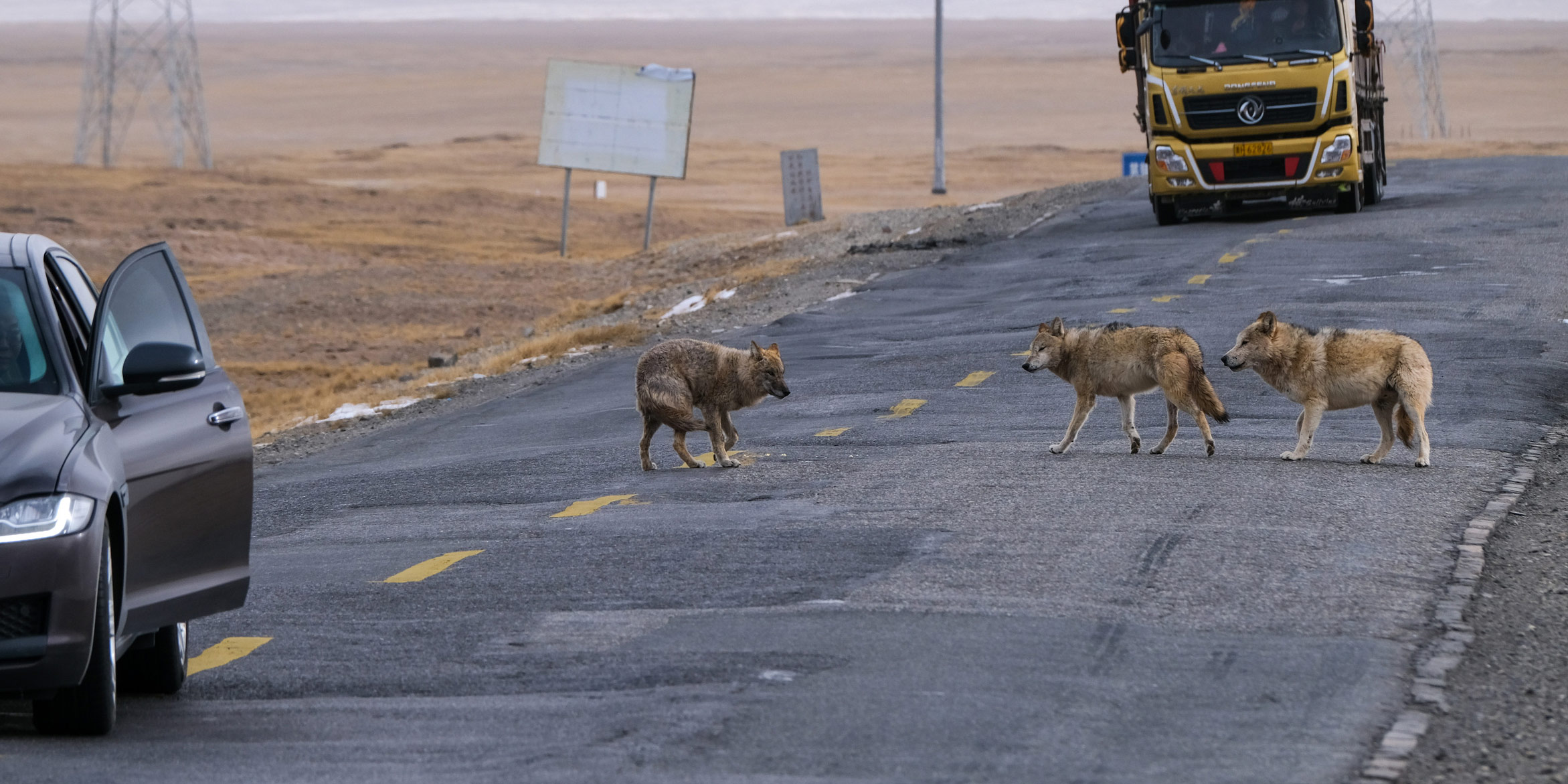
On the side of a highway in the Hoh Xil National Nature Reserve in the northwestern Qinghai province, a young girl breaks a pork sausage into small pieces and tosses them to a wild wolf standing a few feet away. She then turns to the camera and smiles. The video recently went viral on Chinese social media, sparking a debate over feeding wildlife.
Two years ago, in the same reserve, a “celebrity wolf” that would beg for food by the roadside was struck and killed by a truck. Yet the practice persists. On Feb. 10, the Qinghai Provincial Forestry and Grassland Bureau warned that disturbing, driving away or feeding wild animals can interfere with their normal breeding and living habits, trigger stress reactions and pose risks to people.
How did sporadic expressions of “love” evolve into a management crisis? What impact does feeding have on individual animals, populations and ecosystems? And who bears responsibility when accidents happen?
Fatal attraction
As early as 2023, a wild wolf along a national highway in Hoh Xil became overweight due to human feeding. It began presenting dog-like behavior, wagging its tail and begging. This has become a common sight in the region, as more wolves grow accustomed to human proximity and food. The consequences have been fatal.
Wolves are not the only species finding internet fame through human handouts. At Mount Sapu in southwestern China’s Xizang Autonomous Region, tourists bring biscuits and bread to feed “celebrity” local brown bears, filming the animals at close range. In Qinghai, Xizang, and the northwestern Gansu province, feeding marmots with snacks such as rice crackers has become a must-do activity for travelers.
Some localities promote feeding as a tourism draw.
In Xichuan county, in the central Henan province, the Danjiangkou Reservoir attracts migratory birds such as black-headed gulls. The local government’s official WeChat account posted in January that large numbers of gulls had gathered at Songgang Wharf and the Southern Water Town, far exceeding numbers seen in 2024. The account described the surge as “a significant reflection of ecological protection.”
Behind the increase is direct artificial feeding. Viral videos show staff tossing buckets of food into the water, while tourists hold up bread. These draw more tourists, whose presence, in turn, draws more birds. According to the local government’s WeChat account, these specific areas did not use to see such large numbers of gulls but daily feeding by staff and tourists created a “clustering effect.”
“On the surface, humans and animals seem close and harmonious. But in reality, the problems behind this are massive,” said Zhou Haixiang, a member of the Chinese National Committee for UNESCO’S Man and the Biosphere Programme.
Peng Kui, a program director at The Nature Conservancy in China, said that a decade ago people reacted to bears, wolves, and snow leopards with awe and instinctive avoidance. Today, many approach them to offer food.
Peng attributed the shift to a cognitive misalignment. Technological advances — sturdy off-road vehicles and advanced outdoor gear — give people what he called a “force illusion” that they can control the situation, emboldening them to approach or provoke wildlife. Meanwhile, the prevalence of urban pet culture and unregulated petting zoos, combined with social-media content that anthropomorphizes wild animals, is eroding the public’s basic understanding of wildness.
“You can easily find videos of monkeys or even predators dressed in human clothes, looking like pets,” said Yin Hang, head of the Qinghai Snowland Great Rivers Environmental Protection Association. “People then approach wolves and bears with the same mindset they would a stray cat.”
The price of a meal
Yin’s organization focuses on the coexistence of humans and Tibetan brown bears. She said that while many tourists believe they are helping animals find food, the idea is a dangerous misconception.
In the wild, Tibetan brown bears eat mainly marmots and pikas.
“Human food is often a disaster for wild animals,” Yin said. “In the wild, bears never eat bananas, instant noodles or spicy hot pot. These processed foods — high in salt, oil and complex ingredients — damage their digestive systems and health.”
Human food can cause obesity, cardiovascular problems, skeletal deformation, hair loss, and organ failure. If bears become accustomed to human food sources, they may ingest harmful substances. Research shows that bears scavenging in garbage dumps can die after ingesting items such as automotive antifreeze.
Beyond individual health, feeding can alter survival strategies, pushing animals from “wild” to “semi-captive.” Yin said adaptable species such as wolves and bears can quickly develop dependency. Once they form a memory of easy food, they may stop foraging elsewhere.
“In nature, a mother bear teaches her cubs to hunt,” Yin said. “But if the mother relies on handouts or garbage, she teaches her cubs to approach humans. The behavior pattern of the entire family changes.”
That shift has contributed to frequent cases of bears preying on livestock, breaking into homes and occasionally attacking humans on the Qinghai-Tibet Plateau.
“Arbitrary feeding is irresponsible,” Peng said. “It satisfies the feeder’s desire for novelty or showing off, but it leaves the risk to nature and to others.”
Fragile prosperity
Compared with fierce mammals, birds seem safer. Feeding them is common in parks and wetlands and is sometimes organized by local managers.
Every winter, swans migrate to the Swan Lake Urban Wetland Park in Sanmenxia, in the central Henan province. In the 1990s, only a few dozen arrived. To keep them there and attract tourists, locals fed them corn. The migratory population swelled to more than 10,000.
But negative effects are emerging. Swans naturally eat aquatic plants and algae. “Under long-term human feeding, they have become accustomed to eating corn,” Zhou said. “During migration, they forage in cornfields, where they may face poisoning.” In 2016, 233 swans died in the northern Inner Mongolia after ingesting corn laced with poisonous substances.
Artificially abundant food can also cause population booms the ecosystem cannot sustain. “Once the feeding stops, the system collapses,” Zhou said. “That is a disaster for the species and the surrounding communities.”
A similar situation exists with black-headed gulls in Kunming, the provincial capital of the southwestern Yunnan province. Since they first arrived in 1985, residents have fed them to keep them in the city. Today, feeding gulls at Dianchi Lake is a standard tourist activity.
Wu Zhaolu, a professor at Yunnan University, calculated that Dianchi Lake can naturally support 100,000 wintering gulls. “Currently, there are 40,000,” Wu said. “The lake has enough fish and shrimp. Without human feeding, they would hunt for themselves and winter safely.”
But decades of handouts have made the gulls “lazy,” Wu said, with fewer gulls hunting for natural food. The bread and biscuits they consume are heavy in carbohydrates but lack the protein needed for migration and reproduction.
Wu’s team has found that Kunming’s gulls are becoming obese and showing gastrointestinal changes. Nearly 1,000 gulls now fail to migrate north due to obesity and dependency, remaining in Kunming year-round. Because they do not breed in Kunming — their breeding grounds are thousands of miles away in Siberia — those birds have effectively exited the gene pool.
Drawing boundaries
The prevalence of feeding reflects a human desire to connect with nature. The problem is in how humans interact with animals, Peng said.
“The core principle should be ‘do not disturb, keep distance’ — protecting both animals and tourists,” he said. He advocates responsible ecotourism that replaces feeding with observation.
In Baihualing, Yunnan, a different model has emerged. Once a poaching hotspot, villagers now maintain “bird ponds” with small amounts of unprocessed food and hidden blinds, allowing tourists to photograph birds without disturbing them.
“The more birds there are, the more money villagers make. The more they benefit, the stronger the motivation is to protect the birds,” Zhou said.
Wu recommended a similar approach for Kunming’s gulls: keep a distance and upgrade the experience from feeding for fun to ecological observation.
“We should respect the birds’ habits,” Wu said. “Watching a gull dive for shrimp is beautiful. That is what we should advocate, not inducing it to eat bread from your mouth for a photo.”
The shift requires coordination. Governments must clarify rules and tour operators must promote responsible tourism.
But ultimately, there needs to be a change in public mindset. “The best relationship between us is to keep our distance,” Yin said. “Take photos and create memories and leave behind undisturbed nature. That is true respect and love.”
This piece was originally published by Caixin Global. It is republished here with permission.
Reporters: Kang Jia and Lu Zhenhua.
(Header image: Wolves wait for tourists to feed them on the road in Hoh Xil, Qinghai province, Feb. 20, 2024. Jiang Feibo/VCG)