The Rapid Rise of China’s Merch-Driven F1 Fandom
SHANGHAI — From above, the public square resembled a living mosaic. The crowd sorted itself into hat colors symbolizing the Formula One (F1) teams they loved — Ferrari red, McLaren orange, Mercedes blue.
In the middle of the sea of colors stood Guo Xiaoyao, the founder of a 500-person regional F1 fan club. The crowd gathered around her, waiting to receive her homemade merchandise: customized rings she had commissioned online engraved with the words “Still We Rise” — British F1 driver Lewis Hamilton’s personal mantra and brand slogan — as well as DIY “marriage certificates” fans could make with Hamilton’s name and photo.
This year Guo noticed a surge of fan merchandise culture at the Chinese F1 Grand Prix in Shanghai, which has been held annually since 2004, though suspended between 2020 and 2023 due to the COVID-19 pandemic.
Over the last five years, F1 — once little known in China — has skyrocketed in popularity in the country. According to data from UK-based sports analytics firm Nielsen Sports, the Chinese Formula One fanbase grew by nearly 40% from 2024 to 2025. This explosive growth in interest has led a unique fandom to emerge in China, characterized by merch trading, regional fan clubs, spin-offs, and brand revival.
Total attendance across the three-day 2026 Chinese Grand Prix weekend, concluding March 15, exceeded 230,000 spectators — the largest audience in the history of the event. More than two-thirds came from other Chinese regions outside Shanghai, while overseas visitors accounted for roughly 14%.
A “real sport”
F1 wasn’t always popular in China.
As a girl in middle school in the early 2000s, while her classmates were interested in basketball, football, or pop music singers like Jay Chow, Guo was watching global Formula and sports car racing. Her fascination with F1 often failed to land among her peers.
“Oh, I think I saw it on TV once. Isn’t it just a toy car racing track?” she recalls a classmate asking her.
“No,” she said. “Racing is a real sport. Both the drivers and the rules of the race itself are really interesting.”
Influenced by her father, Guo grew up watching motorsports, often pulling all-nighters to watch international races live. In her hometown of Zhengzhou, capital of the central Henan province, following the sport felt like living on “a small island all on her own,” she says.
Even Guo’s childhood best friend of 20 years showed no interest in watching F1 with her, something Guo describes now as a “wall” between them that was only broken two weeks ago, when her friend finally joined her for a live watch party of a race.
As a child, Guo could never have imagined that she would one day sit in the grandstands of the Chinese Grand Prix three years in a row — not just as a spectator, but as an organizer and leader of a fanbase.
Having previously attended concerts for her favorite singer, where trading fan-made goods was already common, Guo naturally merged that culture into the F1 fandom. Designing merchandise, she said, feels like competing against herself. Last year, she arrived carrying a 20-inch suitcase packed with self-designed fan merchandise including hundreds of magnets, keychains, acrylic standees, and stickers — so heavy that she had to have it delivered to her hotel in Shanghai.
“Every year I try to go further, toward what is more creative, more unique, and more in line with current trends,” she tells Sixth Tone.
“This year, there will be many more fans exchanging merch,” she says. Another fan group she belongs to — one dedicated to Lewis Hamilton — has grown from just over a dozen members to more than 160. “The competition is getting intense. But the initial spirit never changes.”
“I don’t care whether the items I get in exchange for trading my merch are handmade or factory-produced, or whether my merch costs more to make than others’,” she says. “If people like what I made, that’s enough. In my more than 30 years, I never imagined I could meet people (like those at F1 fan events) whom I truly admire, regardless of age or gender.”
When meeting F1 fans from other countries at the circuit, they often find the scene a cultural shock. “They’re usually stunned at first,” Guo says. “It takes them a while to understand how the swapping culture works,” highlighting that fan groups in China are often organized around specific teams or drivers, with merchandise designed accordingly.
Spin-offs and branding
Guo has also witnessed a dramatic influx of newcomers into China’s F1 fan space in recent years. She believes that nearly half arrived via media spin-offs rather than through the races themselves — documentaries, films, and user-generated content circulating on social media and short video platforms such as Bilibili, RedNote, and TikTok.
For 22-year-old Wang Yuhan, fandom began unexpectedly after reading an online novel in 2024 featuring a fictional Chinese F1 driver. Curiously, she then started seeing real-world racing content across social media.
“I wouldn’t call myself a real fan,” Wang says, describing how she was confused while watching the Shanghai race — her first live viewing. “I didn’t understand the rules, even with online commentators explaining. So I went back to watching documentaries instead.”
But for Lim Wenkang, a motorsports development consultant at Dan Wells Driver Management, part of the joy of following Formula One comes from creating and sharing memes online.
As an industry insider, he attributes discipline’s resurgence in China to its successful business model, which combines content-driven, entertainment-oriented, and platform-based operational strategies.
“Around 2017, Formula One’s popularity in China was considered relatively sluggish, even close to in decline,” he tells Sixth Tone.
Lim believes that the turning point came after American mass media conglomerate Liberty Media acquired Formula One Group. They implemented sweeping reforms to the sport’s business model, revitalizing the sport’s presence through digital media, social media, and spectacle-driven storytelling. Productions such as documentary series and film adaptations became major gateways for new audiences. Last year’s “F1: The Movie,” starring Brad Pitt, was a box office success in China, taking more than $56 million and making it one of the year’s most successful Hollywood films.
Lim thinks that as of 2026, Formula One’s influence in China is entering a new, more “mainstream” phase.
“We’re seeing more Chinese brands joining commercial collaborations,” he says, citing co-branded campaigns linked to F1 and motorsports on e-commerce giant Ele.me (now Taobao Flash). Shopping malls have begun to dedicate noticeably larger retail spaces to motorsport-themed displays from sportswear brands such as Puma and Adidas, something rarely seen just a few years ago, according to Lim.
When Lim founded the Motorsport Association at Beijing’s prestigious Tsinghua University — according to him, the first student motorsport community in China — in 2022, building an audience required starting almost from zero.
“We had to educate everyone, including audiences and sponsors, about what F1 even was,” he recalls. “Now promotion is much easier. Most people already know the sport. I just need to explain where (China) fits within it.”
Editor: Marianne Gunnarsson.
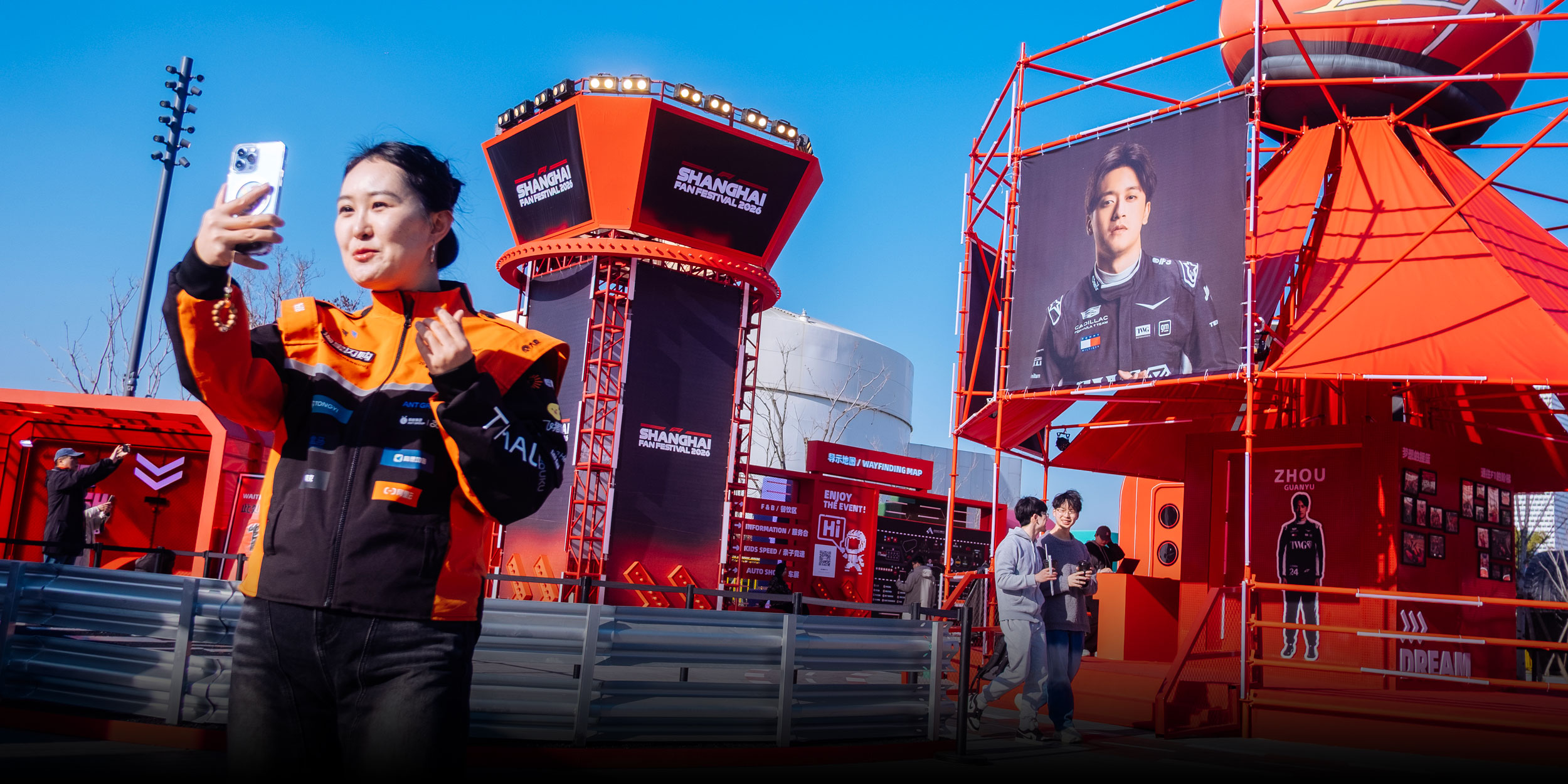
(Header image: A woman takes a selfie in front of an onscreen image of Zhou Guanyu, the first Chinese Formula One driver, March 10, 2026. Wu Huiyuan/Sixth Tone)