The Thoughtful Side of Chinese Cinema Was on Display — in Berlin
This year’s Spring Festival was not the usual seven, but nine days long. For China’s film industry, that meant a holiday that usually sees great box office returns now had two more days to attract audiences to the cinema.
Various commercial films vied for viewers, but the final tally was disappointing: this Spring Festival’s box office stood at 5.8 billion yuan ($844 million), a sharp year-on-year decline of nearly 40%. No film managed to grab nationwide attention the way last year’s “Ne Zha 2” did, or “YOLO” the year prior. The most-watched title, “Pegasus 3,” was merely a run-of-the-mill sequel.
What was supposed to be a long holiday in which China’s movie industry could show its vibrancy was instead one that showed it was rather stale.
Fortunately, thousands of kilometers away in snow‑covered Germany, inside the arthouse cinemas of the 76th Berlin International Film Festival, a small group of Chinese filmmakers showed a different side of the country’s movie industry. Their films were quiet yet unyielding, displaying a style that is entirely their own.
Held from Feb. 12 to 22, this year’s Berlinale welcomed a total of nine new Chinese-language productions, including narrative shorts, animated features, experimental works, and documentaries, offering a rich tapestry of contemporary Chinese cinema.
What stands out most about this Chinese contingent is its youthfulness. Of the nine films, six are directed by filmmakers from the Chinese mainland, all of whom were born after 1985. For each, this marked their debut at a major international film festival.
“Ni’er” marks director Tan Yucheng’s first work. Qu Jingkai won the Berlinale Shorts CUPRA Filmmaker Award for “Di San Xian,” his first appearance on the global festival circuit. Xu Zao, though experienced in short films, presented “Han Ye Dengzhu” (“Light Pillar”) — an animated feature — as his true feature debut. Wang Beidi, who first gained notice with a student film four years ago, returned with “Scorching,” a Cantonese short that blends realism with humanistic depth. Zhang Xinyang, a recipient of a scholarship from established director Jia Zhangke’s Next Talent Project in 2019, unveiled his debut feature film “Panda.” And cross-media creator Shen Zhongmin made her feature directorial debut with “Shanghai Daughter,” a film she wrote and directed. The latter two films premiered in Berlin.
Unshackled by commercial imperatives, viral trends, or rigid conventions, these emerging directors weave their observations of life, reflections on the times, and insights into human nature directly into their frames. Their work may bear traces of inexperience, yet it brims with sincerity; it may lean toward the niche, but it carries a sharp artistic edge.
If youth is their most visible hallmark, then rootedness in local realities and universal empathy is the core that allows their stories to transcend language and culture. From “Ni’er,” a story rooted in the small-town experiences of China’s era of social transformation, to “Panda,” which takes its Chinese title from the “Treatise on Cold Damage and Miscellaneous Diseases” — a classic of traditional Chinese medicine — and is embedded in the heritage of Eastern humanism; from the portrayal of youthful sentiments amid Harbin’s icy world in “Di San Xian,” to the depiction of Guangdong province’s factory town young female workers in “Scorching”; from the reflection on sent-down youth memories among the rubber forests of the southern Xishuangbanna Dai Autonomous Prefecture in “Shanghai Daughter,” to the vision of near‑future film studio landmarks and media evolution amid northern China’s wintry snow in “Light Pillar” — each work bears a distinctively Chinese mark.
More importantly, these works are not confined to local contexts. With delicate cinematic language, they reach for universal human themes that resonate across borders. “Di San Xian” interrogates school bullying; “Light Pillar” portrays individual loneliness in the digital age; “Panda” explores urban outsiders’ spiritual struggle and unyielding independence; “Shanghai Daughter” evokes nostalgia and displacement; “Scorching” examines the constraints of order and quiet acts of resistance. These shared human truths form a bridge for cross-cultural communication, turning Chinese movies from distant exotic spectacles into stories whose emotions resonate across the world.
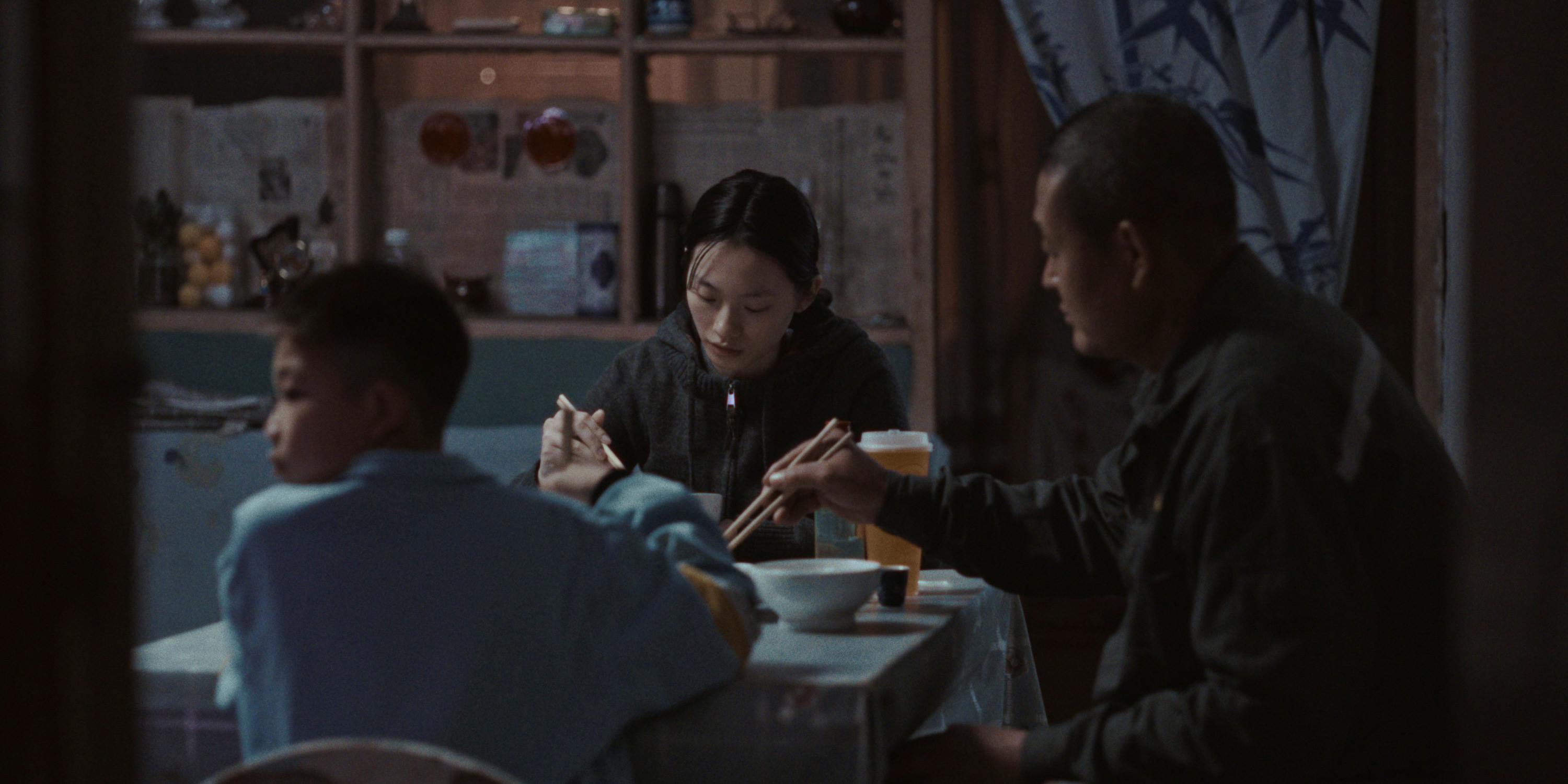
I would like to single out “Ni’er.” In my view, this 15-minute short film in Hebei dialect stands as a compelling illustration of how local storytelling can achieve profound cross-cultural appeal. The film centers on a 17-year-old girl, Ni’er, working at a gas station in Hebei province, in northern China. The monotony of her daily toil, the invisible yoke of familial expectations, and the silent discipline of rural society restrict her youth to a small, narrow, bounded corner of the world.
Her stagnant world is pierced by a glimmer of light with the arrival of a female truck driver, who awakens in her a yearning for freedom, propelling her onto a journey of self-discovery. Director Tan Yucheng employs space as a metaphor: the gas station, which is meant to be an energizing stop for travelers, is transformed into a cage of entrapment.
The confusion and choice of a 17-year-old are not merely a unique portrait of Eastern rural life but a universal coming-of-age proposition that transcends borders. Emotion is conveyed through a poetic and restrained cinematic language. Long, static takes lay bare a sense of oppressive temporality, while sparse dialogue allows emotions to simmer beneath the silence. The recurring motif of “hair” serves as a powerful symbol of both discipline and emancipation. The piano piece “A Maiden’s Prayer,” which underscores the ending, imbues this path of awakening with profound warmth and poetry.
Inside Berlin’s Urania Cinema, on the first day of the Year of the Horse, overseas audiences may not have grasped the nuances of the Chinese characters on screen, yet they perfectly read the confusion and resolve it in the eyes of Ni’er. The warm and sustained applause that filled the theater affirmed a timeless truth about art: works of genuine global significance are always rooted in authentic local expression.
Beyond sincere expression, the Chinese-language films at this year’s Berlinale also boldly push boundaries and innovate fearlessly, exploring the infinite possibilities of cinema with an unconstrained vision and expanding the artistic frontiers of Chinese cinema.
Among them, “Light Pillar” represents a pioneering breakthrough in Chinese animation, skillfully blending live-action fiction and animation. Director Xu Zao uses animation to construct a cold, repressive film studio of the future, and low-resolution live-action footage to recreate the vivid, earthly reality of the world around the turn of the millennium. The collision and shifting between these two visual forms not only serve the theme of virtuality and reality, but also offer a new paradigm for formal experimentation in Chinese animation.
Meanwhile, Shen Zhongmin’s “Shanghai Daughter” innovated with its casting. As the sole professional actor, the lead actress portrays her character through a restrained performance — rejecting deliberate emotional outbursts, she quietly blends into the natural and cultural environment of Xishuangbanna. The local non‑professional actors need no elaborate rehearsal; they simply embody their natural responses of daily life. The lead’s wandering observation and the non‑professionals’ authentic performances weave the fictional root‑seeking narrative into the lived texture of reality.
These thoughtful experiments do not chase novelty for its own sake; form serves content, and technique empowers ideas. They demonstrate that China’s new generation of filmmakers is actively forging its own cinematic language, reshaping the face of Chinese arthouse cinema with fresh expression.
This Chinese New Year, the commercial blockbusters of the domestic holiday season and the arthouse Chinese films at the Berlinale together form a vivid picture of Chinese cinema’s dual tracks. Chinese cinema has never been monolithic. It can be the lively, popular genre films of the Spring Festival, catering to mass entertainment with sometimes naked commercial priorities; it can also be the profound, uncompromising authorial voices at international festivals, upholding artistic integrity and social concern.
The Berlinale has long been celebrated for its inclusive diversity and unwavering focus on emerging voices, serving as a vital gateway for young Chinese filmmakers to step onto the global stage. We have every reason to anticipate that this year’s cohort of China’s new-generation directors will take home far more than just screening opportunities from Berlin — they will gain creative confidence and the courage to engage in dialogue with the world. And the future of Chinese-language cinema continues to thrive and grow, nurtured by each such appearance, exchange, and transformation.
(Header image: A still from “Ni’er.” Courtesy of Wang Chenxu via Berlinale)