A Viral Video Has China Debating the Rising Cost of Lucky Money
From a viral video of a man in southern China’s Guangdong province handing out modest red envelopes to government calls for restraint and online “reference charts” ranking acceptable gift amounts, the rising cost of “lucky money” has drawn fresh scrutiny this Spring Festival.
Chinese New Year red envelopes, or hongbao, are cash gifts traditionally given to pass on luck and blessings. In recent years, rising incomes and social expectations have pushed their value steadily higher.
When a video of a man surnamed Chen handing out 100-yuan ($14) packets to 23 nieces and nephews surfaced on Douyin, the Chinese version of TikTok, it resonated widely for its restraint. The clip showed children gathered at his home on Feb. 17, the first day of Chinese New Year, to exchange greetings and receive their packets — a customary ritual in Guangdong.
He later told domestic media that in Guangdong, red envelopes are primarily a gesture of good fortune rather than a measure of generosity.
On lifestyle platform Xiaohongshu, also known as RedNote, posts about “lucky money” have drawn more than 2 billion views and nearly 12 million discussions. While some videos capture children’s excitement, many more reflect anxiety. Young Chinese describe budgeting months in advance or bracing for the holiday’s financial toll.
“Those born in the 1980s are under so much pressure,” one user from eastern Zhejiang province wrote. “Our elders are getting older and need red packets, and we also have to give them to the children.” Another responded, “Married couples born in the 1990s without kids are the worst off – we give but get nothing back.”
The contrast has fueled admiration for Guangdong’s more modest customs. Ahead of the holiday, a “Guangdong Reference Chart” circulated widely online, suggesting benchmark sums — 100 yuan for immediate family, 50 yuan for close relatives, and as little as 5 yuan for neighbors — offering what many saw as a blueprint for restraint.
In southern China’s Guangxi Zhuang Autonomous Region, officials have moved to formalize that restraint. On Feb. 10, Long’an County issued a proposal titled “Small Lucky Money, Big Heartfelt Intentions,” which urged residents to agree in advance on maximum red envelope amounts and to favor symbolic sums over showy ones. The document emphasized that the holiday’s value lies in reunion, not spending.
Long’an also encouraged families to redirect lucky money into “growth investments,” such as educational books and toys for younger children, museum tickets for students, and “practice funds” to support skills training for young adults.
Baise, another city in Guangxi, released a similar initiative, recommending caps of no more than 20 yuan and discouraging the expansion of gifting circles. It proposed alternatives such as handwritten couplets or storytelling, suggesting that younger family members reciprocate with time and help rather than cash exchanges.
A recent commentary in the state-run news outlet Guangming Daily attributed red envelope pressure to entrenched norms of reciprocity and “face.” To establish “low-burden” gifting as a new standard, it argued, families must agree collectively to step back from monetary competition.
“For society as a whole,” it said, “we must advocate for a mindset that values sentiment over material gain in social interactions. Let people understand that the true beauty of the Spring Festival lies in families sitting together and sharing warm, cozy moments, not in the thickness of red packets or the expensiveness of gifts.”
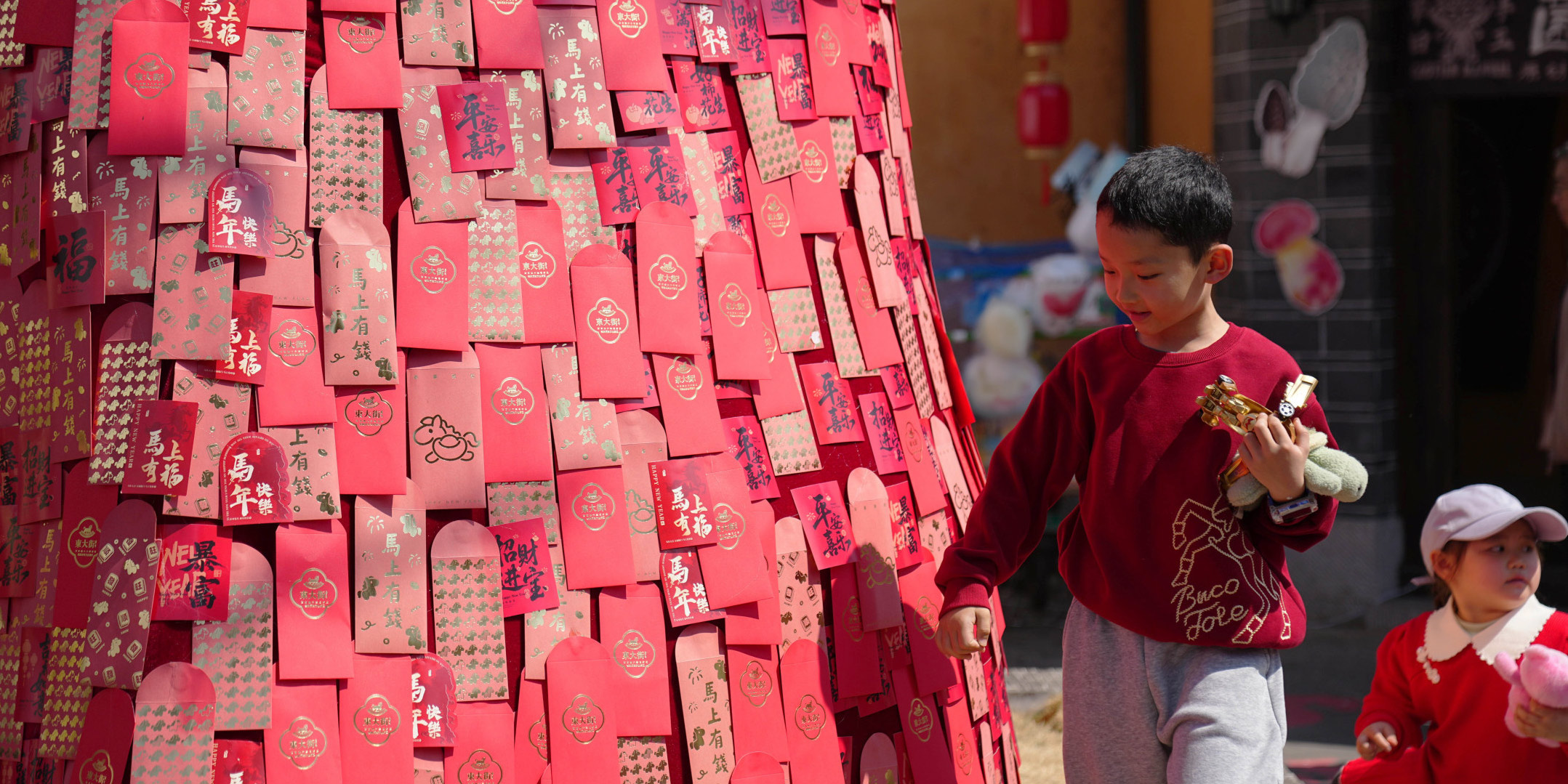
(Header image: A boy walks past an installation decorated with red envelopes in Mengzi, Yunnan province, Feb. 17, 2026. Liu Ranyang/CNS/VCG)