Gen Z Flips Tradition as ‘Reverse Spring Festival’ Travel Surges
For five consecutive Spring Festivals, Liu Mengjie joined China’s great migration home. The trip to central China’s Henan province meant weeks of scrambling for tickets, a long train ride, and a full day on a rattling county bus before she even reached her hometown.
“Once I got home, I had to follow my parents around to visit relatives I barely knew, answering questions about my salary and facing pressure to get married and have kids,” she told Sixth Tone. By the end of the Chinese New Year, she felt more exhausted than after a workweek. “The fatigue made me dread the holiday season.”
This year, she stayed in Shanghai and asked her parents to make the journey instead. And having moved into her own apartment and adopted a dog, she began to feel rooted in the city. “I’m no longer the passive returnee,” she said.
Across China, Liu is part of a growing number of young people reversing a long-standing Spring Festival ritual, a shift dubbed “reverse Spring Festival” on social media.
The trend has gained momentum this year, as a record nine-day holiday break has given families more flexibility in how they reunite. Flight bookings linked to the practice rose 84% year-on-year in February, according to Meituan Travel, with major urban centers including Beijing, Shanghai, Guangzhou, Shenzhen, Chengdu and Chongqing emerging as key destinations.
Additional data from travel platform Qunar suggests bookings by passengers aged 60 and above during the holiday climbed more than 35% from a year earlier, with many departing from smaller, third- and fourth-tier cities for first- and new first-tier urban hubs. A significant share traveled in groups, pointing to parents making the trip to visit their children.
On social media platforms, posts about “reverse Spring Festival” have drawn millions of views. Many users describe returning home as an exhausting obligation, citing difficult ticket bookings, long journeys, and holiday congestion. Others say they would rather spend the break unwinding with friends or partners than navigating large traditional family gatherings.
Changing course
When Liu Mengjie first floated the idea of staying in Shanghai, her parents balked. “Can we really not be home for the New Year? What about visiting all the relatives?”
It took weeks of back-and-forth before they agreed to spend the New Year in a city they had never visited.
Liu says she’s planned the holiday carefully. For New Year’s Eve, she ordered several premium dishes from a hotel, but reserved a few family recipes to cook alongside her parents. “I don’t want Mom slaving away in the kitchen,” she said, “but I also don’t want to lose that warm feeling of us cooking together.”
After the dinner, she plans to take them on a short trip to neighboring Zhejiang province, taking advantage of readily available train tickets and reasonably priced hotels, a lighter, more relaxed version of the holiday she remembers.
Zhang Yina, a professor of social development and public policy at Fudan University in Shanghai, said the shift reflects a growing emphasis on rest and personal fulfillment, particularly among China’s Gen Z.
“The meaning of the Spring Festival is no longer confined to traditional reunions,” she said. Instead, many are seeking celebrations that feel restorative and tailored to their own lives.
Looking ahead, Zhang expects a “dual-track” future for the holiday: traditional homecomings will remain culturally significant, while travel and leisure become an equally accepted way to mark the season. “It won’t swing from one extreme to the other,” she said. “People will choose whatever makes them feel most at ease.”
Beyond inviting parents to cities where they work, some young Chinese are steering the holiday toward travel altogether. Ji Yi, a 30-year-old bank employee from the eastern city of Nanjing, has made a habit of taking his parents on short getaways during Spring Festival.
His parents were hesitant at first. Before their first New Year’s trip, his father kept muttering, “Who doesn’t stay home for Spring Festival?” Yet once they arrived at the hotel, he was the first to head straight for the hot springs, while his mother snapped photos to share in the family group chat.
This year, the family traveled to the coastal province of Fujian — and, he said, his parents even took the initiative to browse travel guides beforehand.
On another trip, the family spent two nights in a nearby city. Ji still recalls an unhurried breakfast on the third day of the New Year, with no relatives to visit and no schedule to keep. “My parents seemed completely at ease,” he said.
“That kind of celebration made me feel that Spring Festival had truly become a time to rest.”
According to Ji, older generations are not opposed to change but simply need someone to take the lead. “For many of us, traveling during the Chinese New Year isn’t about escaping family,” Ji said. “It’s about building deeper conversations and genuine companionship in a relaxed setting.”
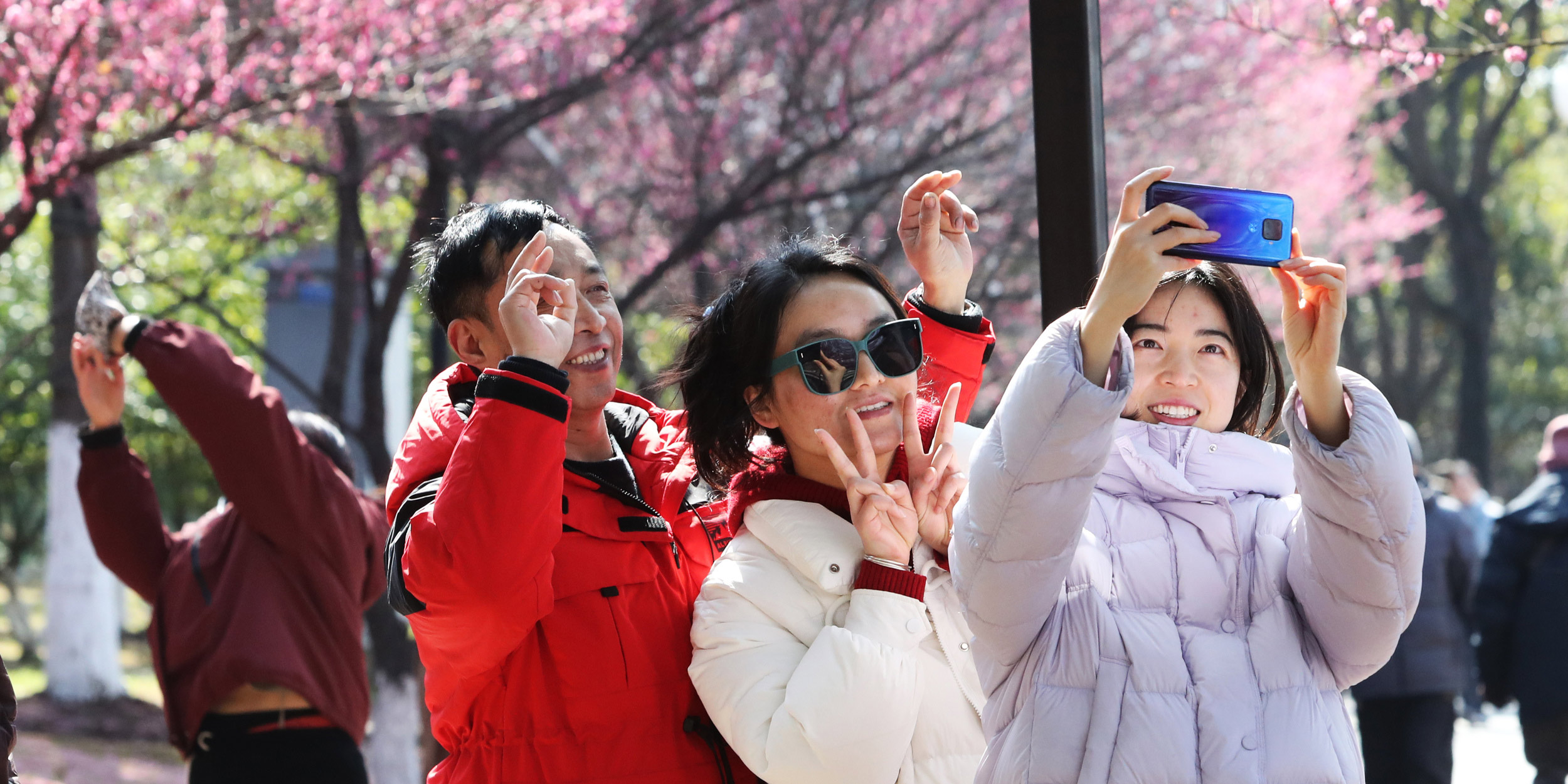
(Header image: Family members take selfies in Suzhou, Jiangsu province, Feb. 17, 2026. Wang Jianzhong/VCG)