Inside China’s Historic Electricity Milestone and Clean Energy Revolution
China crossed a historic threshold in 2025, consuming 10.37 trillion kilowatt-hours (kWh) of electricity — the first time the nation has surpassed the 10 trillion mark. The milestone caps a dramatic expansion, as power consumption has grown 2.5 times over the past 15 years, and stands at 7.7 times the level recorded in 2000, according to the National Energy Administration.
From manufacturing to transportation to daily life, electricity has become the primary driver of economic growth, industrial upgrading, and rising living standards. By 2030, China’s electrification rate is expected to reach 35%, which is 8% to 10% higher than the Organization for Economic Co-operation and Development (OECD) average, according to the China Electricity Council.
For now, China uses more than twice as much electricity as the U.S., and more than the European Union, Russia, India, and Japan combined.
Industrial transformation drives consumption patterns
The secondary sector still dominates China’s power grid, accounting for 64% of China’s total electricity consumption in 2025.
Within this sector, traditional energy-intensive industries saw power consumption grow just 1.8% compared to 2024. By contrast, high-tech and equipment manufacturing sectors increased their electricity use by 6.4%, signaling a fundamental transformation in China’s industrial base.
“These high-tech manufacturing industries are playing an increasingly dominant role in industrial electricity consumption, with power demand coming more from high-value-added and technology-intensive sectors,” said Jiang Debin, deputy director of the Center of Statistics and Data at the China Electricity Council.
The service sector is electrifying even faster, with tertiary industry power consumption jumping 8.2% from 2024. Much of the increase has been driven by the accelerated construction of “new infrastructure,” including charging piles and 5G base stations. Power consumption in charging and battery-swapping services alone surged by 48.8%. By December 2025, China had installed 20.09 million electric vehicle charging stations nationwide.
The geography of power consumption reveals both established patterns and emerging shifts. Major economic provinces like Guangdong in the south and Jiangsu, Shandong, and Zhejiang in the east are still the country’s biggest power consumers.
New trends are also emerging. Inner Mongolia, rich in wind and solar resources, has in recent years adjusted its electricity consumption structure. Alongside the explosive growth of the big data industry, the region is shifting toward a model of “meeting local demand while strengthening outbound transmission.”
Strategic emerging industries such as data centers, advanced materials projects, electric vehicles, and photovoltaic manufacturing are expanding into areas including the central Henan, the northern Hebei, the southwestern Sichuan, and the eastern Anhui provinces, as well as the northwestern Xinjiang Uyghur Autonomous Region. These industries are reshaping where — and how — China consumes power.
The green energy transformation
Behind the rising demand lies an even more dramatic transformation in how China generates electricity. In 2025, the country’s total installed power generation capacity reached 3.89 billion kilowatts, nearly 11 times the capacity 25 years ago.
The power generation mix has also become cleaner. In 2023, non-fossil energy sources — including hydropower, nuclear, wind, and solar — accounted for 52.4% of China’s total installed capacity, overtaking fossil fuels for the first time. Coal-fired thermal power, which represented 74% of capacity in 2000, had plummeted to just 39.6% in 2025.
Yet this green revolution faces a geographic mismatch as China’s renewable resources do not align with its consumption centers. Wind, solar, and hydropower resources are concentrated in the sparsely populated northwest, while the largest demand centers are located along the southeastern coast, thousands of kilometers away.
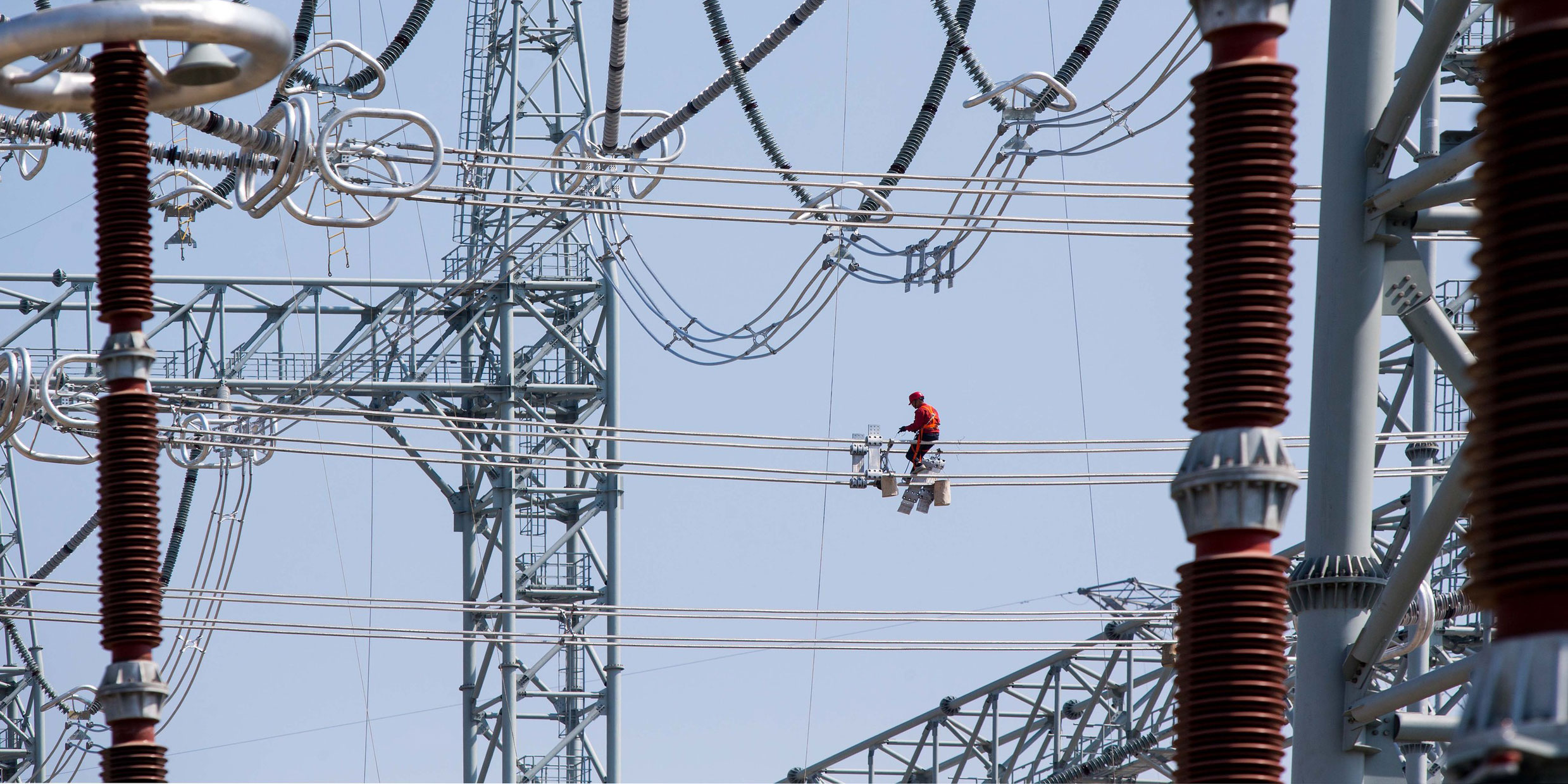
China’s solution has been to build what it calls “electricity expressways.” Since 2009, the country has deployed ultra-high-voltage (UHV) transmission technology capable of carrying both alternating current (AC) and direct current (DC) over long distances with large capacity and minimal losses.
China currently has 46 UHV transmission lines in operation, further improving the national energy transmission network of “sending electricity from the west to the east and from the north to the south.” Provinces with surplus power can flexibly support regions facing supply tightness, significantly enhancing the efficiency of power allocation.
Between 2026 and 2030, China’s total electricity consumption is projected to grow between 4.2% and 5.6% annually, according to the state-run Xinhua News Agency. With GDP expected to expand around 5% per year, electricity consumption could increase by around 5.5% annually based on the electricity elasticity coefficient, potentially pushing total consumption beyond 13 trillion kWh by 2030.
Reported by Yang Ruixian and Zhang Shuqi.
A version of this article originally appeared in The Paper. It has been translated and edited for brevity and clarity, and is republished here with permission.
Graphic designers: Wang Yasai and Fu Xiaofan; editors: Lü Yan, Wang Juyi, and Elise Mak.
(Header image: Tang Dehong/VCG)