How Chinese Millennials Are Reimagining Weddings
Editor’s note: In boardrooms and banquet halls across China, wedding traditions worth hundreds of thousands of yuan are now being quietly dismantled — not by economic necessity, but by choice.
On Chinese social media, more young people are discussing their “low-cost” weddings, sometimes held at McDonald’s or hotpot restaurant Haidilao. Three couples share their wedding stories, revealing a common thread beyond budget consciousness.
Whether eloping to Sichuan’s mountains, shooting photos at a rock festival, or hosting a sustainable garden fair, these couples are using their weddings to answer a fundamental question: Whose life are we building? Their choices expose how a single day’s celebration can become affirmations of relationships, identity, and what it means to be an adult in modern China.
An impromptu plateau proposal — Bao and Lü
At 4,000 meters above sea level, facing Mount Gongga, the highest mountain in southwestern Sichuan province, Lü suddenly knelt down and proposed.
His words stayed with me: “See, we can even drink Mixue Bingcheng here on this plateau. Truckloads of ingredients have to be hauled up here to make what looks like an ordinary cup of milk tea — our love is like that too.”
After two years of dating, we began talking about marriage in 2024. Our parents got on well when they first met, and my mother gave us her blessing.
Then we discussed specifics, and everything changed.
My parents said that a traditional ceremony was optional, but insisted on an engagement banquet. The betrothal money had to be transferred to them first. They would forward it to me as required.
However, we believed that since Lü’s parents had already traveled from their hometown in Chengdu, Sichuan, to my hometown of Zhuji in eastern Zhejiang to formally meet and discuss our marriage, that alone signified their agreement to our engagement. With that understanding, we made other arrangements. Before the 2025 Spring Festival, we visited my parents with gifts and formally invited them to attend the engagement ceremony in Chengdu.
The dinner collapsed anyway. My father suddenly asked, “So, what are you doing about a house?” Lü and I had never been in a rush to buy as we both worked freelance and had not decided where to settle down, and we said as much.
My parents immediately replied, “Then what is there left to say!”
Lü felt gutted — all our efforts to avoid conflict had been futile. My mother even cried, “Our daughter’s not marrying you!” Caught between them, I was too shocked to even cry.
Because of this impasse, I skipped going home for the Spring Festival. To heal my wounds, I attended a writing retreat, spending a month putting my feelings to paper. While writing, I discovered that I was no longer the child who would share everything with her mother, who stayed silent to avoid disapproval, who desperately craved validation.
After the incident, I tried to reconnect: I sent my parents texts and letters expressing my need for clearer boundaries, for respect. I explained that their constant criticism wasn’t just a rejection of Lü, but a rejection of me. They remained unmoved.
In September 2025, we decided to drive to Western Sichuan (Editor’s note: Famous for its raw and stunning landscapes). Our plan was to get married there, just the two of us.
I informed my parents, “I’m going to Western Sichuan, and I’m going to get my marriage certificate while I’m there.”
My mother replied mockingly, “Congratulations, you’re married now — and with nothing to show for it.”
Her words cut deep. I didn’t respond. I composed myself and went off to get married.
Preparations for the wedding took around two weeks, mostly spent buying outdoor equipment, planning the route, and figuring out how to obtain our marriage certificate in Western Sichuan. The only wedding-related items we bought were a large fabric character for “double happiness” and a wedding veil.
On Sept. 15, 2025, we embarked on our month-long marriage road trip, driving over 2,500 kilometers from Hangzhou, the capital of Zhejiang province, to Western Sichuan, with the two of us taking turns.
On our wedding day, we came across a beautiful, empty spot. We set up the tripod, laid out our “double happiness” character, and took photos and videos of ourselves in front of it. There was no makeup or styling, just greasy hair and windbreakers.
Our love was like the milk tea we’d drunk on the plateau: sweet, but it had traveled a perilous route. Now we could finally drink it.
We got our marriage certificate in Sichuan. After returning to Hangzhou, we threw a casual after-party — possibly the closest thing we had to a traditional celebration.
Even the party cost almost nothing. It was potluck style, and people stood around and ate as there weren’t even enough stools. Most of the guests didn’t drink alcohol. Instead, I provided 20 milk teas, which I got free of charge from Chagee after the brand discovered my video about our wedding trip on Xiaohongshu, or RedNote.
My wedding bouquet was even brought by a friend, as I hadn’t even thought to arrange it. Everyone said I needed to throw it, but when I did, I intentionally didn’t wish the catcher an early marriage. Instead, I yelled, “I hope you get rich!” Everyone fought for it excitedly.
My relationship with my parents remained chilly. On Mid-Autumn Festival, my dad messaged our family group chat bitterly, “Not even my dearest daughter sent a greeting, nor did my son-in-law come visit.”
I scrolled the chat and again saw the mocking message from my mother congratulating me on marrying for nothing. I angrily replied, “Since getting married, you haven’t sent a single blessing.” My father then left the group chat.
I didn’t back down. I immediately posted to our extended family group, which had over a dozen people, announcing my marriage and making clear there would be no banquet.
In their eyes, an ideal spouse should be nearby, financially secure, and immediately able to buy a property in Hangzhou. They never say these things outright, only hint at them when evaluating my partner.
But I believe these “prerequisites” have little to do with marital success. I married because I met someone who truly respects my independence, someone who wanted to build a partnership. We resolve conflicts calmly. Lü is my best friend.
Our entire road trip cost over 20,000 yuan ($2,898). For the after-party, I spent over 200 yuan, including roses for everyone. My needs were met. A single banquet table in Zhejiang province would have cost a few thousand yuan, plus cigarettes, alcohol, and gifts, all of which are massive expenditures for obligations I don’t value.
After this experience, I believe people should approach weddings as smart consumers: How do you meet your needs for less?
If photos matter to you, find out the price for a regular portrait session. If it’s about quality time with loved ones, calculate the cost of hosting a party. Not every need has to be met through a wedding alone.
The moment I felt most grateful on our wedding day was on the grassy steppe below the snow-capped mountains in Sichuan, watching other newlyweds in tight wedding dresses being directed to run for photos. I, on the other hand, wore a warm windbreaker and took a nap in the sun. I was incredibly happy. I wanted the mountains to witness my everyday self, wearing light makeup and comfortable clothes.
The most precious ritual is always unexpected. It is when a herd of cows crosses the road and we stand together, holding back the cars behind us so they can pass. When we get into accidents on National Highway 318 and, instead of blaming each other, we stay calm and comfort one another. When we see traces of an ancient ocean and understand why our partner is moved to tears.
My relationship with my parents remains suspended. I believe we love each other, but that doesn’t mean we understand each other. I also want to tell other women: You don’t have to be a perfect daughter. You can accept having an imperfect mother.
A rock ‘n’ roll wedding photoshoot — Shi Shulin and Chen
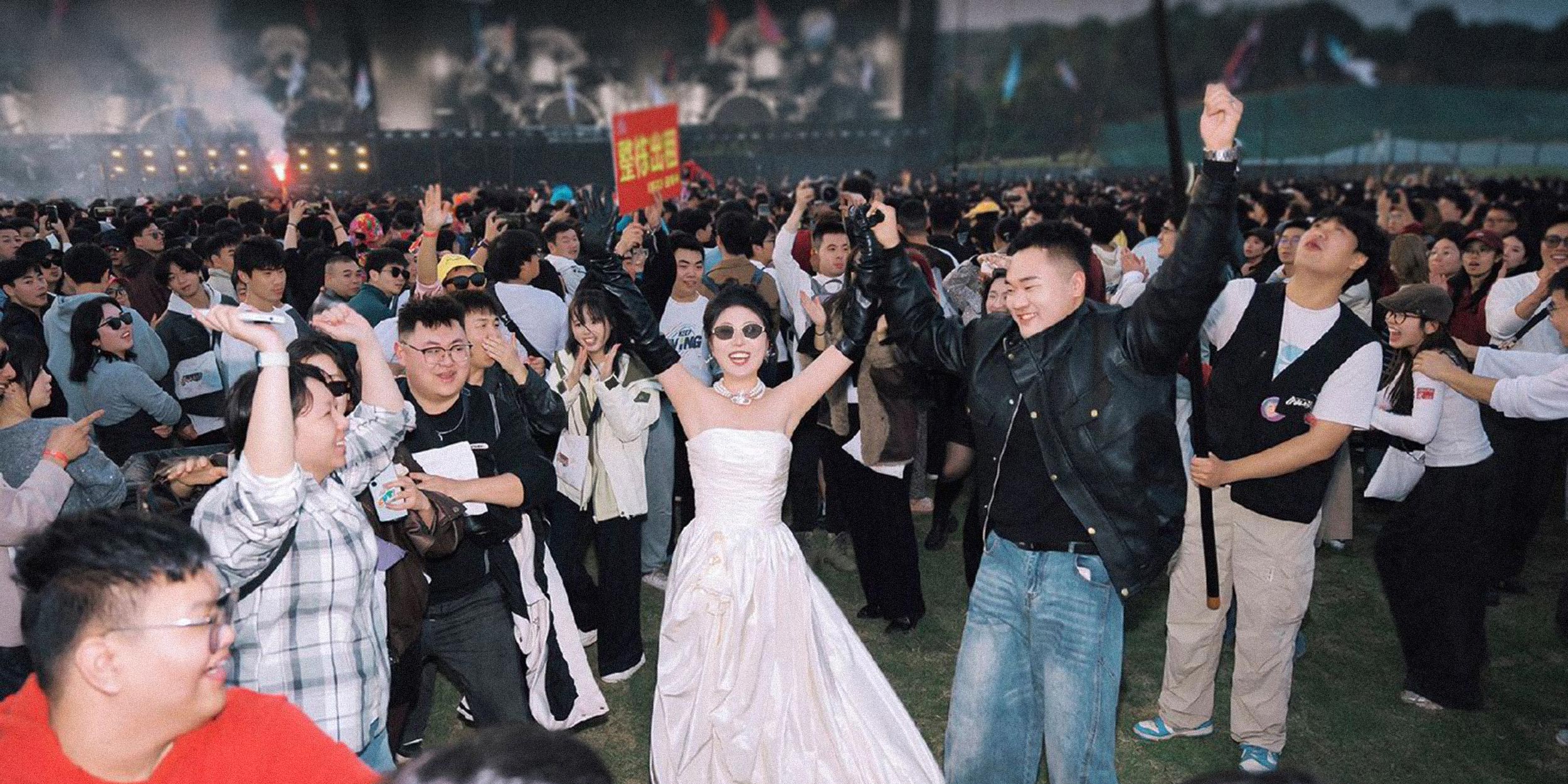
At the Lushan Music Festival in the eastern Jiangxi province in November, everywhere we went, strangers offered congratulations, and our big bag of wedding candy emptied in 10 minutes.
When the band played, the guitarist and drummer struck up. Fans formed a circle amidst the crowd and started dancing. The photographer filming us immediately asked Chen and me to join the circle so he could take some photos of us.
Everyone cheered, and we became the center of attention. Strangers handed us wine. It felt exactly like a traditional wedding reception. Chen lifted me up. I steadied myself with my left hand and threw devil horns to the sky with my right.
We’d obtained our marriage certificate in early 2025. As the year’s end approached, our parents urged us to take wedding photos for next year’s reception. But the studio’s “assembly-line” brides all looked beautiful and fake. I felt conflicted.
Then a friend commented on my outdoor wedding video: “Why don’t you two film it at a music festival?”
I said, “That’s brilliant.”
Because of work obligations, we could only arrive the day of. We changed clothes at the venue, and two girls even helped me tie my skirt. Everyone we met that day was amazing.
Back home, I uploaded the photos to Douyin, the Chinese version of TikTok, and private messages flooded in with photos people had taken. Seeing these photos, my dad couldn’t believe it — how could everyone be so cooperative? He thought the crowd must be AI-generated. My mom was delighted by the congratulations. She went through the comments, replying and liking each one.
My parents studied music and art. My dad would put on rock music at home and play guitar in his spare time, with my mom singing along. Watching them, I wanted to find a soulmate like that.
I met Chen through work when I was in the military in 2021. Later, we discovered we had a shared music taste. At the time, I felt lost and depressed about my career, but meeting Chen, who is so cheerful, was like light breaking through.
When I decided to change careers in late 2023 and leave the army, only Chen supported me.
Chen and I live in different cities in the eastern Anhui province, but we use our vacations to travel and attend music festivals together.
We’ve never treated getting married as a hasty decision. Prior to registering our marriage, Chen and I talked late into the night about what our future marriage would look like to ensure that we were clear on our respective roles once wed.
Our wedding reception is scheduled for March 2026, but it’s just to inform friends and family we’re married. I don’t think we’ll be able to top the delirious happiness of the music festival photo shoot. In our hearts, the real reception already happened. The most important thing about a marriage is that we remain ourselves.
A garden party of strangers and vegetables — Qian Qian and Mr. Da
My wedding reception took place at a vegetarian garden fair centered on sustainability.
I’m conflicted about traditional weddings. Since childhood, I can only ever remember the bride and groom walking on the red carpet and eating until full. After six times being a bridesmaid, “traditional wedding” meant only endless nights and ordeals for me.
I wanted something simple. No smoking, drinking, noise, or waste.
A year before getting married, my partner and I rented a place with a vegetarian couple. We often cooked together and gradually adopted similar eating habits. We discovered that our bodies were better suited to a vegetarian diet.
In summer 2025, I entered a vegetarian-themed event planning competition, submitting a proposal for a plant-based, sustainable wedding. Unexpectedly, my proposal reached the national top seven and won a grant that kick-started funding for my actual “wedding-fair.”
I booked a friend’s teahouse in Shekou (an area in the southern metropolis of Shenzhen). It has a garden terrace and a semi-open sunken plaza.
Before the wedding, I introduced the “sustainable wedding” concept on social media. The theme resonated, with tens of thousands of views making it easier to recruit booth vendors. Within two or three days, more than 40 businesses wanted to join.
Many came from out of town with no rehearsal. It wasn’t until four days before the wedding that I finally decided who would be in charge of each booth. I gave each applicant a small stand to design freely, offering activities such as henna painting, essential oil making, item exchanges, and storytelling. The stall owners prepared almost all reusable stall materials at their own expense.
Many find it hard to imagine inviting so many strangers to witness a wedding, but it felt natural to me. Shekou is a port connected to the world. I’ve met people from all over China and abroad since I was young, so I’ve always had an open mindset.
Our wedding-fair was held on Oct. 25, 2025. I got up to exercise as usual, while my partner charged the car. We then loaded our supplies and drove to the venue.
At 9 a.m., friends arrived to help move supplies. My partner and I didn’t bother dressing up and just joined the preparations. The meal consisted of 15 vegetarian dishes. There was no assigned seating or dining times — guests were just encouraged not to waste food.
Next to each dish sat a card. By scanning the QR code, guests could hear my husband and me tell stories about the dish, as well as ingredient sourcing and nutritional information.
In Shenzhen, a wedding banquet can easily cost 500 to 1,000 yuan per person. Mine cost 108 yuan.
Around 500 people attended the wedding. Originally, only registered guests could enter, but the enthusiasm shown by passersby meant we couldn’t refuse anyone. That day, everyone rediscovered each other and saw the community as it truly was.
But although many strangers came, my parents did not.
When planning the garden party, I felt the venue was so close to home that I didn’t need to give them advance notice. When I told them three days prior to the date, they said they had already committed to a friend’s son’s wedding booked three months earlier. We both found that acceptable. I recorded what I wanted to say to them and played it at the event.
This is the “comfort zone” of our two generations. My parents don’t express love directly to our family. I once tried to change them, but it made them uncomfortable. Still, before the garden party, they gave me a great deal of unspoken support. Many of the fruits we served came from our fridge at home. Before I left for the wedding, my mom reminded me which pomelos taste best.
Some think I organized my wedding this way to save money. That’s true — it is an advantage. Traditional weddings easily cost hundreds of thousands of yuan, and wedding planners and videographers often work mechanically. At my wedding, friends filled these roles out of goodwill, which in itself is a precious form of trust.
My partner and I love life on our terrace. All our romance happens there. We wake up early to sun our backs, watch movies at night, and dance wildly under the moonlight until we collapse exhausted. Recently, we’ve started writing love letters — one every two weeks — choosing to fall in love at a slower pace in fast-moving Shenzhen.
Our personalities complement each other. We know how to appreciate one another. While he’s slow to make decisions and prefers to think things through, this helps us avoid impulsive choices. We’re both committed to continual learning; if one partner stops growing, the two drift apart.
I’m not much of a consumer beyond daily necessities. I used to feel anxious about investment, but now I realized I don’t need much money. What’s truly worth comparing is who’s happier. When people see you laughing and cheerful every day, they’re affected too. That, perhaps, is what sustainable life in the spiritual sense really looks like.
As told to reporters Zhao Yunqiao, Li Jinglei, Qu Wangye, and Yang Shuyuan.
A version of this article originally appeared in Original (Jiefang Daily). It has been translated and edited for brevity and clarity, and is republished here with permission.
Translator: Tom Arnstein; editors: Wang Juyi and Elise Mak.
(Header image: Shi and Chen celebrate with the crowd, Jiujiang, Jiangxi province, November 2025. From Shi’s Douyin)